

There are new challenges for Britain as the focus turns to preventing genocide: is there a risk of genocide in the West Bank? is settler violence of genocidal intent? Brian Brivati reports.
By Dr Brian Brivati, Executive Director, Britain Palestine Project
In the The Guardian today, Monday 23 Nov 2026, international lawyers say the Myanmar Genocide judgment puts a new onus on governments such as Britain’s, and Eirik Bjorge expects the Foreign Secretary to change policy.
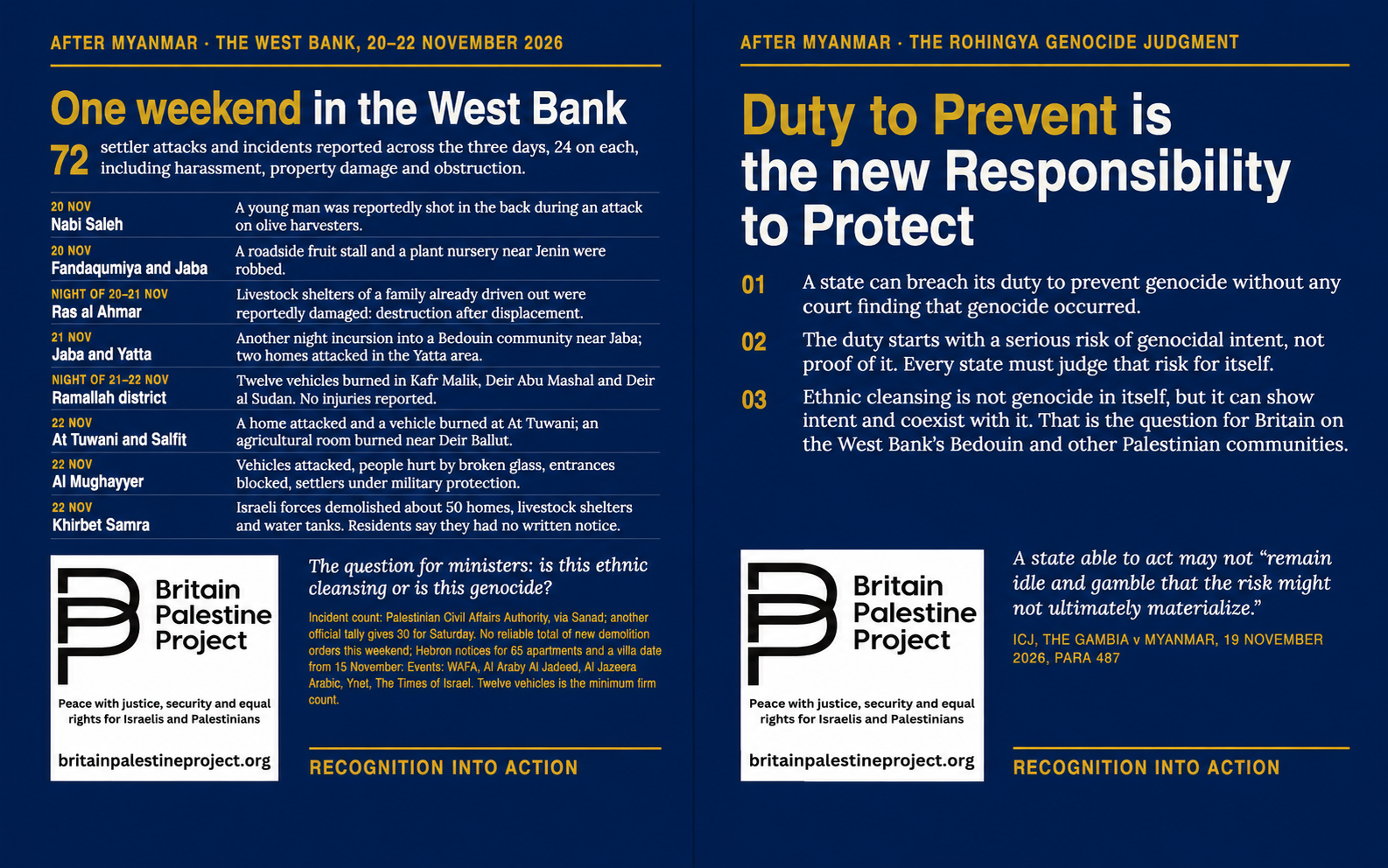
The Foreign Secretary, Ed Miliband, told the BBC on Sunday that Israel has a case to answer and that Britain has “never adjudicated before the court does”. A Commons Library briefing restates the Government’s view that a formal determination is for a competent court. Al Jazeera reports today that closed military zones have become staging posts for settlers. The weekend’s attacks followed Britain’s sanctions on eight settlement construction firms on 17 Nov, which Israel’s Foreign Minister called a hostile act.
On 19 Nov the International Court of Justice held that a state can breach its duty to prevent genocide without any court first finding that genocide occurred.
Questions for the Foreign Secretary (paras refer to paras in the Myanmar Genocide Judgement):
1. Is genocide taking place against the Bedouin of the West Bank?
1.1. Has the Government assessed the risk of genocide in the West Bank, on its own and together with Gaza? When, and with what conclusion?
1.2. Does it treat Area C’s Bedouin and herding communities as a part of the Palestinian group, judged by geography and their place in Palestinian life as well as by numbers, as a group in their own right (Bosnia v Serbia, 2007, paras 198–201)?
2. When does ethnic cleansing become genocide?
2.1. On 8 Sept the Foreign Secretary called settler violence ethnic cleansing. The Court holds that displacement is not genocide in itself but can show genocidal intent and coexist with it (paras 407, 455–456). What would the Government need to see to conclude that ethnic cleansing carries a serious risk of genocide?
2.2. In Myanmar, displacement did not explain the conduct because people were attacked as they fled, ordered back to burned villages and their children killed (paras 459–462). Is the Government tracking those markers in the West Bank?
2.3. The Court reads the intent to destroy as wider than killing, covering destruction of the group as a group (paras 292–293), and conditions of life count if capable of causing death over time, before deaths occur (paras 348–349). Does the Government apply both readings to its assessment of the West Bank?
3. If genocide is still only a matter for the Court
3.1. Does he accept paragraph 487, and withdraw the Government’s submission in Al-Haq that the duty cannot be breached unless genocide is actually committed? As an intervener in Myanmar, does he accept the Court’s reading as binding under Article 63(2) of its Statute?
3.2. Will the Government reach no view on the risk in Gaza until pleadings close in May 2029?
3.3. Did its last assessment ask whether there is a serious risk of genocidal intent (para 479), or whether intent is the only reasonable inference, the standard for proving genocide at trial?
4. If His Majesty’s Government accepts a responsibility to prevent, what follows?
4.1. Will he order a fresh assessment of Gaza and the West Bank on the test in paragraphs 479 and 486–487, publish a reasoned summary as the Government did for its humanitarian law assessment in September 2024, and report to the House by a fixed date?
4.2. What weight will it give to the Government’s own findings that Israel is not committed to humanitarian law and that Israeli Ministers have supported forced displacement (paras 304, 404)?
4.3. If it finds a serious risk, which means will he use? Rremaining arms licences, F-35 components, military and intelligence cooperation, sanctions beyond the 17 Nov package, intervention in South Africa v Israel? Which has he ruled out, and why?
4.4. In the West Bank, will Britain fund return and the rebuilding of water and shelter, and press Israel to protect communities and prosecute attackers, as the Court ordered return and restitution for the Rohingya (para 615)?
The responsibility to protect, agreed at the 2005 World Summit, covered ethnic cleansing as well as genocide, but it was a political commitment, and collective action ran through the Security Council. Article I of the Genocide Convention is a legal duty on every state party, and any party can take another to the Court for breaching it, as The Gambia did.
That legal duty now needs to become a political commitment. In The Gambia v Myanmar the Court made the duty to prevent clearer. It arises the instant a state learns, or should normally have learned, of a serious risk (para 478). It turns on “a serious risk of the presence of genocidal intent”, not proof (para 479): the Court found Myanmar in breach although it could not determine whether the civilians Myanmar failed to restrain had that intent (para 486).
A state able to act may not “remain idle and gamble that the risk might not ultimately materialise”, and its responsibility “is not conditioned on a finding that genocide has occurred” (para 487). Britain’s duty depends on its capacity to influence events (Bosnia v Serbia, para 430). The Court divided nine to six, and Judge Tomka, dissenting, warned that the new reading could politicise the Court and fall hardest on powerful states.
In the Guardian today, international lawyers say the Myanmar Genocide judgment puts a new onus on governments such as Britain, and Eirik Bjorge expects the Foreign Secretary to change policy. The Foreign Secretary told the BBC on Sunday that Israel has a case to answer and that Britain has “never adjudicated before the court does”. A Commons Library briefing restates the Government’s view that a formal determination is for a competent court. Al Jazeera reports today that closed military zones have become staging posts for settlers. The weekend’s attacks followed Britain’s sanctions on eight settlement construction firms on 17 November, which Israel’s foreign minister called a hostile act.
On 19 November the International Court of Justice held that a state can breach its duty to prevent genocide without any court first finding that genocide occurred.
Questions for the Foreign Secretary – paras refer to paras in the Myanmar Genocide Judgement
1. Is genocide taking place against the Bedouin of the West Bank?
1.1. Has the Government assessed the risk of genocide in the West Bank, on its own and together with Gaza? When, and with what conclusion?
1.2. Does it treat Area C’s Bedouin and herding communities as a part of the Palestinian group, judged by geography and their place in Palestinian life as well as by numbers, as a group in their own right (Bosnia v Serbia, 2007, paras 198–201)?
2. When does ethnic cleansing become genocide?
2.1. On 8 September the Foreign Secretary called settler violence ethnic cleansing. The Court holds that displacement is not genocide in itself but can show genocidal intent and coexist with it (paras 407, 455–456). What would the Government need to see to conclude that ethnic cleansing carries a serious risk of genocide?
2.2. In Myanmar, displacement did not explain the conduct because people were attacked as they fled, ordered back to burned villages and their children killed (paras 459–462). Is the Government tracking those markers in the West Bank?
2.3. The Court reads the intent to destroy as wider than killing, covering destruction of the group as a group (paras 292–293), and conditions of life count if capable of causing death over time, before deaths occur (paras 348–349). Does the Government apply both readings to its assessment of the West Bank?
3. If genocide is still only a matter for the Court
3.1. Does he accept paragraph 487, and withdraw the Government’s submission in Al-Haq that the duty cannot be breached unless genocide is actually committed? As an intervener in Myanmar, does he accept the Court’s reading as binding under Article 63(2) of its Statute?
3.2. Will the Government reach no view on the risk in Gaza until pleadings close in May 2029?
3.3. Did its last assessment ask whether there is a serious risk of genocidal intent (para 479), or whether intent is the only reasonable inference, the standard for proving genocide at trial?
4. If HMG accepts a responsibility to prevent, what follows?
4.1. Will he order a fresh assessment of Gaza and the West Bank on the test in paragraphs 479 and 486–487, publish a reasoned summary as the Government did for its humanitarian law assessment in September 2024, and report to the House by a fixed date?
4.2. What weight will it give to the Government’s own findings that Israel is not committed to humanitarian law and that Israeli ministers have supported forced displacement (paras 304, 404)?
4.3. If it finds a serious risk, which means will he use: remaining arms licences, F-35 components, military and intelligence cooperation, sanctions beyond the 17 November package, intervention in South Africa v Israel? Which has he ruled out, and why?
4.4. In the West Bank, will Britain fund return and the rebuilding of water and shelter, and press Israel to protect communities and prosecute attackers, as the Court ordered return and restitution for the Rohingya (para 615)?
The responsibility to protect, agreed at the 2005 World Summit, covered ethnic cleansing as well as genocide, but it was a political commitment, and collective action ran through the Security Council. Article I of the Genocide Convention is a legal duty on every state party, and any party can take another to the Court for breaching it, as The Gambia did. That legal duty now needs to become a political commitment. In The Gambia v Myanmar the Court made the duty to prevent clearer. It arises the instant a state learns, or should normally have learned, of a serious risk (para 478). It turns on “a serious risk of the presence of genocidal intent”, not proof (para 479): the Court found Myanmar in breach although it could not determine whether the civilians Myanmar failed to restrain had that intent (para 486). A state able to act may not “remain idle and gamble that the risk might not ultimately materialize”, and its responsibility “is not conditioned on a finding that genocide has occurred” (para 487). Britain’s duty depends on its capacity to influence events (Bosnia v Serbia, para 430). The Court divided nine to six, and Judge Tomka, dissenting, warned that the new reading could politicise the Court and fall hardest on powerful states.


