

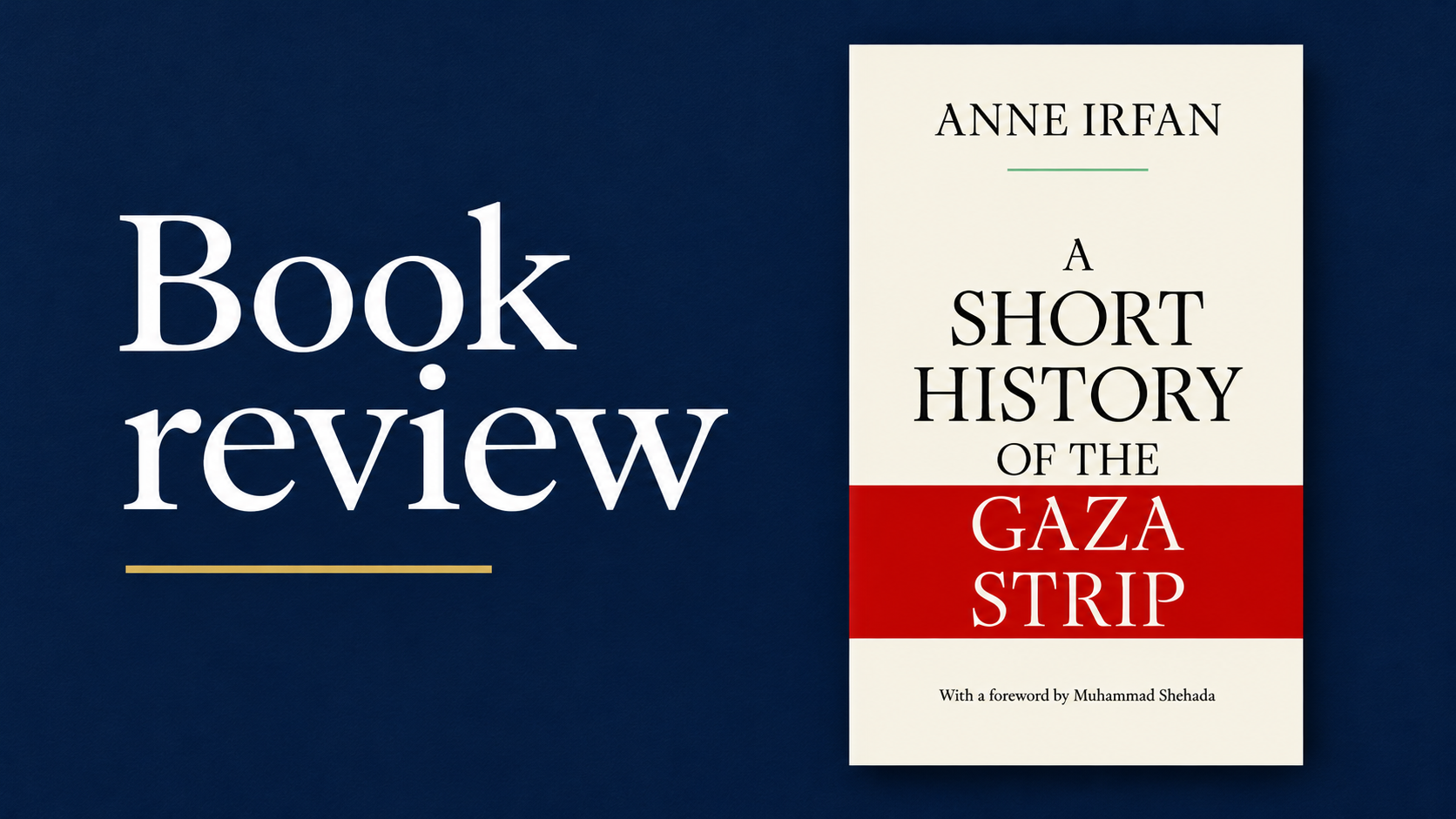
By Anne Irfan.
An invaluable and concise guide to the real story of Gaza: 78 years of dispossession, oppression, killing and incarceration by Israel , all of which led to the explosive Palestinian resistance break-out of 7 Oct 2023. Review by former BBC Middle East Correspondent Tim Llewellyn
Simon & Schuster paperback
ISBN 978 1 3985 6539 5
£11.95
Review by Tim Llewellyn
For most of the mainstream Western media, and therefore for most English-speaking people, the Gaza tragedy began on 7 Oct 2023. That morning, the Palestinian resistance and hundreds of Gazan followers stormed out of the Gaza Strip and for a day defied and defeated Israel’s military machine, killing hundreds of soldiers and civilians and taking hundreds of hostages, armed and unarmed alike.
Anne Irfan’s brilliant and concise book, published in 2025 with an afterword added in March 2026, is invaluable for those (often deliberately) misled Westerners.
The resistance-led expedition that rocked Israel and sparked an Israeli genocide that continues to the date of this writing (10 Nov 2026) had its roots in 1948 (maybe even earlier) when, first, well-armed Jewish irregulars in the dying months of the British Mandate, followed by the newly created Israel army, after 15 May 1948 and the creation of Israel, ethnically cleansed as many of Palestine’s majority Arab inhabitants as it could from the Palestinian lands it had seized.
‘Ethnically cleansed” is a euphemism for ‘expelled by force, under threat and fact of death’. The Gaza region took per capita (about 30,000 inhabitants pre-1948) the largest proportion of expelled Palestinians, some 200,000, during the 1948 Nakba. By 1949, Gaza’s territory had been shrunk by Israeli action and subsequent frontier-drawing (in co-operation with the occupying Egyptian Army) from a grand fertile area of 460 square miles to a coastal, isolated strip of 141.
The progress of the Gazans from then on, more and more as time went on becoming a majority of refugees as children, grandchildren and great grandchildren arrived, became a tragedy to experience and to observe. Israel confined, besieged, constantly attacked, raided and killed Gaza’s people, first in their tents, then in their corrugated iron shacks and sheds. These were sometimes, but not always, reprisals against Palestinians who tried to revisit their lost homeland. On these missions the Palestinians sometimes, not always, shot or shot at Israeli targets and the residents of their stolen homes and farms.
Briefly and lethally, Israel occupied the whole Strip in 1956 during Israel’s war with Egypt, and then occupied it again, apparently for ever, during the Six-Day War of 1967.
Yet extraordinarily, as Irfan sets out, this beleaguered people continued to flourish, despite more and more of them being women, children and the aged; being killed, wounded and imprisoned. They built on the cultural, religious, entrepot traditions of that greater Gaza that had once linked Egypt and North Africa, Yemen and the Hashemites, to northern and eastern Arabia, Greater Syria and Mesopotamia, and to lands yet further into Asia and the Caucasus.
Universities were founded, education flourished, Gazans devoured the sciences, the arts and the languages. They took–and still take–posts in industry, medicine, engineering, the media and cultural studies across the world, in Europe, the New World and the Middle East. They replenished Gaza’s agricultural life, albeit in restricted and repressive circumstances. Inexorably, Israel tightened its grip, reducing Gazans’ limited and often demeaning work and family trips inside Israel and to Jerusalem and the West Bank.
Their isolation increased dramatically after the First Intifada (1988-1993) and then the failure of the Oslo Accords (1993-4), the breakdown of Arafat’s peace conference with President Clinton and Ehud Barak, then Israel’s Prime Minister, in 2000, and the violent Second Intifada, al-Aqsa.
Gazans became—and still are, despite the genocide—the steadfast of the steadfast, especially in scholarship, survival and creativity; but they have also developed, perhaps because of this ruthless era of siege and attempted humiliation, a nation of fighters and leaders: Khalil al-Wazir (Abu Jihad), Salah Khalaf (Abu Iyad), Arafat’s two main lieutenants in the formative years of Fateh, the largest unit of the Palestine Liberation Organisation in its heyday, until they were both assassinated, Abu Jihad by Israel, Abu Iyad by Palestinian dissidents, and Yasser Arafat himself were all Gazans.
The real importance of Irfan’s book to me is that it records modern Gaza’s epic tragedy and explains why it culminated, inevitably, in 7 Oct 2023. This was an enormous, cosmic jailbreak from an incarceration that had lasted 75 years, and intensified during the previous 17 to such an extent that international institutions such as the United Nations had serially warned of famine, as Israel tightened siege conditions and severely restricted Gaza’s agricultural exports and trade (often deliberately wrecking or placing off-limits the fertile areas that produced the tomatoes, oranges, lettuces, olives, the multiplicity of foods that Gaza grew).
Israel’s army, navy and air force had regularly “mowed the lawn”, as a senior Israeli political adviser put it, a callous way of noting the regular invasions and slaughter of Gazans, civilian and fighter alike. Another Israeli, a sidekick of one of Gaza’s epic persecutors, Prime Minister and former border-raider Ariel Sharon, likened the severe restrictions on Gaza’s imports of power, fuel, water, medicine and basic necessities, to “putting Gaza on a diet”.
Cynicism and cruel black humour augmented the Israelis’ ceaseless oppression of the Palestinians of Gaza.
Irfan does not dodge the responsibilities of Palestinian politicians. Arafat’s naivete in Oslo, the authoritarian nature of his Fateh’s rule in the occupied Palestinian Territories after 1994, the corruption of the Palestine Authority, the increasing harshness of Hamas’s rule in Gaza since 2007 and the reprisals it and its fellow resistance groups have inevitably provoked.
She is honest and her book is compelling.
For this reader, however, pace the shortcomings of Palestinian leaders, this work chronicles why Israel’s policies made 7 Oct inevitable (one is amazed it did not come sooner). It reminds us that armed resistance is legal but is often not containable. It does not and cannot by its asymmetrical nature obey rules of war which the occupiers themselves anyway break at will.
It explains by tracing their recent history why Gazans became what they are.
It tells plainly the story of a brave, indefatigable people who are determined to stay in their country against all the odds, in defiance of a genocidal neighbour and its many good friends and supporters in the West, including Britain.
Tim Llewellyn is a former BBC Middle East Correspondent and Editor of the Britain Palestine Project website.