

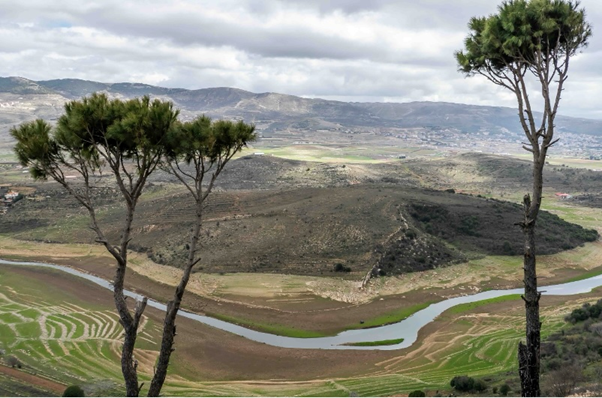
Photo Caption: View of Qaraoun Dam And Litani River With Jeb Janine, Lebanon. Image: Paul Saad/Shutterstock
By Moshe Gilad
Haaretz
9 Apr 2026
Israel, and the Zionist movement going back to the 19th Century, always coveted the Litani River as the northern frontier of any future Israeli state. The Litani rises in the Bekaa Valley, runs south through that rift between Syria and Lebanon, and finds the Mediterranean Sea about 18 miles north of the present Israel-Lebanon frontier. It is a major source of Lebanon’s water, irrigation and electric power. Only the insistence by the French during and after the First World War that the Lebanon-Palestine border be drawn where it is today prevented the British gratifying the Zionists’ desire to push Palestine north to the Litani, and thus be, eventually, Mandate Palestine’s and thus Israel’s northern boundary. There is a settler movement in Israel called Uri Tzafon which regards South Lebanon as Northern Galilee. And Israel the state still very much has its eyes on this lush and productive sector.
THE GREEK PHILOSOPHER Heraclitus said 2,500 years ago, “You cannot step into the same river twice.” He meant that reality is in constant flux: the water flows, and the person entering the river changes as well. Naturally, Heraclitus never encountered Israeli reality. Here, it seems, one can step into the same river three or four times and nothing changes. The waters and those who enter them quickly forget past experience and eagerly jump in again.
The Litani River will one day serve as a fascinating case study. Students will try to understand how a Lebanese river repeatedly becomes the object of Israeli aspiration. Even experts on collective memory will probably examine the Litani to understand how it is repeatedly rediscovered as a perfect solution while all associated problems are forgotten. This is happening again before our eyes, and not for the first time. In this case, the saying often attributed to Albert Einstein seems more fitting: “Insanity is doing the same thing over and over and expecting different results.”
The Litani River is the longest and most important river in Lebanon. It stretches 174 kilometres (108 miles), originating in the Al-Aleeq springs in the Baalbek area and flowing south along the Beqaa Valley. In the late 1950s, the Qaraoun Dam was built north of the village of Qaraoun, creating a large artificial lake. The dam supplies about 15 per cent of Lebanon’s electricity.
While the Litani may appear to many Israelis as a magic solution or a cherished aspiration, its current condition tells a different story. Last winter, Lebanon experienced its most severe drought since records began. The river’s water level dropped to a historic low, threatening the country’s water supply, electricity production and agriculture.
An Israel vision based on a biblical idea not even mentioned in the Bible
In the Israeli imagination, the Litani is often seen as a natural northern border. Although it is not mentioned in the Bible, some interpret it as a biblical boundary separating the Upper Galilee from Lebanon. The may also argue that it marks the northern border of the territories of the tribes of Asher and Naphtali.
This idea echoes proposals made by early Zionist leaders more than a century ago. In 1919, David Ben-Gurion wrote: “The Litani River, or as the Arabs call it the Qasmiyeh River, is the dividing line between the two parts of the land. The northern border of the Land of Israel should therefore be the Qasmiyeh River.” Similarly, geographer Avraham Brawer wrote in his 1929 book The Geography of Eretz Yisrael that the northern boundary should be the Ayun Valley and the Qasmiyeh Stream, that is, the Litani.
The 1916 Sykes-Picot Agreement between Britain and France placed the Litani under French control. The current border between Israel and Lebanon, known as the Blue Line, is based on the 1923 Newcombe-Paulet Agreement, which defined the boundary between the British Mandate in Palestine and the French Mandate in Syria and Lebanon, as well as the 1949 armistice agreements.
Over the past 50 years, Israel has returned to the Litani several times. In 1978, during Operation Litani, Israel army forces reached the river and pushed Palestine Liberation Organisation forces north of it. In the First Lebanon War in 1982, Israel captured extensive areas up to the Litani, including Lake Qaraoun. Three years later, the Israeli army withdrew from most of these areas but maintained a so-called “security zone” in southern Lebanon, controlled jointly with the South Lebanon Army (an irregular force Israel set up in the zone) until 2000.
During the Second Lebanon War in 2006, the United States authorised Israel to expand operations up to the Litani, but Israeli forces did not reach it. A month into the war, the United Nations Security Council passed Resolution 1701, establishing a cease-fire between Israel and Hezbollah. The resolution called for the deployment of UN peacekeeping forces alongside the Lebanese Army in southern Lebanon and for Hezbollah to withdraw north of the river, creating a buffer zone. In practice, Hezbollah later re-established its presence south of the Litani, and Israel kept up aerial attacks on and surveillance of Lebanon.
What is South Lebanon? In one Zionist view it is just Northern Galilee
In November 2024, Israeli forces again reached the river near Deir Mimas, a Christian village north of Metula, and in the Saluki area, where a tributary flows into the Litani. Around the same time, a right-wing movement called “Uri Tzafon” emerged, advocating for Israeli control of southern Lebanon up to the river and the establishment of settlements there. Its website stated: “The idea of settlement in Lebanon sounds as detached from reality to the Israeli ear as settlement on the planet Venus, but it is not.”
The site further argued: “What is ‘South Lebanon’ actually? It is simply the Northern Galilee. The clear natural border between Israel and the Lebanon Mountains runs along the Litani River, Lebanon’s greatest river, an area about which Moses said: ‘a land with brooks, streams, and deep springs gushing out into the valleys and hills.’”
The movement’s founding conference included Prof. Amos Azaria, one of its founders and leader, along with Prof. Yoel Elitzur and Dr. Hagai Ben-Artzi, the brother of Sara Netanyahu.
On the Hebrew-language website of Israel’s Defence and Security Forum, a group opposed to the two-state solution, it is written: “A mention of the Litani River as a border line already appeared in the Bible. Although the name ‘Litani’ is not explicitly written, many researchers estimate, based on geographical data, that today’s Litani River is a continuation of the biblical Euphrates. According to this assessment, one can rely on the verse in the Book of Joshua: ‘From the wilderness and this Lebanon even unto the great river, the river Euphrates… and unto the Great Sea toward the going down of the sun, shall be your coast’ (Joshua 1:4).”
A review of dozens of recent Israeli articles about southern Lebanon suggests that a broad and troubling consensus is taking shape regarding the Litani River’s status and future. This consensus is often expressed in two of the most alarming words in Hebrew: “no choice.” Many seem to believe there is no alternative but to conquer part of southern Lebanon, reach the Litani, and establish it as Israel’s new northern border. We have done this several times before. It did not help then. Still, the argument goes, there is no choice.
Israel’s orders: all Lebanese to move north of the Litani
The orders issued by the Israeli army last month came in several waves. First, a series of directives targeted 120 communities across a wide area of southern Lebanon. This was followed by an order instructing all residents south of the Litani to evacuate northward. The order included Tyre, one of Lebanon’s main cities, home to around 160,000 people. Altogether, the evacuation orders covered roughly a tenth of Lebanon’s territory.
On March 24, Israeli Defence Minister Israel Katz stated that the military would maintain control of southern Lebanon up to the Litani River. He added that hundreds of thousands of Lebanese residents would not be allowed to return “until security is guaranteed” for Israel’s northern communities. A few days later, on 31 March, Katz said that homes in Lebanese villages near the border would be demolished “like in Rafah and Beit Hanoun,” referring to areas in Gaza where Israeli forces carried out widespread destruction during the war.
Katz explained that the goal is “to permanently remove border-adjacent threats” to Israel’s northern residents. He added that more than 600,000 displaced Lebanese would not be permitted to return to southern Lebanon until security and safety are ensured.
In late March, the IDF bombed the Qasmatiyeh Bridge, which carries the coastal road across the Litani. The following day, it struck the Qaqaiya Bridge. During the same month, the Dleifeh Bridge was also bombed. This is the largest bridge in southern Lebanon and the second largest in the country. It had previously been destroyed by the IDF in 1981 and reopened only in 2009. In total, five of the eight main bridges crossing the Litani were targeted from the air.
According to Israeli military sources, 585,000 people have fled southern Lebanon so far, about 70 per cent of the population south of the river. Lebanese authorities report that since the start of the fighting and through to the end of March, approximately 1,200 people have been killed, including 121 children, and about 3,400 have been injured. Hundreds of thousands of children have been displaced and are no longer attending school. A new refugee crisis is taking shape. The Nakba, in this view, is being recreated.
Geographer Dr. Amnon Kartin rejects the idea that a river can serve as a meaningful natural boundary. “The border between Israel and Lebanon is an agreed and recognised one. It was established in the 1920s and later reaffirmed in the armistice agreements. Reaching the Litani reflects the ambitions of those who want to settle beyond the border. Extending Israeli sovereignty to the Litani sounds far-fetched. These are messianic fantasies. From a geographical perspective, there is no such thing as a ‘natural border.’ They can still fire at us from the Beqaa Valley, so what difference does it make?”
A new refugee crisis is taking place—and with it a messianic fantasy
Prof. Eran Feitelson, also a geographer at the Hebrew University, adds: “The Litani is not a transboundary river. The Hasbani and Ayun are cross-border streams. What happens in the eastern sector is more significant than what happens in the west.
“When we entered Lebanon in 1978, the Shi’ite communities in southern Lebanon were not hostile to us. We managed to turn them against us, and we are very effective at consolidating opposition. It feels like we have seen this before: creating a buffer zone and similar measures. Unfortunately, it did not work then, and it is difficult to imagine it working now.”
Dr. Michal Braier, an architect who heads the research division of Bimkom – Planning and Human Rights and teaches urban planning at the Hebrew University, emphasises the political nature of planning, especially when dealing with a complex and conflict-ridden area, and draws a comparison between the West Bank and southern Lebanon:
“Israel is constantly trying to reshape geography and demography, and that is extremely dangerous. In the West Bank, Bezalel Smotrich’s ‘decisive plan’ aims to remove 80 per cent of the Palestinian population and leave the area for settlement, effectively Judaising it. This has devastating consequences for the communities being expelled and for any chance of future peace. I have no doubt that following a similar path in Lebanon would be just as destructive, if not more so.
“Expulsion and displacement create resistance and hatred. That is the opposite of security. It also places a profound moral stain on us. The idea that moving a million people north of the Litani will create security is baseless. And this does not even begin to address the violation of international law.
“There are also reports that Israel has begun spraying agricultural areas in southern Lebanon, and that Israeli groups are advocating entering the area to plant trees as a first step. I see no justification for using such measures to prevent residents from returning to their homes. There is no justification for this within Israel’s borders, and certainly not beyond them. These are practices reminiscent of those used during the Nakba. It is crucial to acknowledge the injustice and inequality that resulted and to recognise the need for correction.
“We are using the civilian population in Lebanon as a tool to pressure the state, and that is a mistake. I see this clearly in our work with Palestinian communities, who want to live peacefully, with basic rights and dignity, not under occupation. We are the ones preventing that. In Lebanon as well, there seems to be an assumption that populations can be manipulated, displaced and uprooted. It is frightening that such ideas have become normalised in Israeli discourse.”
This article was originally published by Haaretz on Thu 9 Apr 2026.