

July 2025
Watch Video
Listen to Audio/Podcast
We hear from child psychotherapist Teresa Bailey, a founding member of the UK Palestine Mental Health Network. Drawing on decades of experience in children’s mental health services and recent advocacy with colleagues in Gaza, Theresa delivers a searing and compassionate account of what war does to a child’s mind and body.
Teresa explores the catastrophic mental health impact of Israel’s war on Gaza’s children. From trauma-induced mutism to the neurological effects of starvation, from shattered trust in parental safety to the impossibility of healing amid ongoing bombardment, this talk explains why this war is not just about land, but about destroying the very possibility of future generations.
Teresa shares the heart-wrenching questions asked by Palestinian children and uplifts the heroic work of Palestinian clinicians and the community’s power of resilience.
This episode contains graphic themes and emotional content. Listener discretion advised.
Teresa Bailey is a semi-retired consultant child and adolescent psychotherapist. She has worked in the NHS for over 30 years, edited the Journal of Child Psychotherapy, and is now series editor for Independent Psychoanalytic Approaches with Children and Adolescents. She is a founding member of the UK Palestine Mental Health Network and leads a campaign for child psychotherapists to speak out against the genocide in Gaza.
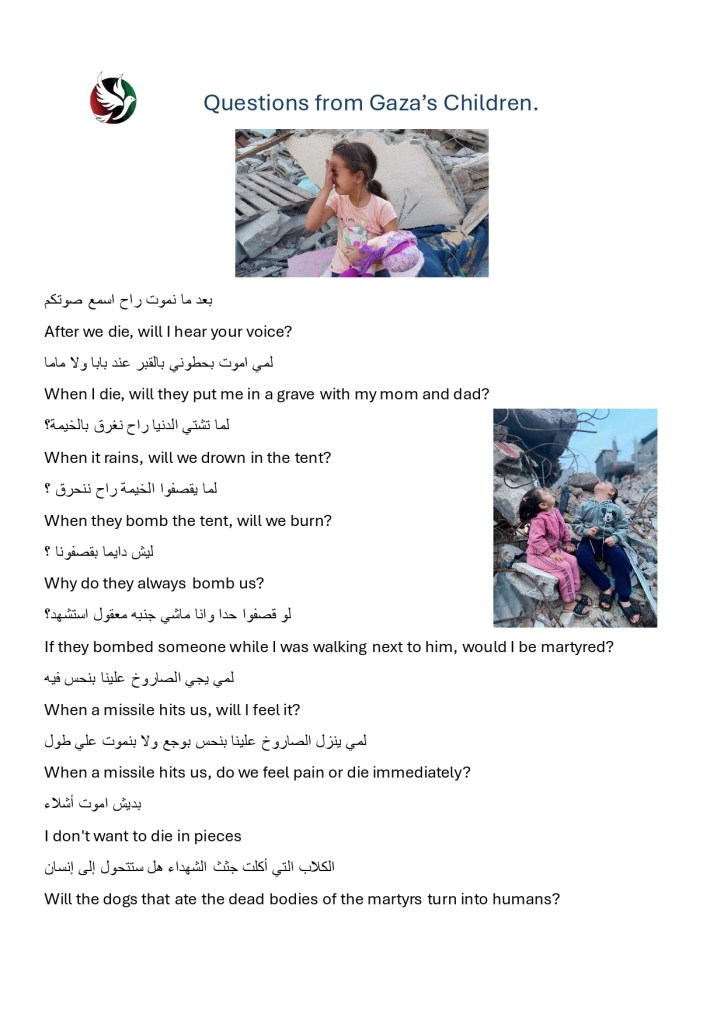
Questions from children of Gaza, courtesy of the Palestine Trauma Centre

References
Music, G. (2010) Nurturing Natures: Attachment and Children’s Emotional, Sociocultural, and Brain Development. London: Taylor & Francis.
Perry, B., Szalavitz, M. (2007) The Boy Who Was Raised as a Dog: And Other Stories from a Child Psychiatrist’s Notebook – What Traumatized Children Can Teach Us About Life, Loss and Healing. New York: Basic Books
Shalhoub-Kevorkian, N. (2019) Incarcerated Childhood and the Politics of Unchilding. Cambridge, UK: Cambridge University Press
Van der Kolk, B.A. (2015). The Body Keeps the Score, Mind, Brain and Body in the Transformation of Trauma. UK: Penguin Random House
Transcript
Good afternoon. Thank you for the opportunity to speak to day about the impact on children of the war being waged against Gaza.
Before I start my presentation, I’d like us to look at some photos of children in Gaza. Not their shredded bodies, limbless torsos, bloody dead faces. Let’s remember their beauty, their need to play, dance, smile, cuddle their grandma, wrestle with their dad, chase their friends, sink into the arms of their mum, just like all children around the world. And keep in mind, these are little ones, with developing brains and bodies, just like our own children and grandchildren. Remember the beautiful little round head of an infant, the way they grip your little finger. Think of the toddler falling on her bottom repeatedly as she tries her first steps. The little boy who wants you to admire his dance moves. The teenage girl who adored by her dad as she pirouettes for him in her new clothes.
This is what we are thinking about today. Children with dreams, hopes, silly jokes, inventive play.
I would like to share with you some of the voices of children from Gaza. The Palestine Trauma Centre in Gaza collected up some questions from the children they work with. How many of their questions can you answer? What would you tell your own children?
The children’s questions are courtesy of the Palestine Trauma Centre.
Ideally, this presentation would be done by a Palestinian colleague, so many of whom have the expertise and knowledge to do this but are either dead, have been abducted and are in detention in Israel or have no access to the internet. I send them my deepest respect and solidarity.
I would like to acknowledge the exceptional work of Professor Nadera Shalhoub-Kevorkian, especially her concept of ‘unchilding’; of Dr Samah Jabr, Palestinian psychiatrist, psychotherapist and writer, Assistant Clinical Professor, George Washington University USA and her work on child trauma and as well as the work of Dr Yasser Abu-Jamei, Palestinian clinical neuropsychiatrist, Director of the Gaza Community Mental Health Programme, on the war on children in Gaza.
I would like to honour the courage of Palestinian colleagues: those health professionals who are still alive, in their work to rescue and treat the children of Gaza, this includes the men and women of the Palestine Trauma Centre. I honour the memory of those who have been murdered and those who are still alive but incarcerated in Israeli jails and subjected to torture.
Why is this clearly a war on babies, children and families?
The state of Israel is currently not allowing baby formula into Gaza. Why?
It has systematically destroyed nurseries, schools, universities in wanton and barbaric scholasticide. Why?
Why are sick children with cancer, diabetes, kidney disease, children with limbs blown off, malnourished, starving left without medication, chemotherapy, insulin, anaesthesia for operations and amputations, pain relief?
Why are children with brain trauma and horrific shrapnel wounds not having treatment?
Because hospitals and all their medical equipment have been destroyed.
Doctors and health staff have been murdered or abducted and tortured. You may have seen the Channel 4 programme, ‘Gaza: Doctors Under Attack’ originally commissioned by the BBC but they then refused to broadcast it.
Let’s remind ourselves that this is deliberately inflicted trauma, what a friend and member of the Irish Mental Health Network, the late Eamon McMahon, called ‘the careful maiming of children’, referring to the targeting of babies and children by snipers.
Dr Mark Perlmutter, a surgeon from the US, who volunteered at the European hospital in Khan Younis, said ‘No child gets shot twice by mistake.’
(29/10/2024 – 15:49 In an interview with FRANCE 24, Tete a Tete)
Almost half of Palestinians in Gaza are under 18. 70% of those killed since October 2023 were women and children. Gaza’s Government Media Office reports that More than 3,500 children below the age of five years “face imminent death by starvation”. 1.1 million children daily lack the minimum nutritional requirements for survival. There are 10.000 cases of acute malnutrition, and 1600 of severe acute malnutrition. Israel has destroyed all rehabilitation programmes in Gaza.
(The Guardian, 2/5/25)
Even before the genocide, around half of children in Gaza suffered from symptoms of ongoing trauma because of the repeated devastating attacks on the area bedwetting, behavioural problems, sleeping difficulties, severe depression and suicidality.
Malnutrition in children lowers their immunity to diseases and has irreversible consequences on their health and development.
1 in 4 children now suffer from chronic diarrhoea, pulmonary infections and rampant skin diseases. (Unicef, Amman 19th June 2025)
At least 4000 Palestinian children have lost one or more limbs. When I say lost,I mean they’ve been blown off or shot. (Middle East Monitor, December 8th 2024)
It is not easy to have children evacuated for specialist medical treatment. Of course, if Israel had not destroyed the healthcare system they could have been treated in Gaza. These countries have offered life-saving treatment if they can be evacuated: Italy, Spain, Luxembourg, the US, Romania, Slovakia, Qatar, Pakistan, Egypt, Belgium, Malta, UAE, Saudi Arabia, Kuwait, Jordan, Lebanon, Malaysia. WHO evacuated 20 children in March. According to Agence France Presse 216-300 children have been evacuated since March. (Palestine Solidarity Campaign)
UN Secretary General Antonio Guterres says that 2,500 children need immediate evacuation to avoid imminent death.
The UK has accepted 2 children from Gaza, who do not have war injuries.
Child mental health and trauma
These are some facts about the physical attacks on babies and children. What about the psychological consequences?
Children need love, protection, laughter, families, communities, connectedness, friends, play, toys, exercise, food and water, education and language to thrive.
Two of the greatest fears tiny children have, conscious or unconscious, whatever their circumstances, class, race are the terror of abandonment and the fear of obliteration.
Over time, all children in good enough environments, will have have repeated experiences of physical stability, loving, consistent, responsiveness from the care-giver, not having to wait too long for that response and the opportunity to test out their first steps towards independence. This allows them to develop a feeling of internal security and integrity, the sense of home as a safe place, a haven from the outside world, and a belief in the capacity of their parents/carers to protect them.
The most natural, instinctive thing we do to calm ourselves and others is to stroke, cuddle, rock and soothe. It gives a feeling of safety, love, protection.
Children in Gaza, whose homes and lives are constantly under threat or attack, live with primary sources of terror: abandonment and obliteration. However, these are not just early, internal world, primitive, infantile responses on the ordinary developmental path to the next stage of life. For the children of Gaza, these are real fears of real abandonment and obliteration from the external world.
Imagine being three years old, completely dependent on the adults who love and protect you, losing those loving adults suddenly and in the most terrifying way possible. Your mum who comforted you when you fell over is no longer there. The dad who played with you, gone, suddenly, forever. Your siblings, cousins, aunties and uncles grandparents. All gone. Think how it is for us, as adults, to mourn the loss of a loved one: we have words for our sorrow and grief. When that loss is sudden and traumatic, it is hard enough to bear in our materially comfortable world. To lose their source of protection and love is a disaster for a child wherever they are. Put that child in an environment of bombing, rockets, fire, guns, nowhere to shelter, no place of safety, no loving parent left. Now take away all their food.
These children suffer from mutism, wetting, frozen in fear, soiling, nightmares, mutism, uncontrollable trembling, constant terror. We have seen the distress and terror of these children on our TV screens.
Young children, too young to know what is happening, will sense something amiss, pick up their parents’ anxiety as they anticipate the arrival, not knowing when it will be, of the jets, the bombs and the lethal quadcopters.
They are forced to watch as school, hospitals, homes are destroyed in front of them. Any parent under these horrific circumstances would be forgiven for not being able to provide the most natural instinct: hugging, rocking, reassuring their terrified children.
For parents, they are confronted with their own helplessness, distress and impotence. Their humiliation, their inability to protect their home and their children, their distress are exposed for all to see. Their helplessness in the face of the Israeli war machine reduces parents to a state of impotence.
The child’s developmental need to believe in their parents’ omnipotence and capacity to protect them is shattered forever, damaging the important sense of safety that this belief once held for them. Instead of it coming gradually, naturally, over time, it is destroyed prematurely in the most frightening way.
Children’s sudden, rapid loss of confidence in their parents to protect them comes prematurely, before the natural stage of individuation.
When the home, and everything that has been created, crafted, woven, painted, built is bombed into rubble, it is a reflection of the worthlessness, in the eyes of the destroyer, of the child itself.
Since October 23, entire families have been eradicated, sometimes just a single child from the family survives.
Over 39,000 children have lost a parent. At least 17.000 have lost both parents. (Middle East Monitor April 4th 2025).
Thousands who lost both parents were pulled from under the rubble. Imagine being bombed then buried under rubble and dust for hours, in the dark, maybe in silence or with the screams of the injured or the calls of the rescuers if you have not not lost your hearing after the deafening noise of the rocket exploding.
Small children in Gaza have been forced to think about death. In normal circumstances, children don’t have a concept of death till about 5 years of age. Children in Gaza are faced with the threat of death 24 hours a day. Their own of that of the people who look after them.
Children and young people in Gaza have had no education for almost two years.
Many have stopped speaking and have regressed in development.
Malnutrition means they are constantly tired and unable to play.
So not only is there a war on children’s bodies, but at the same time a war on their minds.
Dr Ahmad al-Farrah, Head of Paediatrics at Nasser hospital has said:
“I can’t begin to describe how bad things are. Right now, we have enough formula for about one week. But we also have infants outside the hospital without any access to milk. It is catastrophic. This whole generation is being targeted. They will suffer from memory problems, developmental delays. And the problem is, even if nutrition becomes available later on, the damage is permanent.” (The Guardian, 5th July 2025)
Children in situations of uncertainty, danger, the possibility of imminent injury or death, theirs or their parents/caregivers, do not have the opportunity for normal development: ordinary separation and gradual individuation in the context of a secure home and family are denied them. Ordinary responses to fear or danger are not available to them.
‘The body responds to extreme experiences by secreting stress hormones….meant to give us strength and endurance to respond to extraordinary conditions. People who actively do something to deal with a disaster- rescuing loved ones or strangers, transporting people to a hospital, being part of a medical team, pitching tents, or cooking meals-utilise their stress hormones for their proper purpose…..Helplessness and immobilisation keep people from using their stress hormones to defend themselves. When that happens, their hormones are still being pumped out, but the actions they’re supposed to fuel are thwarted……they keep fuelling fight/flight/freeze responses……In order to return to proper functioning, this persistent emergency response must come to an end’. Bessel van der Volk 2014
Dr. Bruce Perry’s, a psychiatrist from the USA, has researched and written widely on work on childhood trauma.
“Trauma is an experience that overwhelms a child’s ability to cope.”
Trauma doesn’t just leave emotional scars—it rewires the brain, especially in children.
Trauma is not just the event itself but the child’s experience of it.
Children are especially vulnerable because their brains are still developing
Trauma and the Developing Brain
One of Dr. Perry’s major contributions is explaining how trauma impacts brain development. The brain develops from the bottom up: brainstem → midbrain → limbic system → cortex.
A traumatised child often operates from the lower brain areas (survival mode).
Fight, flight, or freeze. These are survival responses. In trauma, this system can be chronically activated. In non-stop trauma, it is activated non-stop.
It leads to Dysregulation. Trauma can impair self-regulation. Children may appear hyperactive, inattentive, or aggressive— a reflection of dysregulated stress responses.
Graham Music is a psychotherapist and author who has written extensively about developmental trauma, attachment theory, and the impact of early life experiences on psychological development. One of his key contributions is his focus on in utero trauma — the psychological and emotional effects of experiences in the womb.
In the context of in utero trauma, Music writes that prenatal experiences can profoundly shape a person’s psychological state and emotional well-being later in life. This concept is rooted in the growing body of research suggesting that experiences during pregnancy, particularly in the first trimester, can have long-lasting effects on a person’s mental health and behaviour.
Music states that this trauma can be the result of
Prenatal Stress: He refers to the importance of the maternal-foetal bond, suggesting that the emotional states of the mother are not only experienced by her but can affect the foetus as well.
Attachment and Early Development: Early attachment disruptions, even before birth, can influence later relational patterns.
Impact of Trauma on the Unborn Child: Trauma experienced by the mother during pregnancy can directly impact the developing foetus’s nervous system.
Neurobiological Effects: If the prenatal environment is consistently stressful or traumatic, the developing child may be more vulnerable to emotional and psychological difficulties later in life.
So, trauma can be transmitted from a mother to her baby in utero through a variety of mechanisms. One key way trauma is transmitted is through the release of stress hormones, such as cortisol, in the mother’s body. These hormones can cross the placenta and affect the developing fetus, potentially leading to negative effects on the baby’s brain development and stress response system.
Additionally, maternal trauma can also impact the physical health and well-being of the baby during pregnancy, potentially causing complications such as low birth weight or preterm birth. The emotional and psychological impact of trauma on the mother can also affect her ability to provide consistent and nurturing care to her baby after birth, leading to further negative effects on the child’s development.
Overall, the transmission of trauma from mother to baby in utero is a complex and multifaceted process, involving both biological and environmental factors. Understanding and addressing this transmission is crucial for supporting the health and well-being of both mother and child.
A child who’s terrified may be hyper-vigilant, scanning the area constantly for threats. the child is in emergency survival mode. The sky may once have been a place to fly kites, dream, play. Now, it is a place from which death descends, from which incessant noise haunts every waking and sleeping hour. Any time a bomb might fall, a jet will scream by, a quadcopter with its death rattle can shoot at any time. They often pick off people who have been bombed and who scramble to escape from their tent or a shelter.
“Relationships Are the Agents of Change”
Perry says that healing can only happen in the context of safe, predictable, nurturing relationships.
The most powerful tool we have is connection. Therapeutic, educational, or parenting strategies work best when they are relationship-driven.
“The more healthy relationships a child has, the more likely he will be to recover from trauma and thrive.” (Perry, 2007)
But what if your whole family has been obliterated? You can’t reason with such a child who will be in a dysregulated state. They first need help to make them feel safe and calm. Impossible in Gaza. There is no safety, there is no calm.
Any trauma treatment is impossible as there is not respite from the bombing, the rockets, the quadcopters, the fear, the smell of blood, decomposition and sewerage.
His trauma treatment model is The Neurosequential Model of Therapeutics
NMT Principles:
Interventions are sequenced based on the brain’s developmental trajectory, starting with lower-order brain regions (like the brainstem and limbic system) and then progressing to higher-order regions (like the cortex).
Start with regulation (rhythmic, sensory experiences like music, movement).
Move to relating (safe, responsive relationships).
Then engage in reasoning (cognitive tasks, talk therapy).
Understand behaviour as communication.
Offer structure, predictability, and routine.
Use co-regulation strategies (breathing together, calm voice, rhythm).
These are all used by the brave people who work in the Palestine Trauma Centre in Gaza.
The Mental Health Toll on Children in Gaza
Children experience fear, anxiety and depression. There is no ‘P’ in PTSD, it is ceaseless, unrelenting trauma.
They suffer nightmares, bedwetting, soiling and hypervigilance.
Imagine living in a tent with no water or electricity and your child is wetting and soiling every night.
The children are likely to experience developmental regression, so they function at a much younger age than their years.
Children as young as 8 are experiencing suicidal thoughts, even wishing for death.
Children repeatedly exposed to bombing, grief and fear develop deep and lasting psychological wounds.
Perry again:
Freeze, Fight-or-flight becomes the default state
This can lead to an underdeveloped prefrontal cortex: a region of the frontal lobe, crucial for decision-making, reasoning, planning and memory. It also plays a vital role in emotional regulation, personality expression and social behaviour.
Overactive amygdala: The amygdala, a small almond-shaped structure in the brain, plays a crucial role in processing emotions, particularly fear and anxiety. It also contributes to memory, decision-making, and the “freeze, fight-or-flight” response. The amygdala helps us detect threats, learn from emotional experiences, and link emotions to memories.
Persistent increased cortisol levels can have lifelong health impacts.
He goes on to say that a child under 2 months living in fear, chaos, unpredictability, adversity, if taken out of the environment, will continue to live as if they were still in that chaos, fear, adversity.
For the children in Gaza, the terrifying reality is incessant air strikes, bombs, sniper shootings, the threat of quadcopters and noisy buzzing drones overhead 24 hours a day, fundamentally alters a child’s brain. The fight-or-flight response becomes the norm. This impacts memory, learning, impulse control—essentially, their future.
Toxic, corrosive stress and chronic trauma, along with disrupted attachment and developmental regression lead to grief, depression, anxiety, sleep disorders,
and aggression.
UNICEF Report
“Every child in Gaza is living through trauma.” – UNICEF, 2023
Gaza is home to over 1 million children, many of whom have known only war. Since late 2023, Gaza has seen levels of destruction and humanitarian collapse caused deliberately not experienced in the world for decades.
The usual protective factors for children which are no longer present in a continuous, predictable way:
Safe adult attachment
Return to usual routine (e.g., school)
Access to psychosocial support
Expressive arts, play, group therapy (PTC provides these as much as it can.)
We have to keep in mind the toll on health care workers, who are living through the same terror as those they are helping. They are also susceptible to secondary trauma through working with those subjected to terrible trauma.
On top of all of this, Israel is now starving infants and children to death.
“Starving a Generation”
The Defence for Children International Palestine report indicts Israel for weaponising starvation as a tool of genocide
Ramallah, June 24, 2025 – Defense for Children International – Palestine, in collaboration with Doctors Against Genocide, published a report asserting Israeli authorities have deliberately weaponised starvation as a method of genocide, resulting in the preventable deaths and suffering of Palestinian children in Gaza that will carry negative impacts for generations to come.
“The world has watched Palestinian children starve to death in real time since the early days of Israel’s genocide in Gaza and refused to take meaningful action to save their lives,” said Miranda Cleland, advocacy officer at DCIP and one of the report’s authors. The starvation occurring today in Gaza will have a lasting, catastrophic impact on Palestinian children and families for generations.”
In the report, Doctors Against Genocide warn of long-term and often irreversible effects, including stunted growth, neurological damage, weakened immune systems, and permanent cognitive impairment.
Dr. Ahmed Al-Faraa, head of paediatrics at Nasser Hospital in Khan Younis, where many of the children in the report received treatment, said in an interview with Doctors Against Genocide, speaking about two-year-old Amro, a severe acute malnutrition patient.
“Look at the vacant eyes of the child. You can see a lot of questions. Where is my mother? Where is my father? What is the crime I did to be punished like that? Children like Amro cannot cry. Staff dealing with the child feel so sad and they are crying because of the sadness [they feel] for him.”
The report asserts that Israeli forces and officials have systematically and deliberately targeted food production and distribution systems, attacked humanitarian convoys and blocked aid from entry into Gaza. It also documents the deaths of children in areas such as north Gaza, which were entirely cut off from aid and supplies. Families report being unable to feed their children as mothers themselves were too malnourished to breastfeed and formula was unavailable.
There is no safe place, no secure base. There is the loss of parental protection, along with humiliation and shame. Terrifying adults visiting violence upon the family is both shocking and outrageous. Children are faced with the trauma of the violent wrenching away of the family home and all it represents for them.
Let’s not forget teenagers, who will also need to develop physical and psychological defences: isolation, rage at perceived slights from others, inability to have physical contact, withdrawal from the world, nightmares, wetting and soiling, mutism, depression, excessive bravado, mania, aggression, hatred of vulnerability in others, dissociation, substance misuse, the list goes on.
The routine sadism and targeted assaults on a children part of the systematic brutalisation of children in order to break their spirit. Hyper-alertness, a strong startle response, anger, fear, nightmares and flashbacks flourish in an environment where there is no secure base externally. There is no space to pause and process.
So, what is needed?
An immediate ceasefire. Food, water, baby formula, medication, medical treatment, shelter, toilet paper, sanitary products, soap, toys and silence. Not the silence of our government or our institutions which refuse to speak out against the genocide, but the silence of the sky, no buzzing of drones, no screeching of attack jets, no whining of quadcopters. Silence that may allow them children to get some sleep without the fear of death stalking them, a sky where they can fly their kites again.
Speaking of silence, the late Dr Martin Luther-King said, “In the end, we will remember not the words of our enemies, but the silence of our friends.”
Gazan healthcare workers will need support themselves, as they and their children will have been through the same things as the children they are helping. Secondary trauma, the experience of being traumatised by being with others who are badly traumatised will be taken seriously. The surviving clinicians and mental health professionals need our voices, our support, our solidarity. They are courageous, highly skilled, well trained and deserve our respect. Let’s make sure we use our privilege to speak out and show our colleagues in Gaza that we see and hear them, that we stand with them and we honour their bravery in their fight to help the babies, children and families of Gaza.
Finally, I have a message from a teenage girl in Gaza with whom I have regular contact when Israel allow wifi. I asked her if she wanted to say something. Here’s what she wrote:
“Tell them that we are very happy when we see how much they love Palestine. We hope they never forget us.”
Thank you.