

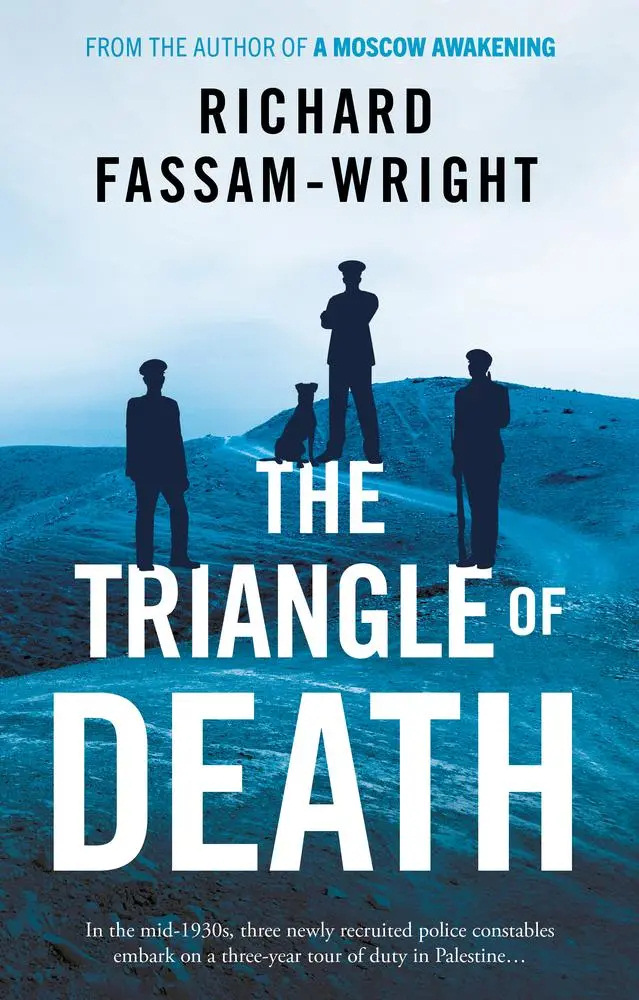
The Triangle of Death
Richard Fassam-Wright
The Book Guild
ISBN 9781835742457
RRP £9.99
Review by Tim Llewellyn
Until the 2000s, English language fiction did not serve the history of the Palestinian people well. This was despite Britain’s responsibility for and violent involvement in their suppression from 1917 until 1948, followed by Israel’s never-ending ethnic cleansing and violent control of Palestine. Eminent novelists such as E.M.Forster and Paul Scott looked critically at the jewel in the Empire’s Crown, India; writers like V.S.Naipaul, Graham Greene and Evelyn Waugh found their targets across Africa, India, Latin America, Central America, the Caribbean and Southeast Asia: but never the Levant.
With the exception of Salman Rushdie and William Boyd, the leading new English-language novelists of the 1970s and 1980s rarely strayed far beyond the United Kingdom, Ireland and Europe. In 1983, John le Carré gave us an overwrought thriller set in Israel, Palestine and Lebanon, The Little Drummer Girl, but it was all intrigue, and sparse in reflection of the Palestinian story.
Muriel Spark’s The Mandelbaum Gate came out in 1965, a tale mostly of English people involved in cross-frontier plotting, spiritual awakening and nervous collapse; Olivia Manning’s much put-upon heroine Harriet Pringle in The Sum of Things (1980), the last of her Levant trilogy, passed through Palestine en route from Cairo to Damascus, without much comment on the indigenous population: there was little about the occupied and much-menaced Palestinian Arabs Manning had actually lived among for a year during the Second World War, working for the Mandatory authority as an Information Officer.
There are four glorious exceptions to this in English writing. In 1963 Ethel Mannin gave us The Road to Beersheba, a sympathetic, moving story of the exodus Israeli troops forced 100,000 Palestinians, including old people, children and invalids to make on foot with anything they could salvage, in burning summer, from Ramleh on the central Palestinian plain to Ramallah, 30 miles uphill in the West Bank. The story ends a few years later with the doomed attempt of one of that disastrous trek’s survivors to cross the Green Line into Israel. Three years later she brought out The Night and its Homing, set among the Palestinian refugees of the Jordanian-controlled West Bank. Both these novels, now almost forgotten, should be read, if only to illustrate that not everyone in the West lived in more or less complete ignorance of what had happened to Palestine and the Palestinians in those crucial years between 1917 and 1948 and after.
Until now, with the book under review, only one writer had given us in English a fictional account of Palestinian suffering under the British occupation, coming to a violent climax during the Arab Revolt of 1936-39. This was Soraya Antonius’s The Lord, in 1986, which followed the pursuit by the vile, sadistic British Palestine Police Chief, Reginal Challis, of the mystical Palestinian rebel, Tareq. Her next book, Where the Jinn Consult , 1987, exposed the British-controlled Palestinians’ continued displacement and oppression during and after the Second World War, now augmented by Zionist terrorism and Britain’s faltering hold on the places and the people.
The explosion of Palestinian literature in English, and translated into English from Arabic, that has occurred since 1990, with the maturity of new generations of Palestinians following the events of the 1980s – Sabra-Chatila, the First Intifada – and the cruel disappointments of the 1990s and onwards, has concentrated on the recent horrors of the intensified occupation.
But now, in his tight, terse novel The Triangle of Death, Richard Fassam-Wright takes us right back into Britain’s crushing of the Arab Revolt, of the late 1930s, a systematic and often cruel and criminal campaign against a subject population from which the Zionists who took over in 1948 learned, and then embellished.
The Triangle of Death follows the fortunes of a young Bristol man, Sam Brown, who, on the spur of the moment, as 1935 nears its end, responds to an advertisement in The Daily Telegraph for recruits to the Palestine Police Force. He is delighted to be chosen, seeing it as an opportunity to get away from dreary Bristol and kind but unexciting parents and social life, and to serve what he believes to be the progressive and avuncular British rule in an outpost of the Empire. (Twenty years later, this reviewer can assure the reader, most Bristolian students would have thought and been taught much the same of that Empire.)
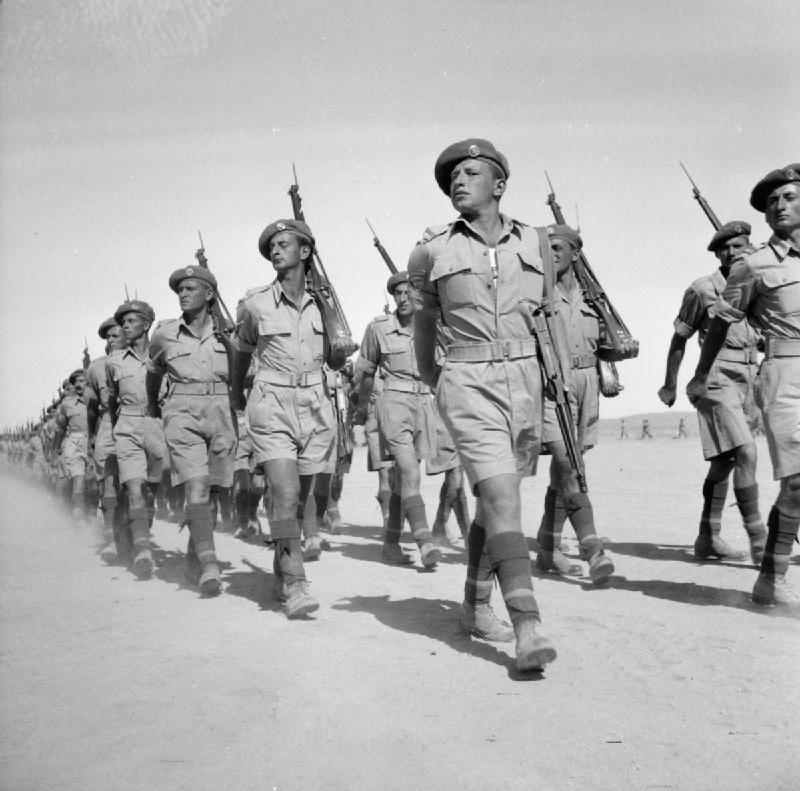
Arriving in Palestine and taking up with two fellow recruits, a thuggish, ill-educated and ill-intentioned Cockney called Spud, but much closer to a sensitive vicar’s son, Jack, who seems oddly out of place in such a colonial venture, Sam takes to the rigorous training in Jerusalem, on Mount Scopus, experiences a near-miss from a sniper in the Old City, but mostly relishes the hard graft and then the relaxation at the cinemas and pubs of Jerusalem and the policemen’s mess, all lads together.
Then the unit is posted to Jenin, in the north of the West Bank, apex of what has become known as The Triangle of Death (it still is one of the most active centres of Palestinian nationalism), with Nablus and Tulkarm at the other two points. The ‘death’, however, though it comes to two Palestine policemen in time, is largely reserved for the local population. These baladi people are marooned between a sometimes ruthless police force, working alongside an often lawless British Army, and the ill-equipped, rag-tag but lethal rebels in the hills. The porous borders with Lebanon and Syria are not far off, these two mandated states run by the French, who are happy to discomfit the British. More modern and more effective arms are beginning to move south into Palestine to augment the freedom fighters’ flintlock muskets and shotguns.
The author describes vividly the horrors inflicted on the rural Palestinians, the racism, the torture, the human shields (we British seem to have invented this routine, strapping suspects or even just any local man available on the front of trains or tied to the bonnets of lorries to discourage bombers and mine-layers), and the murder of innocent but available people when real rebel fighters had vanished into the hills or desert or were unidentifiable.
He also puts the terror in political context: the increased anger aroused among Palestinians by the Peel Commission of 1937, which recommended the partition of Palestine; the judicial hangings, often after kangaroo-court trials, of rebels, minor offenders such as farmers caught with guns and others trapped by the clumsy processes of colonialist order; the role of the Jews, helping the British at that stage, hording arms of their own and absolutely convinced fresh off the immigration boats that Palestine is theirs, all of it, by right.
The story is well and excitingly told and to say much more would risk spoilers.
I have to add, however, that as Fassam-Wright makes clear not all the British, not all the soldiers, not all the administrators and certainly not all the Palestine Police were sadists and convinced Empire builders. The point then as now is that it is impossible, however well-meaning elements of the ruling power may be, to devise a system of colonial rule that will not quite quickly result in rebellion unless a fair and equable solution for the indigenous people is set out early and clearly. Britain put no such solution in sight in or after the Balfour Declaration of 1917 so that the rule of force quickly replaced the rule of law.
Nothing changed in 1948, when the British left, except for the worse. Much worse. The Israelis learned and embellished the methods the British had taught the Jewish fighters between 1936 and 1939.
Tim Llewellyn is a former BBC Middle East Correspondent and editor of the Britain Palestine Project website.