

By Dr Brian Brivati
Executive Director, Britain Palestine Project, in a personal view
2 Nov 2025
“A British officer in Flanders in 1918, transplanted to a British messroom in the same country in 1793, would be more at home than in a foreign messroom of to-day. Though he would find the drinking too heavy for him, he would be surrounded by presumptions indefinably familiar. He would be critical of much, but he would understand from inside what he was criticising. Most of us would be at home taking tea at Dr. Johnson’s, hearing the contact of civilised man with society discussed with British commonsense and good nature, with British idiosyncrasy and prejudice.” George Macaulay Trevelyan, British History In The Nineteenth Century And After (1782-1919), published 1922
In 1826, British statesman George Canning boasted that he had “called the New World into existence, to redress the balance of the Old” through the recognition of new Latin American republics. The phrase epitomises the imperial mindset. In 1922, G.M. Trevelyan noted that the presumptions of British soldiers fighting Napoleon were strikingly similar to those of British soldiers in the First World War.
From the 18th to early 20th centuries, European powers presumed they had the right to redraw maps, install rulers and reshape societies to suit their interests. British politicians like George Canning and later Lord Palmerston engaged in geopolitical engineering across Latin America, Europe, Africa and Asia, convinced that great powers should arbitrate world affairs.
By the 19th century, such attitudes were deeply entrenched. European empires saw themselves as bearers of civilisation to the “backward” peoples of the world, what Edward Said would later critique as the Orientalist habit of treating the East as a passive, childlike entity in need of Western guidance. The very location of the east on the globe described as a reference point to Europe – the Near, the Middle, the Far East.
On 21t Sept 2025 the UK formally recognised the State of Palestine, having said that it would if Israel failed to meet certain conditions. On 29 Sept 2025, Donald Trump announced a 20-point peace plan which he claimed would end thousands of years of conflict. There would be a ceasefire, a hostage exchange and Gaza would then be governed and reconstructed by a peace council made up of foreigners and chaired by a former British PM. George Canning and Trevelyan’s soldiers would have welcomed the announcements and appreciated the hubris of it all.
Trevelyan was writing at a time in which the language of Imperialism had been updated by the League of Nations. Despite talk of self-determination, imposed by Woodrow Wilson, London and Paris largely ignored the wishes of local inhabitants; imperial competition reigned. World War I transformed the Ottoman Empire, Britain and France schemed together to carve up its Arab provinces.
The Arab Palestinian 90 per cent who became the non-Jewish communities – and the British could therefore ignore
The secret Sykes-Picot Agreement of 19161 showed how casually the West drew lines across the map. Britain sought to secure Palestine, determined not to let France (or any rival) gain an upper hand in that strategic region which also played such a central metaphysical role in the minds of Christian Zionists. It is in this context that Arthur Balfour penned his famous declaration of intent.
The declaration, published on 2 Nov 1917, came in the already by then weirdly anachronistic form of a letter from the Foreign Secretary of the British Empire to Lord Rothschild as “leader” of the Jewish community in the United Kingdom. Its promise of a Jewish homeland was caveated by a vague second promise that “nothing shall be done which may prejudice the civil and religious rights of existing non-Jewish communities in Palestine.”
In reality, the indigenous Arab population (about 90 per cent of Palestine’s inhabitants at the time) was neither consulted nor even mentioned by name. Historian Rashid Khalidi observes that Palestinian Arabs were simply ignored – a “subtly racist rationale” underpinned Balfour’s promise, implying that “the Jews were important, were a people with significance, while the Arabs of Palestine…could be ignored, and indeed were not even thought of as a people per se.”2 This exemplifies Orientalism in action: the colonial power recognised one people’s national aspirations while treating another people as invisible in their own land, incapable of self-government.
The primacy of these Imperial ambitions created the logic behind the contradictory promises3 also being made. Britain had already through the Hussein–McMahon correspondence (1915–16), promised Arab leaders support for an independent Arab Kingdom including Palestine in exchange for revolting against the Ottomans.
Those Arab aspirations were conveniently marginalised when the war ended. Britain emerged from WWI with control of Palestine, obtained via a League of Nations Mandate (essentially a relabelled and supposedly time-bound form of colonial rule). The Mandate for Palestine formally incorporated the Balfour Declaration’s terms, giving Britain a legal cover to facilitate the Zionist project. British officials spoke of “trusteeship” and guiding subject peoples toward self-rule, but in practice the Mandate was, in words of the Yugoslav representative of the UN special commission of 1947: “a cynical device for promoting British imperialism under a mask of humane consideration”.
The only Jewish Minister in the Cabinet saw Zionism as a mischievous creed, and opposed Balfour’s Declaration
Britain’s issuance of the 1917 Balfour Declaration was indeed, far from altruistic – it stemmed from a convergence of strategic, religious, and even prejudicial motives. On a geopolitical level, British leaders saw Palestine as vital to imperial interests and World War I strategy: backing Zionism promised to secure Palestine (and the route to the Suez Canal) for the British sphere and pre-empt French claims in the Levant, while also (they hoped) rallying “Jewish opinion” in the United States and Russia to bolster the Allied cause.
This calculus relied in part on antisemitic assumptions about global Jewish influence – an idea Arthur Balfour and David Lloyd George appear to have accepted. Balfour, an avowed imperialist, believed that a pro-Zionist policy would harness the supposed “occult power” of world Jewry in Britain’s favour, and the War Cabinet as a whole put stock in the potential “power and unity of Jewry” to help win the war. At the same time, effective Zionist lobbying profoundly shaped British decision-making: Chaim Weizmann and his colleagues cultivated close ties in Whitehall, convincing key officials that a Jewish homeland under British auspices would serve both British strategic goals and Zionist aims.
Yet, as historian Philip Alexander argues, Balfour’s zeal for Zionism cannot be explained by Realpolitik alone – it also sprang from his evangelical Presbyterian upbringing and a long English Restorationist (Christian Zionist) tradition of supporting the return of Jews to their ancient homeland. Balfour’s own words underscore this religious sentiment.4 In a 1922 House of Lords speech, he insisted that the policy did not arise “purely” from “materialistic considerations,” describing it as an “adventure” and a “partial solution of the great and abiding Jewish problem”.
Balfour said Britain aimed to “send a message to every land where the Jewish race has been scattered… that Christendom is not oblivious of their faith, is not unmindful of the service they have rendered to the great religions of the world”, and to help the Jewish people develop their gifts “in peace and quietness under British rule”.
Alexander interprets this as a form of humanitarian Christian Zionism – a conviction that Christians had a moral duty to right past wrongs against the Jews by facilitating their return to Zion – rather than a literal fulfilment of biblical prophecy. Notably, Balfour and his peers showed little concern for the inhabitants of Palestine themselves. Balfour later acknowledged that Palestine was an “exceptional case” in which Britain “deliberately… decline[d] to accept the principle of self-determination” for the native Arab majority – a blatant colonial double standard that historian Avi Shlaim5 calls the Declaration’s “greatest contradiction”.6
Within the British government, Edwin Montagu (the only Jewish Cabinet minister) fiercely opposed the Balfour policy, denouncing Zionism as a “mischievous political creed”7 and warning that His Majesty’s Government’s course was “anti-Semitic in result”, bound to “prove a rallying ground for anti-Semites in every country”.
The culmination of a centuries-long current within British Christian-Zionist thought
Montagu argued that declaring Palestine the Jewish national home would brand Jews as foreigners in their own lands and might inspire other nations to expel their Jewish citizens; he grimly predicted that such a policy would lead to “a population in Palestine driving out its present inhabitants”. Ultimately, however, Montagu’s objections were overruled – he was absent (on duty in India) when the War Cabinet approved the final text on 31 Oct 1917, and the Cabinet, while adding a token safeguard for non-Zionist Jews, proceeded with what Montagu lamented was “an irreparable blow” to Jewish Britons.
In sum, the Balfour Declaration was the product of intertwined motives: wartime opportunism, imperial rivalry, and ideological conviction rather than humanitarian goodwill. It was not only a diplomatic victory for Jewish political Zionism, but also the culmination of a centuries-long current within British Christian Zionist thought. As Philip Alexander notes, it marked “the culmination of 400 years” of Restorationist theology that began in the 1600s, gained political expression under Lord Shaftesbury in the 1840s, and ultimately shaped British policy in 1917. In this sense, the Balfour Declaration was as much a triumph of Christian Zionist ideology as it was of Zionism itself.
From 1917 to 1948, Britain governed Palestine. From the very start of the civilian administration in it encouraged Jewish immigration and land purchases8 while suppressing growing Arab unrest and withholding, as Martin Gilbert put it in 2011, ‘representative institutions to Palestine as long as there was, in Palestine, an Arab majority.’9 Between 1936 and 1939 it brutally suppressed the Arab Revolt (teaching Jews brutal methods)10 and killed, exiled or imprisoned the majority of the Palestinian leadership.
In 1939, to placate Arab allies whose oil it needed, Britain sharply restricted Jewish immigration – just as Nazi Germany was beginning the campaign to annihilate Jewish people of Europe that became the Holocaust. Tensions in Palestine escalated into intercommunal violence with Jewish terrorists being funded by the French. It stood by whilst 250,000 Palestinians were expelled and the main cities cleared of Palestinians between December 1947 and April 1948. Britain ensured there would be no Palestinian state, freezing the Palestinian currency and taking it out of the Sterling area in February 1948, preventing the UN sending a Partition Commission to Palestine and negotiating with Abdullah of Jordan to take over the parts of Palestine not taken by the Jews… Following May 1948 and the creation of Israel expulsion continued and a further 500,000 were expelled or killed in what Palestinians call the Nakba (“catastrophe”).
The Balfour Declaration set in motion this complex, bloody, and shameful chain of events – beginning with imperial arrogance and ending with Britain, financially exhausted by World War Two, withdrawing under pressure from sustained Jewish insurgent violence. What it left behind was one of the most intractable legacies of empire in the modern world.
Yet we should be cautious in calling it “post-imperial.” Britain and other great powers never truly left this quagmire to resolve itself. By consistently privileging Israel’s post-imperial elite over others, and Israeli self-determination over Palestinian, they have fuelled and sustained the conflict to its present, genocidal stage. This pattern of divide and rule in the process of decolonisation was not unique to Palestine – it was repeated elsewhere, in Rwanda for example, with devastating consequences.
The West knows better – the fallacy at the heart of Orientalism and colonialist thinking and policies
The legacy of the Balfour Declaration is thus deeply paradoxical. On one hand, it paved the way for the eventual establishment of the State of Israel in the shadow of the holocaust. On the other, it set in motion the dispossession of the Palestinian people. Crucially, it demonstrated the imperial (and Orientalist) mindset at its height: a European power presumed to dispose of an Oriental country’s fate with no regard for the wishes of its majority inhabitants.
Balfour himself once justified British rule in Egypt by arguing that Europeans “know” the Orient better than it knows itself – and therefore have the authority to rule it. This presumption that Western powers know best and can decide the destinies of Eastern peoples lies at the heart of Orientalism. The Balfour Declaration is a textbook case: Britain acted as if Palestinian Arabs were a negligible presence, lacking political rights or agency over their own land. As Edward Said would emphasise decades after the end of the Mandate, such attitudes were not an anomaly but part of a broader Western discourse that treated the “Orient” as an object of policy, not a partner in decision-making.
The mid-20th century saw the formal end of colonial empires. After 1945, dozens of nations in Asia, Africa and the “Middle” East gained independence, and principles of self-determination and equality of nations were enshrined in the United Nations Charter.
It seemed the age of imperial diktats was over. Yet, even as flags were lowered and colonies dissolved, the mentality of empire did not simply vanish as the former Imperial powers backed elites against each other. The Cold War that followed often treated newly independent states as pawns in a global chess match between superpowers. Both the United States and the Soviet Union (and their allies) intervened frequently in the affairs of smaller nations, sometimes overthrowing governments or propping up client regimes. The ideological language shifted (to anti-Communism, reform, development, “modernisation,” etc.), but the underlying notion remained that great powers could decide the fates of “lesser” regions – a neo-Orientalist view that those regions could not be trusted to manage their own affairs without supervision.
In the post-Cold War era, Western interventionism continued under new guises: humanitarian intervention, the “War on Terror”, democracy promotion. Some interventions were arguably well-intentioned and framed as a responsibility to protect; others were nakedly about strategic control. The 2003 United States-led invasion of Iraq is the defining case.
Justified by exaggerated claims of Weapons of Mass Destruction and promises to bring democracy, the Iraq War ended up killing hundreds of thousands and destabilising the region. Blair, in particular, lost credibility on the world stage – a British inquiry (the Chilcot Report) by focussing on lessons to be learned rather than on blame to be assigned, largely excoriated the rushed decision-making and misleading of the public – but his reputation and the idea of a responsibility to protect were and remain thereafter tainted.
Across the Arab world, Blair became a symbol of Western duplicity and neo-Imperial overreach (many openly call him a war criminal). Iraq underscored how colonial attitudes persisted: Western leaders still believed they could remake a “Middle” Eastern society by force, discounting local complexities, will and agency. As predicted, underlying many such policies was a view of Arabs and Muslims as the perennial “Other” – to be feared, controlled, or corrected, rather than treated as equal actors.
Even leading Western officials occasionally let slip statements revealing these biases. In 2022, for example, European Union diplomat Josep Borrell described Europe as a “garden” of order and the rest of the world as a “jungle” threatening to overrun it, insisting that “the gardeners have to go to the jungle” to civile it. Donald Trump questioned if Palestinian representatives were to be included in talks as things would be slowed down because of the need for translators.
Even after Britain ended its Mandate in 1948, outside powers continued to dominate peace initiatives and political frameworks in the region. Palestinians, who endured not only colonial rule but also the Nakba and occupation, have frequently found themselves excluded from decisions about their own future. It is against all this backdrop, all this weight of history, that recent proposals for Gaza must be understood. The notion that foreign powers might effectively take over Gaza’s governance for a period would, to any historically aware observer, ring alarm bells. Indeed, to Palestinians it sounds like a revival of colonial “guardianship”.
Gaza 2025: A new ‘Viceroy’ and a “Board of Peace”
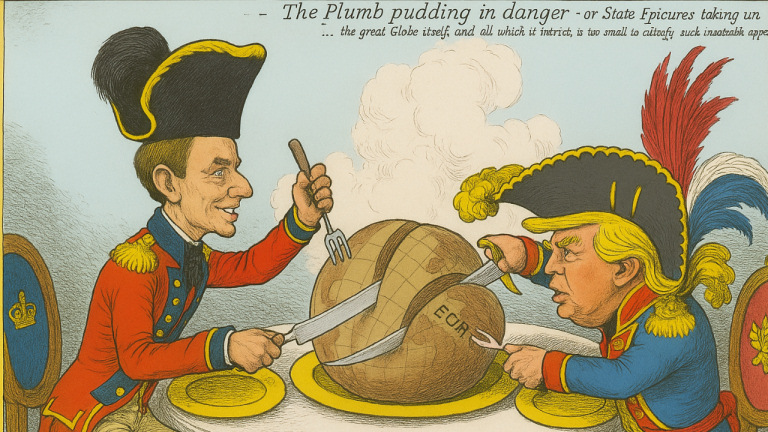
A full century after the Mandate system began a US-led plan for Gaza that uncannily resurrected colonial-era tropes was announced by President Trump. Tony Blair was floated as a potential “temporary governor” of Gaza, essentially a modern-day viceroy, to head a post-war administration. This idea came as part of a 20-point Gaza peace proposal.11 The plan, announced after the genocidal war waged by Israel on Hamas and the people of Gaza, laid out a framework to end the fighting and rebuild Gaza. While labelled a “peace” or reconstruction plan, its details amount to a highly interventionist regime reminiscent of past colonial trusteeships tinged with real estate development opportunities.
The Trump-Blair Gaza plan would strip Palestinians in Gaza of meaningful political agency for an interim – undefined – period and place the enclave under de facto foreign guardianship. The sales pitch is that this would only be temporary – just long enough to demilitarise Hamas, rebuild infrastructure and “prepare” Palestinians for self-governance under leaders deemed acceptable to the international community. This is presented as the reform agenda. To Palestinians, this arrangement must sound all too familiar, evoking the language and logic of the age of Empire.
Defenders of the Trump peace plan argue that it is pragmatic and transactional rather than Imperial. As Blairites once said, “whatever works.” The plan does not seek to occupy or annex Gaza permanently; instead, it presents a deal: Hamas disarms and Gaza receives investment and relief from bombardment. President Trump has described it as a “brilliant deal” that will improve Palestinian lives while guaranteeing Israel’s security – a supposed win-win transaction. The language throughout focuses on incentives and conditional exchanges rather than moral missions: amnesty for disarmament, aid for new governance structures, and so on.
This approach marks a shift in tone from the era of Lord Balfour or the European colonial powers, who justified intervention through “civilising missions” or divine mandates. Today’s architects of the Gaza plan use the vocabulary of markets and counterterrorism. On the surface, it sounds pragmatic – guns traded for butter, dictatorship replaced by technocracy – but the underlying assumption remains unchanged:
Palestinians are not trusted to govern themselves. In essence, the plan preserves an imperial – or at least Orientalist – logic. It envisions Western and allied regional powers administering Gaza on the grounds that Palestinians require external supervision. That denial of Palestinian agency mirrors the same paternalism that defined centuries of imperial rule and aligns precisely with Edward Said’s definition of Orientalism: a system in which the West claims authority over the East.
In the end, these four figures – Canning, Balfour, Blair and Trump – cast an Imperial silhouette across the centuries. Each in his turn embodies the recurring impulse of empire: the Orientalist conviction that great powers are entitled to redraw borders, designate governors, and speak for subject peoples. Beneath their realpolitik runs a metaphysical current. Balfour’s 1917 pledge was marinated in the Christian Zionist belief in Jewish manifest destiny – a fulfilment of biblical prophecy fervently embraced in his era – and a century later Trump’s interventions were buoyed by American evangelicals who heard in his proclamations echoes of messianic prophecy and end-times design.
Even Blair’s crusading zeal carried a quasi-messianic tint; a devout Christian, he often framed his decisions in spiritual terms (allegedly asking “What would Jesus do?”). Yet the language of domination has continuously shape-shifted.
What once was justified as a civilising “mission” is now packaged as “governance reform” or “peacebuilding” – colonial control rebranded in technocratic administration. The presumption that Westerners “know” the Orient better than it knows itself persists, now sheathed in talk of expertise, stability and humanitarian rescue. On the 108th anniversary of Balfour, the lesson that should be heeded is the same one that anti-colonial voices have argued for decades: “Nothing about us, without us.”
- See more detail on the Skyes Picot agreement see here ↩︎
- See more on British elite attitudes here ↩︎
- See John McHugo’s review of Peter Shambrook’s standard work on the subject here ↩︎
- See Anita Shapira’s quotations on the background to Christian Zionism here ↩︎
- Avi Shlaim on the Balfour Declaration, here ↩︎
- Avi Shlaim in conversation with Nic Pelham, here ↩︎
- See Edwin Montagu’s Memorandum here ↩︎
- See more details on Herbert Samuel’s activities encouraging Jewish immigration and land purchases here ↩︎
- See more on Britain’s policy here ↩︎
- See more on the suppression of the Arab Revolt and lessons the British taught the IDF here ↩︎
- For more on the Trump Plan, see here ↩︎