
By Brian Brivati, Executive Director, Britain Palestine Project, writing in a personal capacity with his reflections on the Trump Plan
1 Oct 2025
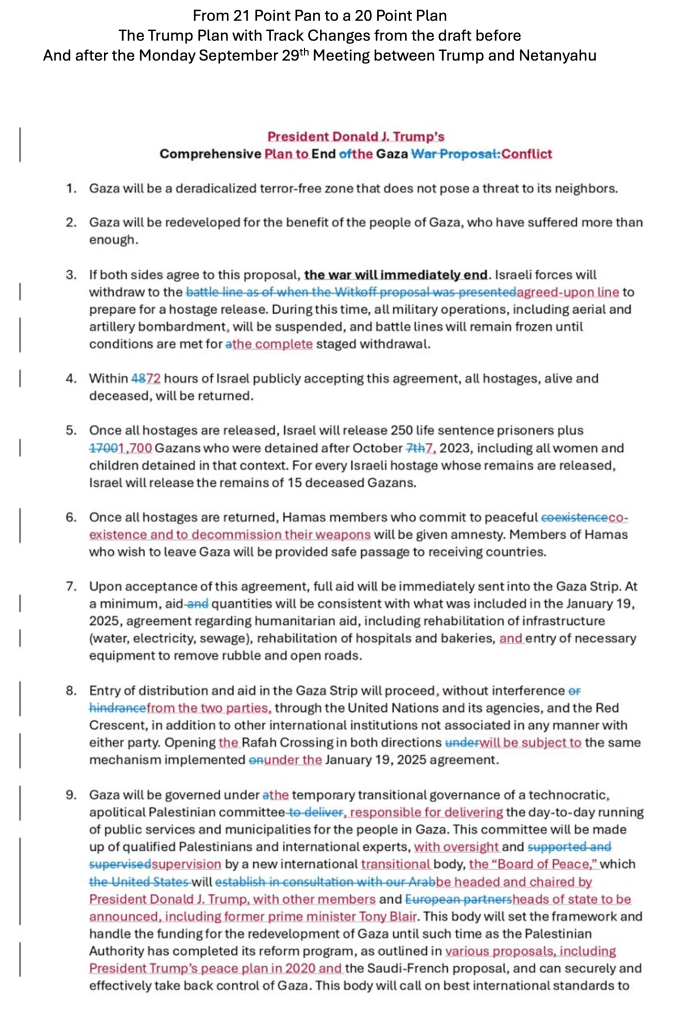
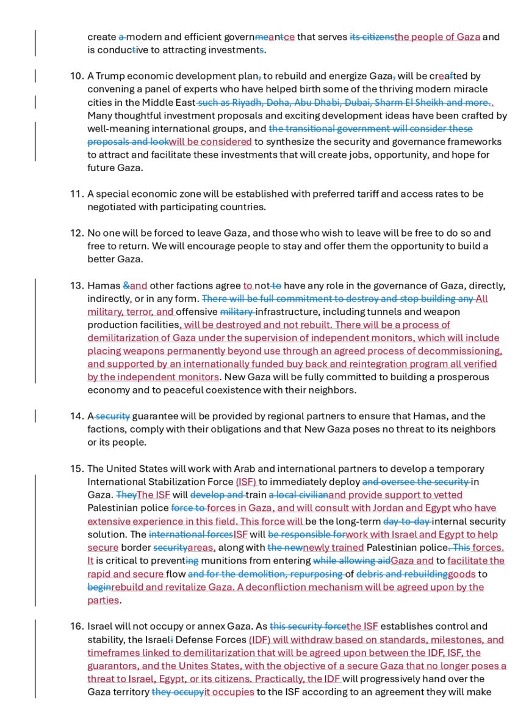
Trump’s plan for Gaza is simple to describe. Twenty points.* A ceasefire. Hostages exchanged for prisoners. Israeli forces pull back in stages. Hamas lays down its arms and leaves power. An international “Board of Peace” decides the big questions. Foreign soldiers guard the borders, aid trucks roll in, money is poured into rebuilding the ruins.
The political legitimacy of these steps and who owes and benefits from what is rebuilt to be decided later. As Trump said in his press conference with Bibi, enough now: the killing should stop. The plan is a framework for trying to make that happen. Much will now develop in the negotiations and the internal politics of Israel and Hamas.
We have come to the point in the political discourse of our age when this can sound like common sense. People stop dying. (Or rather they stop being killed by bombs) Families get their loved ones back: Israel hostages both living and dead, some Palestinians in administrative detention since 7 Oct 2023. (Only a fraction of the 15, 000 held and tortured) The hungry are fed. (But why were they starved?). The famine stops: trucks lined up with three months of food are let in. (As they had been in January 2025). The rubble is cleared. (And how many dead are buried there). Israel can say it has broken Hamas, the Arab capitals can say the bloodshed is over, Washington can say it still has power to make peace, Trump might win a Donald fixed it for you prize.
Common sense can be deceptive.
This plan, for all its neatness, does not answer the only question that matters in the long run: will Palestinians govern themselves, or will they be governed by others in perpetuity? It is the only question that matters for Palestinians and for Israelis, unless Palestinians have agency and their own viable state, Israel will never have security.
The text is plain on this point: this is not yet a Palestinian state.
Self-determination, sovereignty: words that are malleable. The reality is Israeli control
The Imperial Peace Board that manages Gaza is chosen, not elected, and is chaired by Trump. Its laws and budgets must be approved by outsiders. The Palestinian Authority is kept at arm’s length until it reforms – the list of reforms being demanded is long and there is no timetable for when that might be achieved or precise outline of how it might be achieved. Elections are promised in theory, but no dates are given. In the meantime, Gaza is treated as an isolated project – administered by foreigners, supervised by donors, patrolled by soldiers from abroad, developed by real estate speculators.
In this looking glass world, self-determination and sovereignty, once words that gave people dignity and freedom, are here twisted into things that are vague and malleable. In Trump’s earlier plan of 2020, sovereignty was openly described as “an amorphous concept,” and defined down until it meant little more than self-administration under Israeli control of airspace, borders and sea. That same spirit haunts this new plan. The reality is management, not independence. Symbols of statehood without substance.
Of course, there are arguments for such an arrangement. Israel wants security. Foreign governments want order. Donors want guarantees that their money will not vanish into corruption or buy rockets or better still will profit their own national companies. After years of blood and gold and misery, who would not welcome a breathing space? If this plan is implemented, thousands of lives may be spared in the coming months. That fact alone makes it hard to dismiss. The Israelis killed over 100 people in Gaza today, they killed about the same yesterday and they will do so tomorrow.
A breath spacing maybe simply be a pause before a new quagmire. Trump was clear that this would be a matter for Israel if Hamas said no to this plan.
And the moral trade-off is stark. What value is peace if it is built on the denial of political rights? What kind of justice is it that restores buildings that a few Palestinians may be allowed to work in but not own. What sort of order is it when laws are written in Washington and London, not Ramallah or Gaza City? What does this peace do for the structural violence of military occupation and creeping annexation of the West Bank?
The United Nations’ New York Declaration at least confronted most, if not, all of this. It set a clear deadline – 15 months – for elections, reunification of Gaza and the West Bank, and the birth of a Palestinian state. That was ambitious, maybe too ambitious, but it recognised that without sovereignty, all else is temporary. The Trump plan avoids that step. It offers calm now, but defers freedom to some undefined later day.
Tony Blair’s blueprint for a transitional authority in Gaza has supplied the skeleton for one way in which this arrangement can be put into practice.
See the full text of the proposed Institutional Structure for Gaza International Transitional Authority (GITA) here.
Blairite pragmatism, neat on paper: below the international board at the top, Palestinian technocrats running services, foreign troops on the ground, private capital funding the rebuild. A management system more suited to a colony than a people seeking self-rule. It avoided the very questions that bridge politics to people’s lives: economic agency, accountability, the right to decide.
Not a word on the genocide or war crimes, not on 7 Oct, not on the military deployment of bombardment and famine
And yes justice? Barely a word in any of these documents on transitional or restorative justice, let along crimes of genocide or war crimes. This has not just been a war. This latest cycle of violence started with the largest massacre of Jewish people since the holocaust by Hamas on 7 Oct 2023. This was followed by a war of disproportionate destruction against the apparatus of Hamas – social, political and military – beyond self-defence and fully embracing collective punishment. It then extended month on month into a full-scale genocidal war driven by bombardment and famine against the people of Gaza. As a people, because they were a people. The destruction in whole or in part. The denial of the necessities for life. 65,000 bodies found. 20,000 children, 10,000s more under the rubble and not, perhaps, never recovered.
To stop the war is good. To rebuild homes, schools, infrastructure and hospitals is necessary. But to imagine that this alone is peace is a dangerous illusion. For Palestinians, the fear is that once again they will be treated as subjects, not citizens. They will live under administrators, not leaders of their own choosing. Their right to return, to vote, to seek justice for their dead, will be pushed aside in the name of order.
The moral ambiguity is inescapable. Do you accept an imposed calm that saves lives but freezes your political future? Or do you reject it, knowing that rejection may bring more bombs, more hunger, more mass graves under rubble?
Israelis, too, face a choice.
Do they want Gaza pacified at any cost, even if it means an indefinite trusteeship that leaves their neighbours permanently resentful? Or do they understand that real security comes not from domination but from a neighbour who is free and recognised?
The international community, Britain especially because of its colonial past and contemporary responsibility, faces its own question.
The Palestinians will be managers of their poverty, not masters of their fate
Will it back a plan that offers short-term relief but strips sovereignty of meaning? Or will it use its weight to insist that any interim deal leads to elections, justice and a state that Palestinians can call their own – that follows the framework and principles outlined in the New York Declaration rather than the 20-point Trump plan.
The real courage is not in building another system of control, however efficient. It is in trusting Palestinians to govern themselves, and in accepting the risks that come with their freedom. Without that, Gaza will be rebuilt, but its people will remain trapped – managers of their poverty, but not masters of their fate.
And freedom is not only a question of votes or parliaments. It is also the ability to build and own an economy: economic agency is power. Under the Trump plan and its earlier iteration in 2020 as From Peace to Prosperity, Gaza becomes a market for foreign contracts and aid convoys, rather than a place where Palestinians shape their own livelihoods. Economic agency is part of sovereignty.
If the world is serious about peace, it must be serious about sovereignty: political, legal, and economic. That means not just ending the war but enabling Palestinians to own the peace. It means foreign powers stepping back once stability is restored and letting a new Palestinian leadership rise based on a popular mandate. For the true measure of courage is not in drafting plans in foreign capitals but in allowing a people long denied it to take control of their destiny.
Only then will Gaza’s people cease to be managers of their poverty and become, at last, masters of their fate. And only then will Israel have security.
* It had been 21 points last week but the clause where Israel pledged not to attack Qatar was deleted after the Trump-Bibi meeting. See texts with track changes below: