

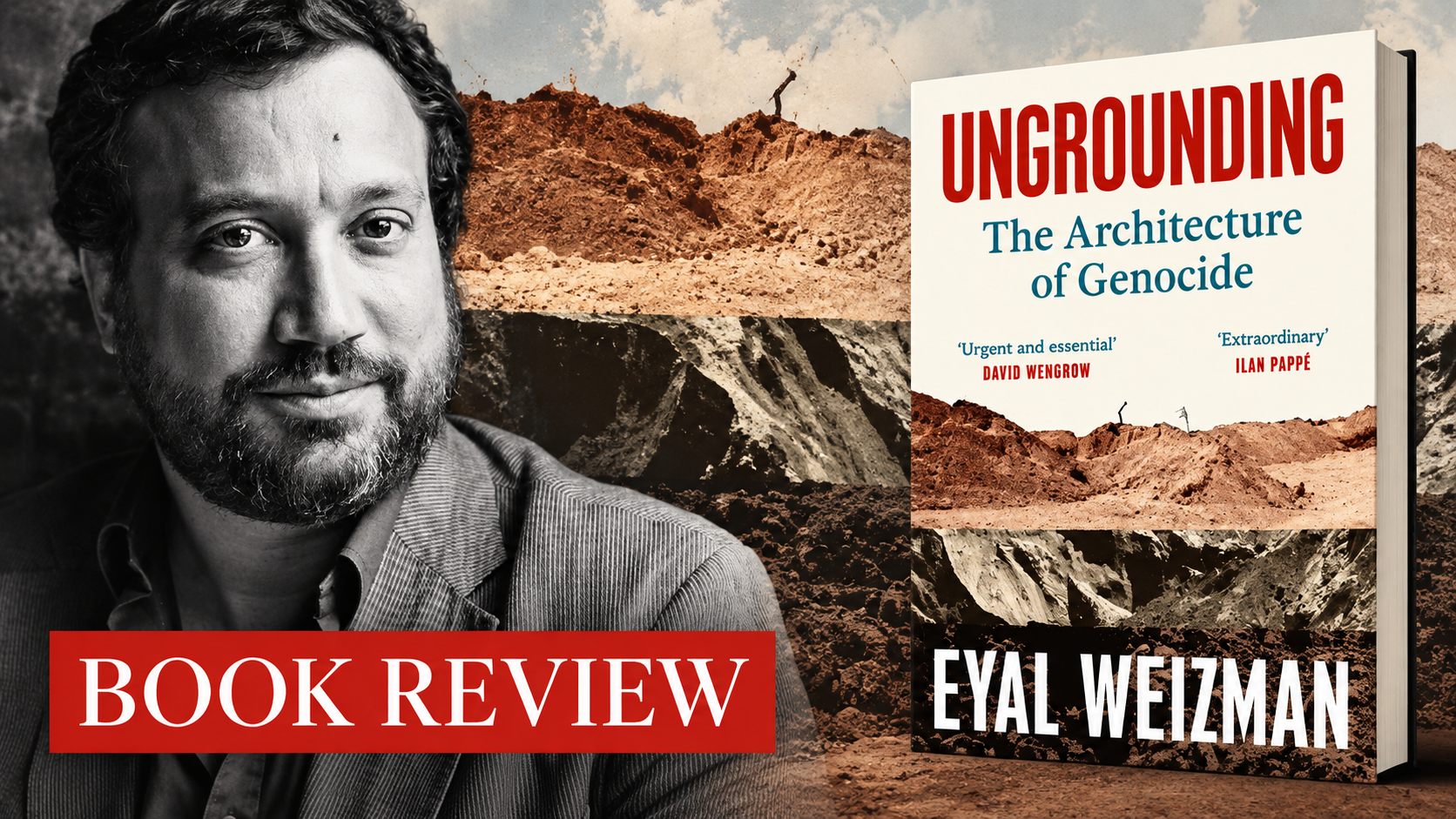
By Eyal Weizman
Vintage Publishing
ISBN 9781911717331
£20.00
Review by Don Macintyre
Since there are few more dynamic man-shaped environments than that long operated by Israel in occupied Palestinian territory, it is understandable that a qualified architect, Eyal Weizman, has become the leading analyst of its use as an instrument of subjugation.
This is not only about the pace –now at its all time peak in the West Bank– of Israeli settlement expansion on the one hand, and dispossession of Palestinians and demolition of their homes on the other. The achievement of his seminal Hollow Land (2007) was to show how walls, checkpoints, roads, bridges, tunnels, land use, airspace, infrastructure and military zoning had created a three dimensional space in which Israel’s physical control over the land it had conquered in 1967 was as absolute as it was possible to make it.
The second strand in the Israeli-born Weizman’s career has been his foundation, and leadership, of Forensic Architecture (FA) a multi-disciplinary team based at London University’s Goldsmith College, which deploys a range of techniques including advanced mapping, architectural tools, video and social media from the ground, satellite and aerial imagery and first person interviews, for, in its own words, “investigating state and corporate violence.”
Weizman’s new and if anything even more important book, Ungrounding: The Architecture of Genocide, draws heavily on FA’s work on the Gaza war, some of which was used to inform South Africa’s case against Israel at the International Court of Justice.
It is a compelling and powerful read, if also for all too understandable reasons an almost unremittingly bleak one, not least but not only for those who knew Gaza before the Hamas-led attack which killed 1,200 Israelis on 7 Oct 2023 and the devastating Israeli war of revenge which ensued. While documenting the mass casualties–at least 77,000 Palestinians killed by September 2026 and possibly many more bodies as yet undiscovered in the rubble—is not Weizman’s main purpose here, he certainly does not neglect them.
One detailed example recorded in his book is the now very well known case of Hind Rajab, the five year old girl killed in January 2024 while she sat alone and terrified in a car among her six already dead relatives. An ambulance crew trying to reach her was also fatally gunned down. Although a Washington Post investigation in April 2024 was the first to cast authoritative doubt on Israeli claims that its troops had not been involved, it was reinforced in June by Forensic Architecture’s own reconstruction. This held that there were 330 bullet holes in the car and added to the international outrage which this August –and too late for Weizman’s book–finally led to the Israel Defence Forces admitting that their troops had indeed fired on the family’s car.
14 civilian rescue workers and an UNRWA employee killed and buried by the IDF
Another of his cases, reconstructed in minute detail by his organisation, was the March 2025 massacre in Rafah’s Tel Sultan neighbourhood of eight Palestinian paramedics, six civil defence workers and a United Nations Relief and Works Agency employee by the IDF, whose troops subsequently used a bulldozer to cover up—in every sense—the bodies with a huge mound of earth.
But while its people are a constant subject throughout, much of the book, as the title suggests, concerns the transformation of Gaza’s landscape in what Weizman argues persuasively has been a deliberate effort to eliminate its viability for Palestinians
The wholesale razing of factories, schools, apartment blocks, universities, landmark monuments, shopping centres, livestock, whole streets, has not only destroyed hopes of livelihood as well as lives, but, in the words Weizman cites early in the book from the Palestinian poet Omar Mousa, has “changed the Strip’s topography beyond recognition” (Mousa memorably goes on to recall a friend musing to him “If we survive this war, what would be our meeting point?”)
Meanwhile the Israeli military imposed an alternative “topography”, to use Mousa’s word, of its own. Weizman describes how 15 new military routes to facilitate armed incursions were driven across the Strip –including through Palestinian cities and refugee camps–destroying buildings within a wide margin on either side and using bulldozers to pile soil and rubble along the routes to create barriers and military outposts.
He maps how five of these by the summer of 2025 became “corridors” running east-west to the coast and dividing the Strip into militarily controlled sections.As he points out, these bore a strong similarity to the “five fingers” in the plan for Gaza settlements developed by Ariel Sharon in the early 70s (all of which were withdrawn by him during his premiership three decades later in a “disengagement” which the currently dominant ultranationalist right have long hankered to reverse).
Indeed, as Weizman points out, each corridor was given a distinctively Israeli name: the Netzarim corridor– notorious as the one that displaced residents of Gaza City were obliged to cross on their way south and acted as a barrier stopping their return–after a Gaza settlement abandoned by Sharon in 2005, and the rest after what Weizman calls the “kibbutz settlements” outside the Strip and nearest to the corridors’ starting points.*
Israel has turned 80 pc of Gaza’s most fertile land into a desert
Plausibly, he suggests that the “distribution” of military outposts along the Gaza Strip corridors was done in such a way “that they could turn into civilian settlements.” Senior ministers in the Netanyahu Government have repeatedly and publicly advocated Jewish settlement in a Gaza largely denuded, as they hope, of its Palestinian residents.
Much of Gaza’s unprecedented devastation is all too visible. But Weizman also digs deeper, almost literally. Having made himself an expert in the strata of Gaza’s complex terrain and subsoil, he argues that especially in the ever expanding buffer or yellow zone created by the IDF in Gaza, the destruction of what he says is a staggering 80 per cent of the Strip’s farmland and 4,000 of its greenhouses Israel turned the eastern and “most agriculturally active part of the Strip” (from which, as from northern Gaza, hundreds of thousands of displaced Palestinians have now been consigned to a perilous existence in the coastal dunes of Al Mawasi) “into a desert.”
He contends that pipework below the land surface cut by the bulldozers, has released raw sewage, unfiltered because of the lack of fuel, into the subsoil. At the same time, toxic materials escaping from razed buildings and the heavy metals including “uranium, lead and arsenic” discharged from bombs that explode underground, have removed from the buffer zone “conditions necessary for life well into the future.” It is hard to challenge Weizman’s view that this unprecedented level of environmental destruction was part of a systematic effort to make Gaza so uninhabitable that its residents would inevitably want to leave.
Weizman’s justified preoccupation with subterranean Gaza extends to the Palestinian-dug tunnels, a constant source of frustration for the Israeli authorities and of whose development over decades he provides an engrossing and comprehensive account.
This covers both how both provided a lifeline for goods during the years of draconian blockade from 2007 (at least until Egypt flooded many of them with sea water in 2015) and, as he says, for decades facilitated—up to and including the current war — “the operations of the armed resistance” in subsoil which after 1967 was “the only part of Palestine left unoccupied.”
On the former function Weizman quotes a Rafah official of Hamas, which levied lucrative taxes on goods coming through the tunnels, as saying that the blockade had been a “blessing in disguise”. The official went on to say that “it weaned us off Israel and 60 years of aid.”
But the latter, arguably exaggerated, claim omits to say that in so far as the punitive Israel-imposed blockade was such a blessing it was much more so for Hamas, whose financial and probably political position was enhanced by it, than for the population as a whole whom, it continued to impoverish, despite goods coming through the tunnels, as much of Gaza’s once vibrant economy—for example its manufacturing sector—ground to a halt.
The blockade followed Hamas’s victory in the 2006 Palestinian legislative elections a few months after Sharon’s withdrawal of the settlements and military bases from Gaza.
A disgraceful attempt to hold the whole Gaza population responsible for 7 Oct
Weizman says the withdrawal was seen by Palestinians “as a victory for Hamas’s path of armed resistance over that of collaboration and diplomatic negotiation championed by Fatah.” While that was no doubt true for some Hamas supporters, I cannot help feeling, having been in Gaza both during and after “disengagement”, and again during the 2006 election campaign, that this is at best an over-simplification, at least in so far as the withdrawal affected the election outcome.
Hamas’s “Change and Reform” electoral agenda did not promote the armed struggle, while Fatah was not only widely seen as corrupt but was fatally split in many areas. This would hardly be worth discussing were it not for the disgraceful attempt by Israeli politicians to justify the slaughter of civilians by blaming the whole Gaza population for 7 Oct.
Indeed, Weizman himself correctly describes one of many such attempts as “infamous”, the remark a week after the attack by Israel’s President Isaac Herzog that “it is an entire nation out there that is responsible. This rhetoric about civilians not being aware, not involved, it’s absolutely not true.”
That said, a major strength of Ungrounding is its setting of the present war within the context of the Israeli-Palestinian conflict in Gaza going back to 1948 —not only its history, but its geography, on which Weizman is especially enlightening. He is good at showing in detail how the old Gaza District under the British mandate was the region’s bread basket until 200,000 refugees were forced into a space less than third of the District’s size, the modern Gaza Strip.
Indeed, the Wadi Gaza basin around the stream running west from the Negev to the Gaza coast was the most fertile in all Palestine.
Particularly striking is his collaboration with Salman Abu Sitta, a formidable chronicler of the Nakba whose family was expelled when he was 10 years old from the village of Al-Ma’in, sitting on the southern edge of the Wadi Gaza Basin and three kilometers outside what is now the border of the Gaza Strip.
With Abu Sitta’s help, Weizman recounts how the residents of Nirim, the kibbutz created in Al-Main’s ruins, gradually ploughed over the Palestinian village, including buildings, walls, roads, vegetable gardens and fields of wheat and barley, before replanting the land with fresh vegetation.
This act was, says Weizman, a “double act of erasure, both of what existed and of the traces that any erasure has taken place.” Here as elsewhere, Palestinians who tried to return to their homes, even to collect belongings they had left behind, were shot on sight. Quite apart from the historical importance of this process, it is an eerie precursor of what has been happening in the Gaza buffer zone today.
This illuminating account –along with the invaluable maps and photographs which underpin it–is typical of the book as a whole. Not all Weizman’s readers, even those as justly outraged by the last three years of Israel’s onslaught against Gaza as he is, will agree with his every political judgment or nuance along the way. But that cannot detract from its lasting significance.
Weizman has charted the underlying rationale for not just the appalling loss of life, and the near-ruination, physical, psychological and economic, suffered by many hundreds of thousands of Palestinian survivors, but for the destruction of a whole and millennia-old civilisation. As such it is likely to be an essential primer for the historians trying to make sense in generations to come of how and why such destruction happened.
Don Macintyre is a British journalist who was The Independent newspaper’s Jerusalem bureau chief from 2004 to 2012, and is the author of Gaza: Preparing for Dawn (2018), now updated as a Kindle book Gaza: Past, Present and Future (2025).