

Dr Brian Brivati Executive Director, Britain Palestine Project
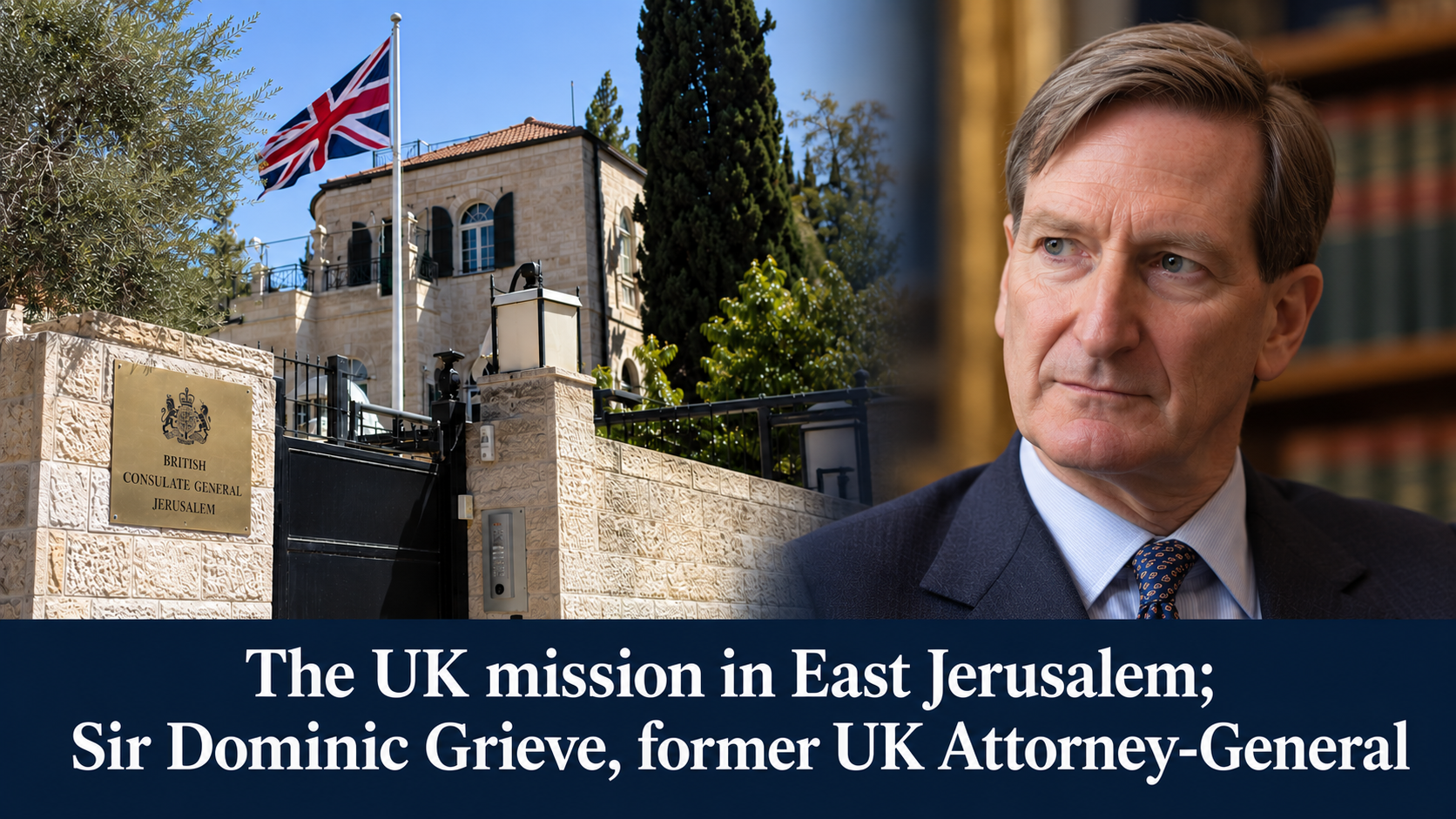
Click here to read Sir Dominic Grieve, Israel does not have right to close UK consulate in Jerusalem, Foreign Office advised, The Guardian, 28 September 2026
Summary
Israel’s threat to force the closure of the British Consulate-General, Jerusalem Britain Palestine Project response
Israel’s threatened closure of the British Consulate-General in East Jerusalem is an unlawful assertion of sovereignty over occupied Palestinian territory. Successive British Governments have affirmed that Israel’s rights in East Jerusalem are limited to those of an occupying power. The British Government today maintains that position. Israel is asserting a right it does not possess as an occupying power to impose sovereign control over East Jerusalem.
- On 8 September Israel set a 30-day deadline, expiring on 8 October 2026, after which it contends that British accredited diplomats in Jerusalem lose their status.
- The UK mission in Jerusalem dates from 1838. It conducts locally the British Government’s relations with the Palestinians. Retaining a Consulate-General in East Jerusalem after recognition of the State of Palestine preserves the UK’s position that Jerusalem’s final status remains to be determined. It does not concede Israeli sovereignty.
- The UK should challenge the closure and demand its reversal, invoking Israel’s legal responsibilities as the occupying power.
The UK mission in Jerusalem is no ordinary consulate
The Consulate-General is Britain’s mission to the Palestinians, independent of the Embassy to Israel in Tel Aviv. The CG reports direct to FCDO. It has its own head, its own staff and a distinct diplomatic role, covering Jerusalem, the rest of the West Bank and Gaza (FCDO).
Retaining the Consulate-General
- The UK CG predates the State of Israel by 110 years. A British Consulate has operated in Jerusalem since 1838. The mission has been sited in Sheikh Jarrah, in East Jerusalem, since the West Bank was under Jordanian administration. It was already in place when Israel occupied East Jerusalem militarily in 1967. The status quo principle in occupation law requires preservation of this inherited arrangement. It reinforces the central objection to evicting the CG: occupation does not confer sovereignty.
- Israel never accredited it. Heads of the UK Jerusalem Consulates-General have not presented commissions to Israel or received an Israeli exequatur. There is no accreditation to Israel for Israel to withdraw. Israel does not exercise sovereignty over East Jerusalem. There are clear limits to its powers as occupier. This is one such limit.
- The CG represents the UK Government in its relations with the Palestinians. The closure falls on Palestinians, not on Britain alone. Closure threatens consular services, including for British pilgrims, other visitors and residents of Palestine. It hampers aid oversight and reporting from the West Bank and Gaza. Alongside the separate order ending British training of Palestinian Authority security forces in Ramallah, it weakens support for Palestinian state institutions.
France, Spain and Sweden maintain Consulates-General in Jerusalem conducting their relations with the Palestinians. Each endorsed the British measures. Israel has indicated it will consider further countermeasures against other signatories. This is a test case, not a bilateral quarrel.
The legal position
The closure is an unlawful assertion of Israeli sovereignty over occupied East Jerusalem. The UK should challenge it as an act outwith Israel’s lawful powers as an occupier (ultra vires). Occupation law, including the Fourth Geneva Convention, and the duty of non-recognition provide the foundation; the status quo argument reinforces it.
The source of the non-recognition obligation is the duty identified by the International Court of Justice in its Advisory Opinion of 19 July 2024, paragraphs 278–279 and 285(7), to withhold recognition of the situation arising from Israel’s unlawful presence in the occupied Palestinian territory, including East Jerusalem. The British Government has accepted that Advisory Opinion.
Article 41(2) of the International Law Commission Articles on State Responsibility sets out the duty not to recognise as lawful a situation created by a serious breach of an obligation arising under a peremptory norm. Applied here, the UK must not treat the closure order as a lawful exercise of Israeli sovereignty in East Jerusalem. (ICJ advisory opinion)
- The powers Israel seeks to exercise belong to a territorial sovereign, and Israel is not one here. In July 2024 the International Court of Justice held that Israel has no title to sovereignty over, or to exercise sovereign powers in, any part of the occupied Palestinian territory, and that its continued presence is unlawful (advisory opinion; full text, paras 254, 261–264, 278). Occupation confers limited administrative and security powers under Article 43 of the Hague Regulations. It does not authorise the occupier to impose sovereignty. A closure purporting to be justified by sovereign control of Jerusalem and retaliation for British trade policy exceeds those powers: it is ultra vires.
2. The Security Council has already declared this class of measure null and void.
| Resolution | Bearing on the closure |
| 478 (1980) | Determines that Israeli measures purporting to alter the character and status of Jerusalem are null and void and must be rescinded; affirms that the Fourth Geneva Convention continues to apply. |
| 2334 (2016) | Refuses recognition of any unilateral change to the 4 June 1967 lines, including in Jerusalem, and calls on states to differentiate between Israel and the occupied Palestinian territories. |
Announcing the closure of the CG on 8 September, Israeli Foreign Minister Gideon Sa’ar asserted Israeli sovereignty over the whole city and said foreign state activity there required Israel’s consent. This expressly links the order to a sovereignty claim over occupied East Jerusalem. UN Security Council Resolution 478 declared Israel’s « annexation « of East Jerusalem null and void. The historic Consulates, including the British CG, preserve a presence without recognising Israeli sovereignty.
- The Israeli announcement usurps the rights of the State of Palestine. Britain recognised Palestine on 21 September 2025. Conducting external relations is a normal attribute of statehood and an expression of self-determination, which the ICJ held no state must impede. The closure obstructs those bilateral relations. Israel has no right to interfere with Palestine’s diplomatic representation.
- There is no justification for this act of retaliation. Any legitimate Israeli countermeasure requires a prior internationally wrongful act by the UK. There is none: the settlement import ban gives effect to the third-state obligations the ICJ identified and to UN Security Council Resolution 2334. Even a lawful countermeasure – which this threatened closure is not – cannot suspend obligations protecting consular inviolability (ILC Articles on State Responsibility, Art. 50(2)(b)). Whatever happens on 9 October, archives remain inviolable, premises must be respected after a post closes, and immunity for official acts survives.
Qualifications
- Israel ratified the Fourth Geneva Convention in 1951 and is bound by it in occupied Palestinian territory, including East Jerusalem. The ICRC confirms that occupation confers no sovereign rights and that purported annexation cannot remove the protections owed to the occupied population. These binding treaty obligations supplement relevant customary international law.
- Consular law gives no consulate an unconditional right to remain open, and the mission is protected premises, not British sovereign territory.
State responsibility and remedies
In the House of Lords on 9 September, Lord Hannay of Chiswick asked whether Israel had any right to order the closure of the British Consulate-General in East Jerusalem. He pointed out that East Jerusalem is occupied Palestinian territory over which Israel does not have sovereignty, and asked whether the UK would contest an order he described as disproportionate and ultra vires. Lord Wood acknowledged that Hannay “may have a point” on the law, while warning that Israel could in practice prevent the consulate from operating. Hannay’s intervention identified the central legal issue nearly three weeks before BPP’s note.
The closure order engages Israel’s international responsibility. The UK should issue a formal legal protest, invoking Israel’s state responsibility under the customary rules reflected in the ILC Articles. The UK should expressly withhold consent and demand reversal of the order, cessation of any continuing breach, and
appropriate assurances and guarantees of non-repetition where circumstances require them (Articles 20 and 30). Israel is the responsible State and the UK is an injured State (Article 42). The UK should examine available judicial and other international legal procedures, subject to their jurisdictional requirements.
Israel cannot rely on its domestic law to justify a failure to comply with its obligations under the law of state responsibility (Article 32). If the closure proceeds, Israel will be obliged to make full reparation for the resulting injury (Article 31). This includes restitution to restore the situation before the wrongful act. Compensation will be due for financially assessable damage caused by the act insofar as restitution does not make it good (Article 36). (ILC Articles on State Responsibility)
What the closure is really about
The UK’s settlement sanctions are the excuse; sovereignty over Jerusalem is the object. Israel’s method in the city has been to create facts on the ground through unlawful settlement building and property seizure, and to press states to recognise those facts diplomatically. The closure should be challenged as a further attempt to exercise powers outwith those permitted to an occupier. Israeli Government responsibility for its unlawful settlement enterprise is another example: Article 49(6) of the Fourth Geneva Convention prohibits an occupying power from transferring its civilian population into occupied territory. Both policies seek to turn control under occupation into permanent sovereign authority. This is unlawful. The British Government should oppose both policies.
Britain Palestine Project 25 September 2025
Sources
Original sources dated 17 September 2026. Legal references for this revision checked 23 September 2026.
UK Government and Parliament
UK Government written answer on Jerusalem, July 2021
The closure
ITV, Sa’ar’s closure announcement and claim of sovereignty, 8 September 2026
Legal instruments
- ICJ, Legal Consequences arising from the Policies and Practices of Israel in the OPT, 19 July 2024(case page)
Fourth Geneva Convention, 1949, including Article 49(6), and States Parties (ICRC)
ICRC, responsibilities of the occupying power in the occupied Palestinian territory, 26 July 2024