

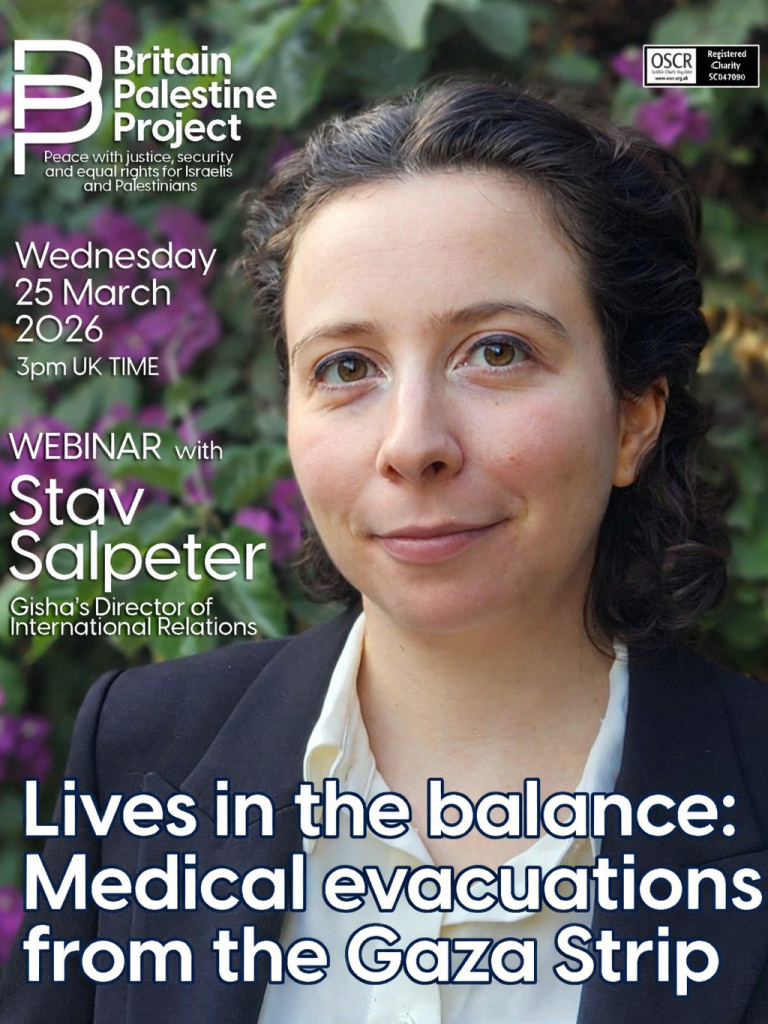
25th March 2026


What does it take to leave Gaza for life-saving medical treatment – and why is it so often impossible?
Diana Safieh is joined by Stav Salpeter, Director of International Relations at Gisha, an Israeli human rights organisation working to protect the freedom of movement of Palestinians, particularly in Gaza.
Drawing on legal cases, on-the-ground realities, and international law, Stav exposes the systemic barriers preventing critically ill patients from accessing urgent care – and why this is not a logistical failure, but a political one.
From the collapse of Gaza’s healthcare system to the legal battles required for even a single patient to leave, this conversation lays bare a system where access to healthcare is controlled, delayed, and too often denied.
Key Topics Covered
- The role of Gisha and its legal advocacy on freedom of movement
- How Gaza’s healthcare system has been systematically degraded
- The bureaucratic and political barriers to medical evacuation
- The closure of the Gaza–West Bank medical corridor
- The human cost behind the statistics: real patient cases
- The role (and limitations) of third-country evacuations
- Israel’s obligations under international humanitarian law
- What international pressure can realistically achieve
Key Takeaways
1. Medical evacuation is a life-or-death issue
Patients often face weeks or months of bureaucratic delays for permits – even in urgent cases – despite conditions that require immediate treatment.
2. Gaza’s healthcare system is on the brink of collapse
- Only 20 out of 677 health service points were fully functioning (March data)
- Severe shortages of medicine, fuel, electricity, and staff
- Medical professionals have been killed, detained, or denied entry
This creates a public health crisis where evacuation becomes essential – not optional.
3. The biggest barrier is political – not logistical
Despite claims otherwise, the obstruction of medical evacuations is rooted in policy decisions, not geography or capacity.
4. The numbers are staggering – and growing
- At least 18,500 people are currently waiting for medical evacuation
- Even under “best case” scenarios, current systems would take over a year to meet existing needs
5. The Rafah crossing is not a sufficient solution
Even when open, far fewer patients than promised are able to leave, and access remains inconsistent and unpredictable.
6. Patients face impossible choices
- Many cannot travel without a companion (often denied)
- Parents must decide whether to leave children behind
- Fear of not being allowed to return discourages evacuation
7. Legal battles determine who lives and dies
Access to treatment often requires multiple court petitions, even for children.
- One cancer patient only accessed treatment after six legal petitions
- His son, with a similar condition, died waiting
8. A functioning system already existed – and was shut down
Before October 2023, around 1,500 patients per month accessed treatment via the Gaza–West Bank corridor.
This route is now completely closed due to policy decisions.
9. International law is clear – but contested
Under the Fourth Geneva Convention, an occupying power must ensure access to medical care.
Israel disputes its status as an occupying power, limiting its obligations in practice.
10. Bureaucracy is being used as a tool of control
“It’s much cheaper to kill people with bureaucracy than with bombs.”
🎯 What Can Be Done?
- Pressure governments to reopen the Gaza–West Bank medical corridor
- Advocate for increased third-country medical evacuations
- Challenge restrictive visa and documentation requirements
- Continue raising awareness and pushing for accountability
📢 About the Guest
Stav Salpeter is Director of International Relations at Gisha – Legal Center for Freedom of Movement. Her work focuses on legal advocacy and policy change to ensure Palestinians’ access to fundamental rights, including healthcare.
▶️ Listen & Watch
Available on:
YouTube | Spotify | Apple Podcasts | Britain Palestine Project website