
Palestine the Reality cover image on a landscape background featuring part of the book's cover photo

The best book on the Balfour Declaration is…

Palestine: The RealityThe inside story of the Balfour Declaration 1917–1938 by J.M.N. Jeffries Published: 1939, reissued 2017 Formats: Hardback, paperback ISBN: 9781911072126 £26.99 First published by Longman Green and Co. Reissued by Olive Branch Press and Skyscraper Publications. Paperback £26.99 By John McHugo    Many people trying to get to grips with the Israel/Palestine conflict…

Read more

A calamitous promise

The Guardian’s Long Read of 17 October was headlined ‘Britain’s calamitous promise’. Author Ian Black writes ‘The brief document that bears Balfour’s name is seen as marking the beginning of what is today widely considered the world’s most intractable conflict.’ Its three-page article, by Ian Black, deals with the motives behind the British Government’s support…

Read more
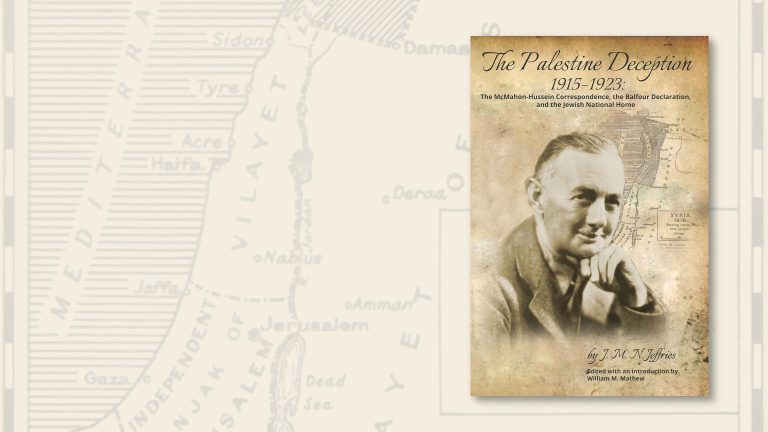
The Palestine Deception - JMN Jeffries - book cover on a landscape map background

The Palestine Deception, 1915–1923, by William Mathew

In 2015, historian William Mathew published a book consisting of a series of articles from the Daily Mail of 1923. These presented a hitherto uninformed British readership  with details of official promises made to the Arabs in 1915–16 of post-war independence for Palestine in exchange for their support in the struggle against the Ottoman Empire…

Read more

Contradictory Promises, by Peter A Shambrook

The seeds of 100 years of conflict Britain, the Arabs and the Jews, 1914 – 1918 2014 – 2018: Britain’s opportunity to acknowledge. In 2014, the centenary of the Great War will be marked in a variety of ways right across the globe. Every country involved will remember and honour those millions who made the…

Read more

Britain’s legacy to the tortured Ottoman Empire

Selfish imperial agreements between Britain and France, combined with the publication of the contradictory Balfour Declaration of 1917, fuelled hostilities in the Middle East This article appeared in The Sunday Telegraph on 2 February 2014 By Patrick Bishop The First World War was the most modern of conflicts. Yet the thinking of the men who…

Read more

Contradictory Promises

See also Contradictory Promises by Dr Peter Shambrook where these promises are explored in more detail. 1915  The McMahon-Hussein Correspondence, • In 1915 Britain promised the Arabs that after the war they would be granted independence in their lands, in exchange for joining a wartime alliance against the Turks. 1917 The Balfour Declaration, • This…

Read more

Biography: Arthur Balfour by Brian Klug

From Brian Klug, Being Jewish and Doing Justice: Bringing Argument to Life London: Vallentine Mitchell, 2011, pp. 199-210 There appears to be a conundrum about Arthur Balfour.1 On the one hand, his name is inseparable from the Declaration he signed as Foreign Secretary on 2 November 1917, which read in part: ‘His Majesty’s Government view…

Read more

The Palestine Mandate July 1922

The Mandate, the full details of which are available in the Avalon Project, incorporated the provisions of the Balfour Declaration. Whereas the Principal Allied Powers have also agreed that the Mandatory should be responsible for putting into effect the declaration originally made on November 2nd, 1917, by the Government of His Britannic Majesty, and adopted…

Read more

British White Paper of June 1922

Below is the White Paper but also read: Rescuing Balfour: Winston Churchill at the Colonial Office   1921-22  Dr William Mathew shows in this essay how Winston Churchill,.. played a vital role in securing the British government`s long-term commitment to the terms of the Balfour Declaration of November 1917. Joseph Jeffries and the ‘Palestine Deception’, 1923…

Read more

The Sykes-Picot Agreement 1916

With the Ottoman Empire drawn into the war the Entente powers assumed that its defeat and dismemberment were inevitable. They negotiated between themselves which portions of the Empire they would take. In 1915 Prime Minister Herbert Asquith appointed the de Bunsen Committee to identify the Ottoman territories that were of interest to Britain. They considered…

Read more

Short biographies by Mary Grey

The War Cabinet (WW1) The creation of the War Cabinet undertook the supreme direction of the war effort. It was composed of David Lloyd George, the Prime Minister, Andrew Bonar Law, Lord Nathaniel Curzon, Alfred Milner, Arthur Henderson and Sir Maurice Hankey (its Secretary). Mark Sykes and Leopold Amery were also secretaries.

Read more