
By Victor Kattan
15 Oct 2025
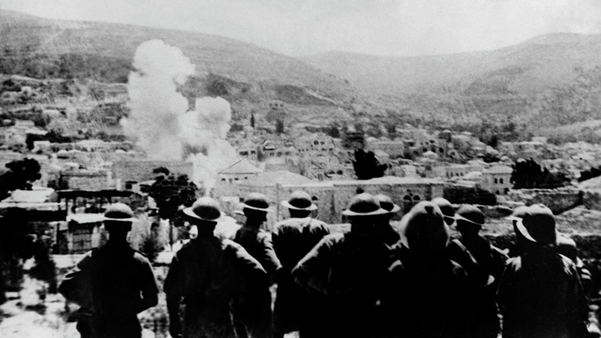
British soldiers look on during blasting operations of the houses of Arab inhabitants of mandate Palestine, circa 1939 (Photo by Heinrich Hoffmann / Deutsche Allgemeine Zeitung / ullstein bild via Getty Images)
Murder. People “shot while trying to escape”. Torture. Beatings. Villages destroyed and pillaged. Homes demolished. Forced removals. Mass arrests. Administrative detentions. Repeated assaults on judicial independence.
These could be descriptions of what takes place in any number of “rogue states” throughout history: from Pinochet’s Chile and apartheid South Africa to Bashar al-Assad’s Syria and Israel’s routine repression of Palestinians since 1967.
But they are actually descriptions of Palestine under British rule in 1936. The history is as shocking as it is despotic — yet, with all eyes on Israel’s war in Gaza and what the United Nations Commission of Inquiry has determined to be a genocide, Britain gets off scot-free.
No more. Last month, lawyers (of which I am one) representing 14 elderly Palestinians challenging Britain’s policies of repression in what was known as “mandate Palestine” (1917–1948), served the British Prime Minister Sir Keir Starmer, the Foreign Secretary Yvette Cooper, the Defence Secretary John Healey and the Attorney General Richard Hermer, with a 427-page legal petition outlining the allegations and rights violations in detail. They are requesting a response to the petition and a formal apology. Their campaign is called Britain Owes Palestine.
If the British Government is hoping the matter might fade, it is likely to be disappointed, as the allegations of war crimes are also vividly depicted in a new film by Palestinian director Annemarie Jacir, Palestine 36, which premieres in the United Kingdom this month (October 2025). The film stars Jeremy Irons as the notorious British High Commissioner in Palestine, Arthur Wauchope (1874–1947), and actors Robert Aramayo as the villainous Captain Orde Wingate (1903–1944) and Billy Howle as Thomas Hopkins, a young government official.
The allegations of violence and repression in the petition and the film are serious. They were independently corroborated by the UK’s flagship current affairs programme BBC Newsnight in a report that aired in 2022, which presented evidence of entire Palestinian villages being razed to the ground, the “caging” of Palestinian civilians in the open air and the use of human shields by strapping them to the front of military vehicles. According to the BBC, the evidence includes audio recordings made decades later in which British soldiers and police officers describe what happened.
Demographic engineering and ethnic division
From 1917 to 1948, “Palestine” (the British name for the area they carved out of the ruins of the Ottoman Empire) was subject to colonial rule in the form of a “mandate”. During those years, Britain fostered the ethnic divisions and violence that has plagued relations between Arabs and Jews ever since. They did so by creating sectarian institutions for each of the “religious communities” — such as the Supreme Muslim Council, which was established by the British colonial authorities to break up the Christian-Muslim alliance that had arisen in opposition to British policy in Palestine as outlined in the Balfour Declaration.
After 1917, Britain’s policies in Palestine could be summed up in three words: occupation, repression and partition. These policies included a prolonged, unlawful occupation, which included large-scale demographic engineering involving the mass immigration of European Jewish people to Palestine — a country that, when Britain occupied it in 1917, was more than 93 per cent Palestinian Arab.
In 1917, most of Palestine’s Jewish community was integrated with Palestine’s Arab population, sharing similar customs and a shared language — Arabic — although a smattering spoke other languages, including Ladino, Yiddish and Hebrew. It was the latter that was eventually promoted as the national language of a new Jewish nation. There had always been a small Jewish population in Palestine, many of them Ottoman citizens, with Jerusalem serving as a shared civic space. Beginning in the 1880s a small wave of Jews from the Pale of Settlement in Russia began migrating to Palestine, but these early waves of immigration (Aliyah, in Hebrew), which numbered no more than 25,000 people and paled in comparison with what followed.
For from 1917, Britain encouraged Jewish mass migration to Palestine — decades before the Holocaust — as part of a state-backed project to create a Jewish state there without the consent of the indigenous Palestinian Arab population. A situation of relative co-existence that had previously described the relationship between Ottoman Arabs and Jews now became one characterised by domination and conquest.
By the time Britain left Palestine in 1948, the Jewish population had increased from 10 per cent of the total population, as it was counted in the British census in 1922, to more than 30 per cent of the total population by 1947. Such a massive increase in migrant numbers would cause howls of outrage in an increasingly “anti-immigration” Britain today. Indeed, the British state’s objective — midwifed by the brazenly antisemitic former British prime minister Arthur Balfour (1848–1930) — was to stem the tide of Jewish immigration to the United Kingdom from the Pale of Settlement, where many Jews were fleeing Tzarist persecution.
No democratic voice—so the Arabs turned to revolt
The Palestinian Arabs had no democratic means to challenge British policy, for the British authorities refused to establish a legislature whose composition would reflect the country’s demography. They feared that a democratic legislature, reflecting the will of the Arab majority, would block Britain’s pro-immigration policies which saw Palestinian nationality conferred on immigrants following a brief two-year residency requirement.
Britain also interfered with existing Ottoman land laws by making it easier for Jewish businessmen from overseas to purchase vast tracts of land. Conversely, Palestinians living abroad, especially those in Latin America, were effectively denationalised. In short, the notion of “displace and replace” — which the Israeli Government seems to wish to replicate in Gaza today — was practised in Palestine by the British as early as the 1920s.
In 1936, the Arabs of Palestine had had enough. Inspired by their compatriots in Syria and Iraq, they rose up in rebellion and demanded independence. The British authorities responded brutally. The High Commissioner Wauchope declared martial law. The Secretary of State for War, Duff Cooper (1890–1954), sent tens of thousands of British troops to Palestine from across the empire to crush the rebellion, where they employed the “Black and Tan” methods that had been perfected in Ireland.
One of the most egregious and shocking instances of British violence during the Arab revolt was the al-Bassa bus massacre. This took place in September 1938, when soldiers of the Royal Ulster Rifles forced a coach-load of Palestinian villagers to drive over landmines in a contrived explosion. The massacre was a “retribution raid” for an earlier attack in which a roadside bomb killed four British soldiers, though there was no evidence Palestinians had been responsible.
The bus massacre is dramatically brought back to life in the film Palestine 36, as are the instances of caging entire Palestinian families.
‘Disingenuous lack of moral courage’—a British Chief Justice’s judgment on the UK’s Palestine rulers
Chief Justice Sir Michael McDonnell (1882–1956), who was known for his conservative judicial outlook, was dismayed by the growing unrest in Palestine — which he believed could be averted by ending Jewish immigration — and by the dubious legality of the measures employed by British Government. He objected to the use of legally untrained special magistrates to administer “justice” in police stations. He feared that kangaroo trials in police stations were becoming the norm.
But it was McDonnell’s criticism of the British Government in El Qasir v Attorney General (3 July 1936) for relying on “town planning regulations” to justify the destruction of hundreds of Palestinian homes in the port city of Jaffa that made him an enemy in the eyes of the colonial government. He was forced into early retirement on a generous pension after criticising the Government for its “singularly disingenuous lack of moral courage” in refusing to explain that the destruction was considered a military necessity to allow the British military access to congested quarters of Jaffa.
But Britain did more than just apply the law arbitrarily. British officers also trained Jewish soldiers from the Haganah paramilitary group in counterinsurgency techniques to suppress the Arab rebellion — techniques which included arbitrary violence and torture. These Jewish fighters included Chaim Herzog (1918–1997), the Irish-born father of Israel’s current president, Isaac Herzog. Many of these fighters, such as Moshe Dayan (1915–1981), went on to form the bedrock of the Israeli Defence Forces (IDF). Despite the international condemnation of Israel’s military conduct in Gaza, the UK continues to train Israeli soldiers today.
After 1948, the IDF employed the policies it learned from Britain during the “catastrophe” — Nakba, in Arabic — which saw Palestine quite literally wiped off the map. Between 1948 and 1966, the Israeli Government applied martial law against its minority Arab population — a system that Israel then applied to the occupied West Bank and Gaza after the June 1967 war, where it has been in place ever since. Israel continues to rely on British Defence Emergency Regulations to justify its policy of destroying “unlawful” Palestinian homes in the West Bank.
For three decades, between 1917 and 1948, Britain denied self-government to the Palestinian Arab majority, violently suppressed all opposition to Zionism and abandoned the country in the summer of 1948 in the midst of a civil war that its own ethnic, demographic and racial policies had provoked.
As the colonial power in Palestine, Britain was required under the law of the League of Nations and the United Nations to maintain law and order in Palestine up until the moment of its withdrawal in May 1948. But instead of maintaining law and order, British troops stood by amid the violence committed by members of the Haganah and other Jewish militias — including the Irgun and the Stern Gang — against thousands of Palestinians. British troops even joined in the plundering of Palestinian property in the Spring of 1948.
As Chief of the Imperial General Staff, Field Marshall Bernard Montgomery (1887–1976) admitted that the British army, with 100,000 heavily armed troops in Palestine, could have quelled the chaos and revolution, but that the Government had instead effectively “surrendered the initiative to the [Jewish] terrorists”. Montgomery disparaged the Irgun and the Stern Gang as “terrorists” because of the number of British officials, civilian and soldiers they were killing in Palestine — including the 1944 assassination of Lord Moyne in Egypt and the 1946 bombing of the British embassy in Rome.
Ultimately, the British Labour Government of Clement Attlee unilaterally abandoned Palestine, despite repeated warnings from United Nations bodies that, in doing so, Britain would leave Palestine foreseeably exposed to “administrative chaos, starvation, widespread strife, violence and bloodshed”. The Palestinian Arabs were left to bear the brunt of partition and vacate their lands to resolve Europe’s problems. Australia, Canada, the United Kingdom and the United States continued to maintain tight immigration quotas for Jewish persons throughout the interwar years, and even after the Holocaust.
UK policies and practices were serial violations of international law
The lawyers representing the Britain Owes Palestine petitioners argue that UK policies and practices in Palestine from 1917–1948 violated the international law standards of the time. This is because the basis upon which Britain’s right to govern Palestine was subject to obligations in the Covenant of the League of Nations to administer the territory for the “wellbeing and development” of the Palestinian Arabs. The reality could hardly have been more contrary to that obligation.
There was no lawful basis “for what was virtually an invasion of the country by thousands of immigrants”, as Britain’s Foreign Secretary Ernest Bevin (1881-1951) described it in the House of Commons in February 1947. Nor was there a lawful basis to promise the “Jewish people” eventual sovereignty by training them, and arming them, to “ethnically cleanse” the land of its indigenous Arab people. In effect, Britain’s administration of Palestine was nothing but a long-term occupation, as Sir Cecil Hurst, the Principal Legal Adviser to the British Foreign Office, admitted in 1924.
But this was not all. The British Government knew that its conduct violated the legal standards of the time. This is why the Westminster Parliament passed legislation containing “ouster clauses” to grant its officials immunities for anything they had done while serving in Palestine in the past, the present and the future. As Sir Hartley Shawcross (1902–2003), the UK’s Attorney General, admitted in Parliament during a Commons debate in March 1948, these clauses were:
“open to criticism as giving something in the nature of a blank cheque to British officers and British soldiers, enabling them to commit all manner of illegalities, and preventing recourse to British courts in regard to them.
Much water has passed under the bridge since 1948, but Palestinian memories have not faded and Palestinians have not forgotten. Memories of the Arab revolt and British repression have seeped into their national consciousness and passed down from generation to generation.
The British Government has belatedly recognised the State of Palestine, which is a welcome development. The petitioners want to see a Palestine at peace with all its neighbours. But if the British Government is sincere about wanting to foster that future, it needs to reckon with, and apologise for, the past.
Victor Kattan is Assistant Professor in Public International Law at the University of Nottingham. He is the author of From Coexistence to Conquest: International Law and the Origins of the Arab-Israeli Conflict, 1891–1949, and the co-editor of Making Endless War: The Vietnam and Arab-Israeli Conflicts in the History of International Law, The Breakup of India and Palestine: The Causes and Legacies of Partition and Violent Radical Movements in the Arab World: The Ideology and Politics of Non-State Actors. He is one of the authors of the Britain Owes Palestine petition, along with Ben Emmerson KC, Danny Friedman KC of Matrix Chambers, John Halford of Bindmans LLP, Professor John B. Quigley of Ohio State University and Professor Avi Shlaim of Oxford University.