

Encounters in Palestine during my visit in January 2026
By Miranda Pinch
I travelled to Israel on 21 Jan 2026 against Foreign Office advice, which had designated the whole of Israel and Palestine amber and red, meaning only essential travel was advised and no travel insurance was available.
A day after I arrived the Foreign Office changed it back to green, amber and red, giving us travel insurance in the green areas at least. Such changes have a serious effect on all travel to the region and mean the cancellation of similar groups. Palestine relies heavily on tourism and pilgrimages and many of these were cancelled at the last minute due to that travel advice.
The group I travelled with was reduced from 11 to just four of us because of these circumstances.
Not only did I have easy passage into and out of Israel because I am not high profile and therefore not on their radar, but I look like, what I am, an elderly Jew. My mother was a Holocaust survivor who was a secular Jew, so, although I was not brought up Jewish, my Jewish ancestry, 100 per cent Ashkenazi on my mother’s side, makes me Jewish and, if I was so inclined, eligible to move to Israel.
It is important to remind everyone that East Jerusalem, including the Old City, is not in Israel. It is occupied and annexed Palestinian territory. Travelling up from Ben Gurion airport, Tel Aviv, into West Jerusalem by a fast modern train and tram system, you would not know that. But passing from West to East Jerusalem is to pass between different realities and to cross borders hidden from view by Israel.
We spent our first week in the St George’s Anglican Cathedral guest house with other notable visitors in the form of three Church of England bishops and their entourage. We had been due to stay in Bethlehem, but the political situation was dangerous with a real threat of the United States attacking Iran along with Israel, and Iran retaliating. So, the first thing we were shown was the bomb shelter along with an Israeli app for our phones as a local alert for missiles. While in Palestine, we were warned every day that the war would begin that evening. It did not while we were there, but everyone was on heightened alert.
Our primary purpose was to visit Palestinian Christians and communities to hear their stories although we included Hebron and the South Hebron Hills as Palestinian Christians are part of the whole, not a separate issue.
Just after we returned we learnt of a new report that amounts to a de facto annexation of the West Bank by Israel. This report explains some of my comments relating to Bethlehem and the South Hebron Hills although creeping annexation has been apparent for several years.
Israeli Army units support settlers intimidating pupils at Beit Jala school
Early on, we visited a school in Beit Jala near Bethlehem. Hope Secondary School is a non-denominational Christian school which used to have equal numbers of Christian and Muslim students, but, because of emigration, Christians now number less than 40 per cent The school depends entirely on sponsorship from charities and is in area C of the West Bank, which is controlled entirely by Israel, and is surrounded by five checkpoints. Although the Israel Army (IDF) does not enter the school, its soldiers do intimidate the pupils and staff from outside and there are illegal Jewish settlements only a few 100 yards away.
The principal told us that on one occasion children were playing with pine cones in the playground, when one was blown out of the grounds by the wind and hit a Jewish settler who was passing. The settler called the Israeli Army which came to arrest the child and had no interest in the innocent explanation. It was only because another soldier suggested to the school that they say that the child had left the premises, that it went no further. It was a close thing and thankfully there are some more reasonable Israeli soldiers. There are too many similar stories where, for Palestinians, something trivial, or nothing at all, can blow up into a dangerous incident.
The school ensures that the children learn Hebrew in case of interactions with Israeli soldiers and arrest.
Each of the Christian schools we visited told the same story about needing private funding, falling numbers of Christians, but how they are respected by the Muslim families in the area for their good education.
Sister Maria, who is the principal of an Orthodox school we visited in Bethany told us that there are less than one per cent Christians remaining. The school has been registered since 1972 as an Arab and private Christian School. She, as others, told us that the Israeli authorities use the supply of water as collective punishment and cut it off to different areas of Palestine including schools, making its supply uncertain and intermittent.
Within the Old City of Jerusalem we visited what is called the Armenian ArQ. This temporary building housing young Armenian activists is the result of a long story which is likely to continue for a long time. A car park in the Armenian quarter of Jerusalem was ‘leased’ supposedly for 100 years. Unfortunately, there was small print allowing the building of a hotel on the site. It all sounds incredible and it is. The young people are barricading themselves in on the site to prevent the organisation concerned and settlers from the land grab. They are going through the courts to tackle the validity of the contract.
We were told by other churches that Israel is trying to impose taxation and levies on land and property belonging to them, that have never been required before. Just trying to hold on to historic property in Jerusalem is becoming more financially difficult.
Settler menace to the Tent of Nations, near Bethlehem
A short distance from Bethlehem is the Tent of Nations. The Archbishop of Canterbury visited this Christian family a couple of times and gave them important publicity. I was there in November 2024 and when I compare the photos from that visit with now, I can see the development of the illegal settlement right against their boundary fence and the road the settlers have built that looks very much as if they expect to be able to continue it through the Tent’s land. Already, the settlers have built another road on a lower area of their land, and it is impossible for it to be crossed to cultivate the other side for fear of violence from the armed settlers.
It is a policy of settler groups and the Israel Army to make access to Palestinian owned land very difficult for the Palestinians. If land is not cultivated for three years, then Israel can declare the land to be state land, and confiscate it. Daud, the Tent’s owner, uses legal means to protect his land but the Israeli courts keep delaying judgements and in the meantime the settlers encroach more and more.
The Tent relies on international activists to form a protective presence and people come to live there for days, weeks or even months, working and being seen by anyone watching.
Pressures on the Christian Palestinian town of Taybeh, and its famous brewery and distillery

Taybeh is the only entirely Christian village left in the West Bank. It is the Biblical Ephraim.
On the positive side, the village still manages to have a semi-thriving distillery and brewery. Taybeh beer is well known, and the distillery has produced its first very palatable whisky along with various gins, a delicious smooth vodka and wine.
The products cannot easily be exported because of the restrictions and costs placed on Palestinian products by Israel. Even sending them around the West Bank can be problematic with the countless checkpoints and spot checks.
We sadly heard the usual stories of illegal settlements, attacks and damage, stolen land and restrictions. While we were there, there was no electricity for several hours, and we were told that both electricity and water are cut off daily. There are generators, but obtaining the fuel is often difficult.
There is nowhere you can go in the West Bank without seeing the illegal settlements and outposts. When these are built, a lot of Palestinian land is taken for their security as only the security of the armed and illegal settlers is of any importance to Israel. Palestinians, often described as terrorists are almost entirely unarmed and unable to defend themselves, their livestock or their property.
As well as destroying vineyards and trees, the settlers graze their sheep and cows on Palestinian land and even into villages and around Palestinian homes. A vineyard worker from Taybeh had all but one vine cut down by settlers who then drove over the man’s foot on purpose.
The headmaster of a local school explained that the Israeli Cabinet has enacted a law preventing any teacher, even Israeli citizens with Israeli IDs who studied at Palestinian universities like Bethlehem University, from working in Arab schools in Jerusalem. This led to a strike after Christmas when permits for West Bank teachers were stopped. Teachers face restrictions related to religious observances and school days, causing significant disruption.
Schools in Jerusalem are suffering due to the lack of permits, Arabic syllabi, and support, leading to fears of losing Arab cultural identity and history. On top of that Palestinian female teachers are only allowed to teach in Jerusalem if they are married!! The drip drip of restrictive rules and regulations that only apply to Palestinians are designed to drive them out. We were told that it is not uncommon for Palestinians, including women and children, to be forced to strip to their underwear in winter and made to stand for hours until allowed through checkpoints.
A Palestinian nature and picnic spot encroached on by Israeli settlers
We visited Wadi Al-Makhrour, a scenic, ecologically significant valley located west of Beit Jala near Bethlehem, some of which is a UNESCO World Heritage site. But although it is in the West Bank it is now part of the Jerusalem municipality, enabling Israel to take more of it. It was a place where Palestinians could come for picnics and nature, but now Israel is making it more inaccessible for them.
A settlement built in the heart of it has been dismantled, which superficially looked like a good thing, but it is believed that the illegal settlement even by Israel’s standards was in the way of larger Israeli plans.
We were there with three Church of England bishops, Rabbis for Human Rights and assorted activists to help plant olive trees. Two 250-year-old trees had recently been uprooted by settlers and stolen! The trees we were planting were three or four years old and larger than the ones I helped plant in The Tent of Nations in 2024.
After the planting we discussed the bill going through the Knesset on capital punishment, by hanging, for Palestinians convicted of terrorism. One women activist, who came from Tel Aviv, told us that it was only actions such as those organised by Rabbis for Human Rights, gave her any hope. She told us that Israeli society was becoming more right-wing and did not try to see the broader picture.
They do not like Netanyahu but are not against all of his policies and do see the Palestinians as terrorists. Some would be in favour of capital punishment for them. They do not know what is going on in Gaza or about the way ordinary West Bank Palestinians are treated because they are not shown it in the media and do not look any further. They do not want to know. Sadly, it is all too common for Israeli settlers to come and uproot the trees after they have been planted.
Israeli Army and settlers menace Palestinians living close to Rachel’s Tomb

Referring to the Balasan report, the Israeli forces had already made it clear that the plan was to clear Palestinian properties from the vicinity of Rachel’s tomb in Bethlehem. The two examples below are a precursor to that intent.
For those who know Wi’am, the news is shocking. The IDF have been measuring up and taking photographs of their land and buildings situated right against the ‘security’ wall and adjacent to Rachel’s Tomb. It is well known internationally and there is plenty of pressure that can be applied, even though such pressure works less and less these days, as we have seen clearly elsewhere.
It is much more urgent for Clair Anastas, who only has a couple of weeks to appeal the loss of her home, shop and guesthouse as the illegal settlement close by wants to expand. Also close to Rachel’s tomb. We have been told repeatedly that the settlers are not just above the law, they are the law. As we listened to her it looked bleak.
We had tried to visit the Old City of Hebron but were prevented from doing so by the closure of checkpoints, both into the heart of the city and into Hebron itself. We instead spent longer in the South Hebron Hills where we visited Umm al-Khair.
Umm al-Khair hemmed in and threatened on every side
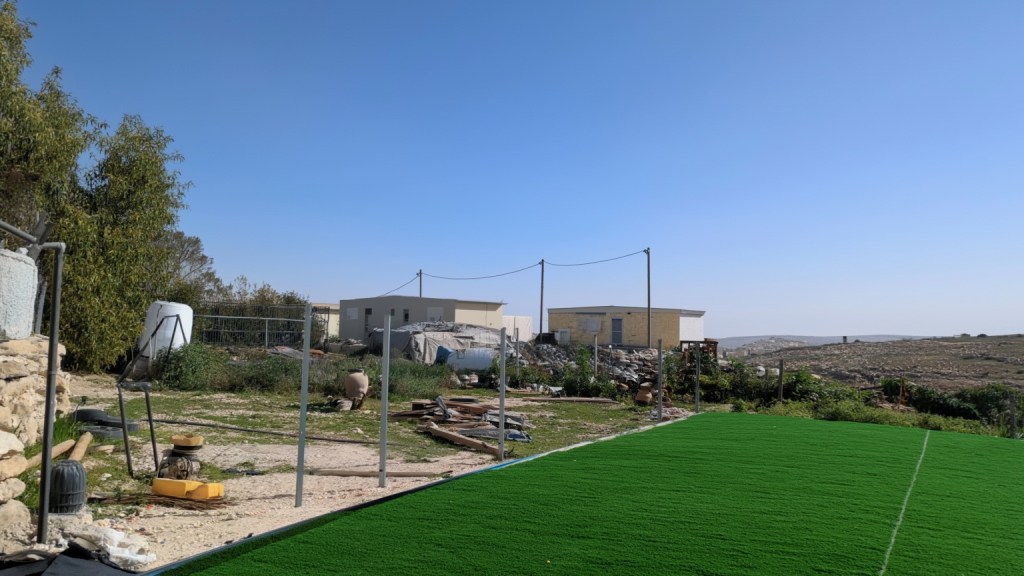
This Palestinian village has changed a great deal since I was last there. No more open views of the beautiful hills and Jordan Valley. Now, not only do they have the Carmel Israeli settlement on one side with their large-scale factory chicken farms, intimidation and countless demolition orders on a village that by far predates the illegal settlement, but there are new portacabins with Israeli families living in them on the village land. The settlers have built a road, planted Israeli flags and stopped the villagers from reaching their grazing grounds for their sheep and their greenhouses. They are hemmed in on every side and their village divided in two.
Two weeks ago, they laid Astroturf on a flat bit of land to create a small football field, and immediately the settlers complained that it affected settlement security and development. The army were called twice and twice the settlers were asked to desist and to take down their flags. The settlers replaced their flags and refused to desist. They are the law and the soldiers obey them. We doubt the football pitch or even that part of the village will survive for much longer and, we have since learned that this piece of astroturf now has a demolition order on it.
On another occasion we met Dalia from the Balasan Initiative.
The controversial aspect of what she had to say, which is central to the rights of Palestinians, is that small victories over land ownership, whether in Al-Makhrour or the Tent of Nations, both of whom claim that their victories are for all Palestinians, are not real. Overall, it does not help most Palestinians and are only short-term gains.
“There’s a difference between rule of law and ruled by law. Israel is not a place for the rule of law. It’s a place ruled by law, which means you use the law, you shape it in whatever way you want to get where you want.” Israel plays the long game, which is speeding up.
The word ‘peace’ has been dropped in favour of ‘liberation’
Combatants for Peace is an Israeli organisation run jointly by Israelis and Palestinians.We met two of them. It was fascinating to hear the quite different individual experiences of the two women who work closely together for the same cause. They told us about the trauma of both Israeli Jews and Palestinians after 7 Oct 2023. The West Bank was locked down for two months and they had not been able to meet. They discovered that the media was reporting entirely different perspectives in Israel and the West Bank and it has taken a while for them to get a better perspective that they can share. Haaretz, the Israeli newspaper and +972 magazine, have been good sources.
There has been no independent examination of what happened on 7 Oct and demanding one is an ongoing struggle. They had thought Israel would start with negotiations to free hostages before the bombardment. Israeli mainstream media fuelled and still fuels the sentiment of hatred and that was not to be. There was some reaction to the starvation in Gaza, but that was quickly countered by a defence mechanism that denied it.
The organisation has stopped using the word ‘peace’ and now says it is working for ‘collective liberation’. Meaning that both Israelis and Palestinians need to be liberated from their trauma. The group does not work in Area A under supposed full Palestinian control, as Israelis are not allowed in those areas, so they act in Area C of the West Bank, which all can enter legally and which is under full Israeli control.
Before leaving Israel, we travelled to Ibelin where we met Mar Elias Chacour. He is 88 and very frail. The recordings I made are difficult to hear, but he was inspiring nonetheless and was clear that the conflict is not between Christians and Muslims but entirely to do with the behaviour of Israel. He wept over the children of Gaza – we were all born babies, he said, not Christian, Muslim or Jew. Christians and Muslims must work together, he said. He told us how Israeli funding for his school had reduced still further, but that they must keep going and are producing exceptionally good academic results.
Let us have much more than condemnatory words, Great Britain!
During our stay in Palestine and Israel there were raids on Jenin, Hebron and even Bethlehem. Each day, more raids, more arrests and more land grabs. The Palestinians live in perpetual fear, do not sleep and have a huge increase in heart attacks and illness caused by stress.
Perhaps the greatest realisation for Palestinians is that there is no rule of law in the West Bank. Even on the occasions that they are successful in Israeli courts, settlers can come, dispossess people and destroy property and the court decisions count for nothing at all. Israel’s soldiers largely support and protect the settlers, who have almost total impunity. Israel expresses concern about their behaviour from time to time, but the army is either powerless to prevent their worst excesses or instructed not to.
Israel will continue to act with total impunity unless nations such as the United Kingdom stop just using condemnatory words but take real actions that impact Israel in a meaningful way.
The title of this account was a quote from Sister Maria, in Bethany, who said several controversial things including one that stopped us in our tracks. She said that Christians are responsible for the evil in the world, because we are not the Christians we were meant to be. When I think of some of those around the world who call themselves Christian, I am inclined to agree with her. I believe Christian Zionism to be particularly dangerous and unchristian as an example of that. Trump’s foreign policy is largely dictated by them.
The other frequently repeated feeling among those we met, was that, although they considered leaving for the sake of their children’s future, to leave would be a betrayal of their Palestinian roots. Every Israeli policy is about ‘encouraging’ them to leave. It is not about leaving voluntarily it is about forced displacement by making life for Palestinians unsustainable.
Miranda Pinch is a veteran Palestine activist, chronicler and researcher, based in Hampshire, in England, and is a longtime member of the Britain Palestine (formerly Balfour) Project’s Advisory Forum, and a contributor to its many different strands.