

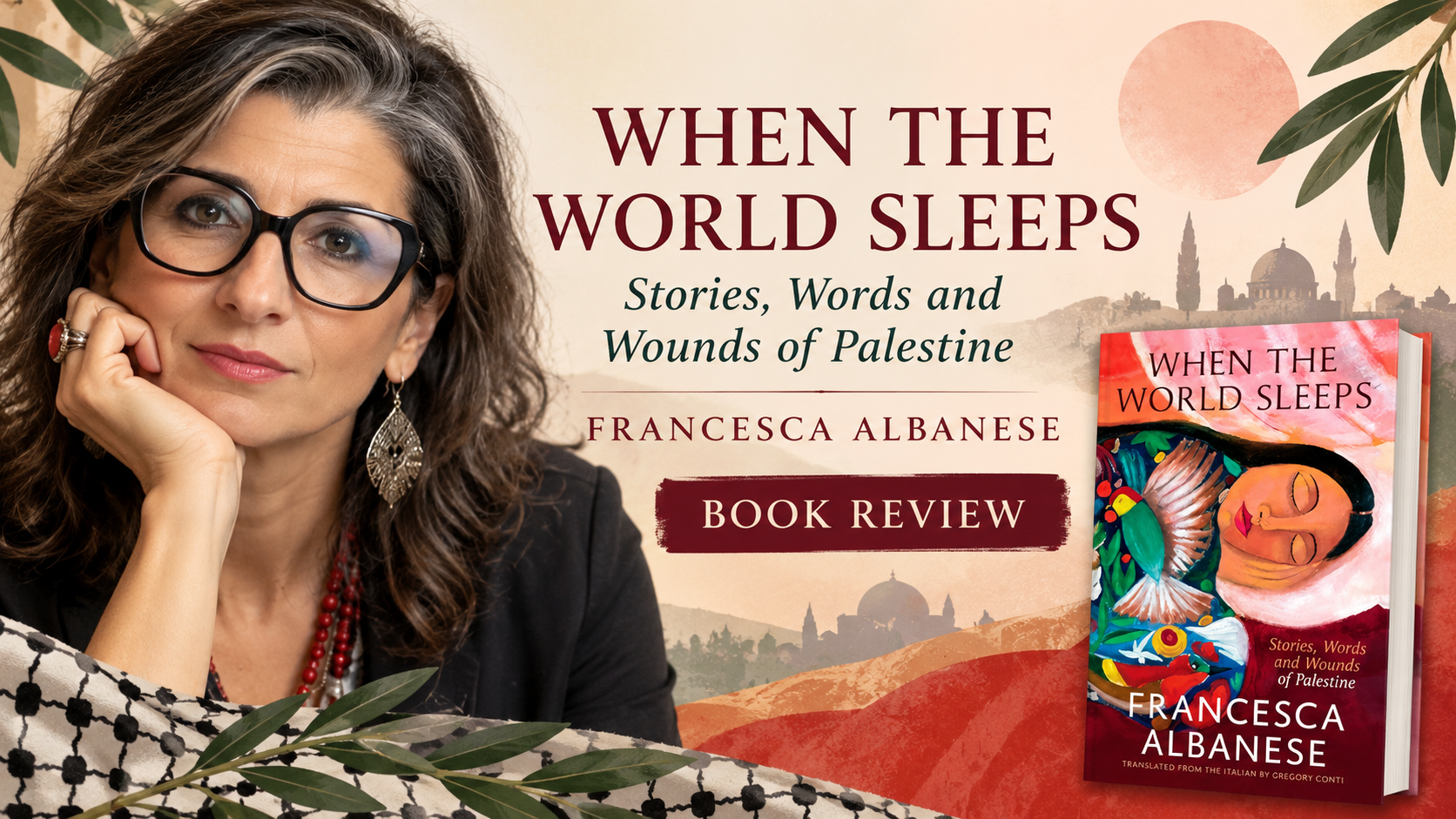
by Francesca Albanese
Hardie Grant Books
Review by Mike Scott-Baumann
This book, by the United Nations Special Rapporteur on the Occupied Palestinian Territory, consists of the personal stories of 10 people who have provided the author with a ‘constant source of inspiration’ and who have realised that ‘When the World Sleeps, it falls on us, the people, to wake it up’, above all to the genocide that has been carried out in Gaza over the last three years.
Many of the stories are ‘brutal, devastating and heart-wrenching’ but, as the author explains in her introduction, each offers a different lens through which to view the genocide and to enhance our understanding. Each story ‘presents the raw human experiences from which we might fashion an alternative, shared future for Israelis and Palestinians alike.’
Starting with Hind Rajab ‘who died at the age of six for the crime of being a Palestinian’, she goes on to remind us that 1,400 children were killed in the 15 years before 7 Oct 2023 and to explore what childhood means in Palestine. The author tells of children whom she has interviewed who are articulate and precise whether talking of the problems of water supply, their schools or of losing parents or homes. A 14-year old tells her that ‘being afraid of death doesn’t stop you from dying, it prevents you from living.’
Abu Hassan was guide to Albanese when she first arrived in Jerusalem. He opened her eyes to the ‘colonisation’ of the West Bank and to the brutal ‘carceral’ system that has imprisoned nearly a million Palestinians since 1967. This was to be the subject of her second report to the UN.
George, a Palestinian engineer, lived in the United States for 20 years before returning to Palestine. He explained what it meant to live in Jerusalem. He introduced Albanese and her husband to the cafes and bars of Jerusalem but also enabled her to learn what it means to look at the house you lived in but can never return to.
Alon is a genocide scholar and one of several Israeli academics who have defended the author against attacks from the pro-Israel lobby within the UN. He cogently explains why calling for the implementation of international law is not anti-Semitic and is convinced that ‘the liberation of the Palestinian people ….holds the key to the liberation of the Israelis themselves.’
Gabor is a quiet-spoken Canadian who, as a Jew of Hungarian origin, has experienced the effects of historical and personal trauma and recognises that Palestinians are now doing so too. This ‘is the eternal point of contact between Jews and Palestinians’, writes Albanese.
Just as the indigenous peoples of Gabor’s adopted homeland, Canada, have been deprived of the right to self-determination and are being prevented from preserving their collective and cultural memory, so the Palestinians face a similar threat. It is vital, he explains, to spread our understanding of what is happening to the Palestinian people because ‘knowledge is crucial and [collective] memory is indispensable.’
Ingrid, a Dutch woman who lived near Bethlehem until she died in 2024, is a ‘tireless and silent revolutionary’ who explained, at a conference the author attended, how the apartheid system applied to Palestine long before the acknowledgment became common currency. A co-founder of the BDS movement and of the BADIL Resource Centre (for Palestinian residency and refugee rights) in Ramallah, Ingrid did much, over many years, to ‘peel away layers of ignorance.’
The author is inspired by the bravery of Ghassan Abu Sitta, the surgeon who operated on thousands in Gaza yet was vilified for highlighting the complicity of western governments and media which made genocide possible.
Eyal, the forensic scientist has, over many years, analysed and revealed the physical infrastructure – or roads, settlements, walls – that has been imposed on Palestinians in the Occupied Territories and has concluded that the Gaza Strip is ‘nothing more than the result of an engineering effort aimed at destroying the living conditions within it …..forcing the population to leave’. He fears that, under Trump’s Board of Peace, ‘reconstruction would not be a remedy for destruction but rather its continuation: it would be used to complete what the genocide failed to accomplish’.
The author first met Malak when, as an 11-year-old, she was exhibiting her painting in her Gaza school. Like many Gazans, she has managed to ‘preserve that love of life that shines through’ in her every word. One of her paintings illustrates the book cover and inspired the book’s title, ‘When the World Sleeps’. As an art student years later, Malak was enjoined by her father ‘to paint our lives, our struggle ….you are our voice.’ She has recently produced a monumental work, ‘the Guernica of Gaza’. Its real title is ‘No Words’.
Lastly, the author tells the reader of Max, her ‘life partner’ and the ever-supportive father of her two children, with whom she has shared time in Jerusalem, as well as other cities, and who has himself carried out research, on the West Bank economy, for the World Bank.
All the stories are of people Albanese has known and befriended. Through these personal stories she is able to further develop and explain her own views about the need for rigorous investigation, judging facts against the law, and speaking truth to power ‘even when it is inconvenient’. All of these are qualities which, in the eyes of many in the international community, the author has exemplified in her work as UN Rapporteur.
She pulls few punches when writing of the West’s complicity in the ongoing genocide in Gaza and ethnic cleansing in the West Bank and is clear on policies which the international community could and should be implementing. Above all, she highlights the fact that ‘for too long the Palestinian issue has been reduced to a humanitarian crisis, instead of being dealt with as a political issue to be resolved in accordance with international law’.
Albanese is honest, brave, forthright and passionate, and the lives of these 10 people exemplify, for the author, why ‘unity and courage are the most powerful forces for change …… Standing together with courage, even against entrenched power, makes change not only possible but inevitable.”
Mike Scott-Baumann is an educationist and trustee of the Britain Palestine Project.