

By Miranda Pinch
16 Oct 2026
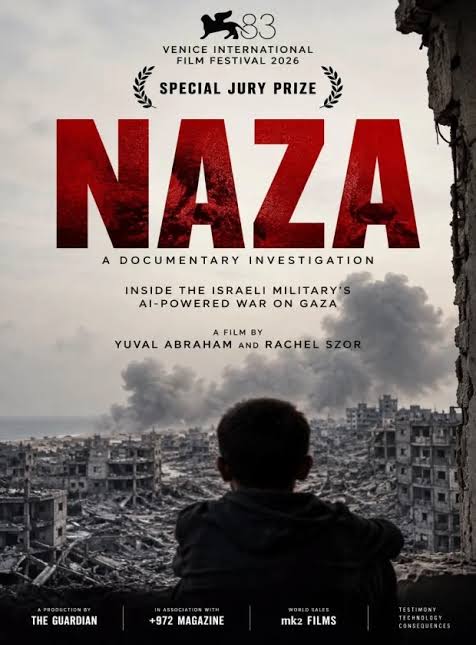
I had already read several reviews of Naza before seeing it. I was doubtful that I would have anything new to say or indeed that I would learn anything new. But having the information condensed in that way and hearing it as it was filmed and recorded in Tel Aviv from members of the Israel Defence Forces themselves gave the information a new credibility thus making it all the more difficult to ignore.
Naza is Israeli shorthand for collateral damage. It represents the number of innocents that Israel can kill, in the Israeli armed forces’ judgment, when aiming for one suspect. A baby is one Naza, while a family or a tower block full of people could number 50 or even 200 Naza. The rule of thumb changed early on in the post-7 Oct 2023 Gaza invasion from 15 deaths as acceptable, to 20, and then to ‘anything goes’. At one stage, the Israeli military agreed that if 75 per cent of occupants had been evacuated from a tower block or neighbourhood, then the area could be destroyed with the remaining 25 per cent still inside, whatever that number of Naza might be.
My first thoughts as the film began were about the callous and stark nature of the reporting. We tend to think of the operatives of remote weapons as totally divorced from their victims, which is just a numbers game, and that is true of many of them. But the opposite is also true. Israel controls mobile phone and internet access across Gaza. Members of the IDF can listen in not just to phone calls but to the ordinary lives of individuals, families and neighbourhoods via those mobile phones, which act, in effect, as spying equipment.
For example, there is the tracking and targeting procedure known as ‘Where’s Daddy?’, which is formally codenamed ‘Lavender’.. The Israeli operative monitors a family and listens to children asking when their Daddy will come home so that that operative knows when the primary target is in their home and most easily killed. Sometimes it does not work well because the family is killed and the target has not returned or has gone out again. That is unfortunate, but acceptable, according to the Israel authorities—just one of those things; but they will kill the target himself eventually, so that is OK.
The murder of anyone in any way associated with Hamas, however indirectly, including a local baker serving bread or an extended family, is fine under this system.
What struck me was not merely the hypocrisy of Israel but the utter hypocrisy of all those countries, including the United Kingdom, that have supported Israel. If everyone with any connection with Hamas, however tenuous or innocent, is fair game, then is not every family in Israel equally fair game as part of Israel’s occupying forces?
Why were the Israelis allowed to get away with such flagrant violations of every human right, while Palestinians are not allowed to resist at all? It was repeated a number of times throughout the film that the Palestinians were unarmed.
The IDF routinely destroys any buildings or structures remaining after evacuation and bombing. It is domicide for the sake of it. One interviewee referred to the destruction of a civilisation and of setting whole neighbourhoods on fire, to erase history. Clearly, for them, it had nothing to do with security or danger.
Throughout the film we hear these testimonies from rooftops overlooking Tel Aviv. The cameras sweep over opulence and TV sets blaring Israeli propaganda from almost every apartment. It is in stark contrast to what is being done to Gaza and is meant to be.
We are told that Gaza is zoned in a very arbitrary way: any Palestinian that crossed an arbitrary, unannounced line could be shot. That included Palestinians desperate for food who strayed from the narrow-designated path. Such slaughter was perfectly acceptable. If Palestinians did not evacuate or move or stick to arbitrary lines or rules they were fair game.
One soldier mentioned the vast numbers of bodies everywhere and how they just added to them and even watched starving dogs eat them.
Another soldier added something I had not realised before but is obvious in hindsight: that all Palestinian diplomatic activity was seen as a security threat and treated that way. So, there was nothing the Palestinians could do except be butchered. That is another grave indictment of the other nations looking on as this massacre of innocents unfolded. The Palestinians were and are entirely helpless and the world just observed and tut tutted and did nothing.
Now the world is sitting up a little and beginning to take action. As in the aftermath of the Holocaust, people will ask themselves why it took so long and why so many innocents had to die.
When asked, one soldier said that yes, it was genocide. No doubt about that. Another admitted that their behaviour was no better than that of the Nazis.
Well before her death in 2008, my mother, a refugee from the Holocaust in 1938, described Israeli behaviour towards Palestinians as like that of the Nazis.
I wonder how she would describe it now?
Miranda Pinch, who has worked with the Balfour/Britain Palestine Project for more than 10 years, and is the daughter of a Jewish refugee from the Nazis, spent three months in Hebron in the West Bank in 2009 with The Ecumenical Accompaniment Programme in Palestine and Israel. She has returned almost every year since. In 2017 she produced a full length documentary entitled From Balfour to Banksy www.balfourtobanksy.com
. Ms Pinch is on the Executive of the Liberal Democrat Friends of Palestine.