

Rescuing Balfour: Winston Churchill at the Colonial Office 1921-22, By William Mathew

                    Given the sheer improbability of the Balfour Declaration, its source in temporary war-time contingencies, its activation of inter-communal conflict in Palestine, and its exposure to increasing opposition both at home and in the Levant, the 1917 War Cabinet pledge to Zionism was in manifest danger of collapse in the early 1920s in advance of…
Read more

Struggling to Maintain the Mandate’s Iron Cage, 1930 – 1947 by Peter Shambrook

Peter A. Shambrook presents the history of the British Mandate for Palestine in the period 1930-1947, highlighting its very negative outcomes for the Palestinian population. In doing so, Shambrook calls for Britain to accept responsibility for its past wrongdoings as a necessary pre-requisite to making any helpful contribution to the current Palestinian/Israeli deadlock. The British…

Read more

British policy and Arab Displacement in Palestine, 1915-23: Contingency. Imperialism and Double-Dealing

            By  William M. Mathew, Senior Fellow in History, University of East Anglia Lecture given as part of the Contemporary Middle East Lecture Programme,               School of Oriental and African Studies, 28 October 2014                                                      I I should begin by briefly explaining the three-part title: “Contingency, Imperialism, and Double-Dealing” – these bearing on the one…

Read more

Perfidious Albion: Britain’s broken promises: the Balfour Declaration (1917) and its impact on the Israeli/Palestinian conflict: what are our responsibilities today?

This lecture was given by Professor Mary Grey in the URC Church, Crondall, Northumberland for their Peace and Reconciliation centre, 5th September 2014 Here in Northumberland, it is impossible to forget the bloodshed of the Battle of Flodden in 1513, not to mention centuries of border raids, preceded by Viking invasions and so on. In…

Read more

The Balfour Declaration – Key players and events by Mary Grey

Introduction – what motivated the Balfour Declaration?  (Powerpoint of Key Players) There is still conflict as to which motive for the Balfour Declaration is stronger – there are at least three motives, and some may interlock: 1. According to Avi Shlaim, there are two main schools of thought: He cites Leonard Stein’s[2] conclusion is that…

Read more

Contradictory Promises

See also Contradictory Promises by Dr Peter Shambrook where these promises are explored in more detail. 1915  The McMahon-Hussein Correspondence, • In 1915 Britain promised the Arabs that after the war they would be granted independence in their lands, in exchange for joining a wartime alliance against the Turks. 1917 The Balfour Declaration, • This…

Read more

Britain’s Secret Reassessment of the Balfour Declaration. The Perfidy of Albion, by John Quigley

John Quigley President’s Club Professor in Law, Moritz College of Law, The Ohio State University, Columbus, OH, United States of America From the Journal of the History of International Law Revue d’histoire du droit international Volume 13, Number 2, 2011 Reproduced here by kind permission of the author and  Koninklijke Brill NV,  the publishers The…

Read more

Powerful symbols and the British-Zionist alliance: approaching the centenary of the Balfour Declaration by Nur Masalha

  Masalha writes that as the centenary of the Balfour Declaration approaches it is timely for a reassessment of the impact of the statement and British policies towards Palestine and its indigenous people. The Declaration is commonly attributed incorrectly to military needs such as protection of the Suez Canal, getting America into the war etc.…

Read more

Wartime contingency and the Balfour Declaration of 1917 William Mathew: an Improbable Regression

Review by Mary Grey Although for many Jews this Declaration represented a dramatic re-entry of Jews into history, this article argues that it was more a regression than an advance. True, the  Balfour Declaration promised to protect the  civil and religious rights of the Arab population, but not the political – despite certain remarks made…

Read more

The Balfour Declaration and the Palestine Mandate, 1917–1923: British Imperialist Imperatives

By William M. Mathew ABSTRACT The article sets the Balfour Declaration of 1917 and the final confirmation of Britain’s Palestine Mandate in 1923 within the context of national imperial concerns: in particular, anxieties over the security of the Suez Canal and the country’s sea-route to its economic and military power-base in India. In 1917 strategic…

Read more

Balfour and Palestine, a legacy of deceit, by Anthony Nutting

Anthony Nutting resigned  from Anthony Eden’s government when he found Eden was going into Suez. Writing around 1975, he reflects on Doreen Ingram’s book “The Palestine Papers: 1917-1922: Seeds of Conflict”. The papers in this book made clear that during and after the First World War British Government ministers and officials had intentionally rather than…

Read more

British White Paper of June 1922

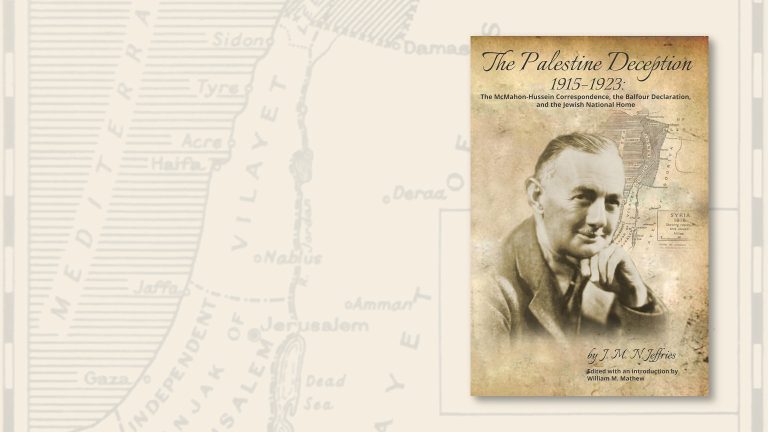
Below is the White Paper but also read: Rescuing Balfour: Winston Churchill at the Colonial Office   1921-22  Dr William Mathew shows in this essay how Winston Churchill,.. played a vital role in securing the British government`s long-term commitment to the terms of the Balfour Declaration of November 1917. Joseph Jeffries and the ‘Palestine Deception’, 1923…

Read more

British White Paper of 1939

In the statement on Palestine, issued on 9 November, 1938, His Majesty’s Government announced their intention to invite representatives of the Arabs of Palestine, of certain neighbouring countries and of the Jewish Agency to confer with them in London regarding future policy. It was their sincere hope that, as a result of full, free and…

Read more