

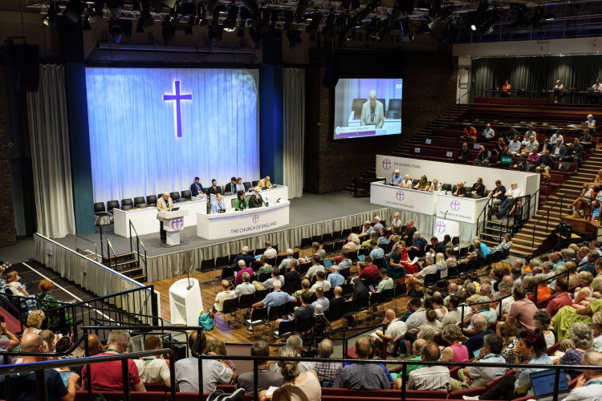
Final text of the Church of England General Synod motion
‘That this Synod respond to the call of Palestinian Christians to stand in solidarity with them and their fellow Palestinians in non-violent resistance to the ongoing occupation. We lament the loss of Israeli and Palestinian lives and the violations of human dignity and rights on both sides, as well as the displacement of population. We commit to a better understanding of the situation in Israel and the occupied Palestinian territory, seeking peace and security for all the peoples of those lands and pursuing that which leads to the establishment of a just and lasting peace.
In particular, we:
- reject antisemitism, anti-Muslim hostility and all forms of prejudice based on religious affiliation and ethnicity;
- acknowledge with repentance the Church’s historic contribution to antisemitism and to the situation now affecting the Palestinian people, reaffirm our commitment to inter-faith dialogue, including Christian-Jewish dialogue and encourage a deeper understanding of Judaism and other faiths;
- pray for all victims of the current conflicts in Israel and the occupied Palestinian territory and for a lasting peace;
- hear the Kairos Palestine Declaration (2009), the Cry for Hope (2020), the Call for Repentance (2023) and Kairos Palestine II (2025) as heartfelt expressions of the lived experience of Palestinian Christians and:
- encourage the Church of England at all levels to engage with those documents as part of a quest for greater understanding of the situation;
- ask the Faith and Public Life Division to commend resources that enable Dioceses and local churches to promote a full understanding of the situation and to respond through prayer, theological study, advocacy and practical support for the work undertaken by the Episcopal Diocese of Jerusalem and other Churches in the service of the people of Israel and the occupied Palestinian territory;
- encourage the Church of England at all levels to engage with those documents as part of a quest for greater understanding of the situation, alongside continued dialogue with Jewish and Muslim voices in the pursuit of justice, equality, peace and reconciliation;
- call on Church investors to implement and demonstrate a leading approach to responsible investment relating to the Occupied Palestinian Territory, and:
- to review their investment policies in the light of the International Court of Justice Advisory Opinion of 19 July 2024 on the illegality of the occupation of Palestinian territory;
- to request the Church Commissioners and Church of England Pensions Board to report back, on a triennium basis, on the progress and success of their approaches;
- the bodies named above to support the EIAG to develop guidance for wider Church of England investors on how to manage human rights risks relating to occupied territories and conflict.
- ask His Majesty’s Government to work urgently for a lasting peace in Israel and the occupied Palestinian territory, that will ensure safety and security for all parties and the upholding of the rights and inherent dignity of all people.’
Voting:
The motion was carried in all three houses as follows
Bishops: for 25; against 0; abstentions 5
Clergy: for 115; against 20; abstentions 30
Laity: for 113; against 27; abstentions 35
Church of England votes to support Palestinians
An edited version of the 13 July article by the Jewish Voice for Liberation
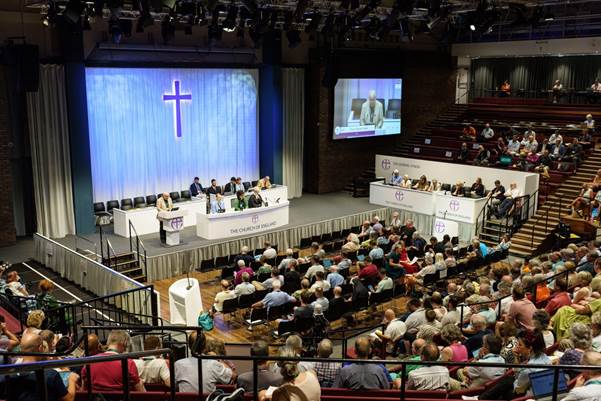
York University. July 10 2026. General Synod. The Archbishop of York gives the opening speech. (Credit: Bridget Catterall/Alamy Live News)
The Church of England’s General Synod has today, July 13, resisted the pressure from the United Kingdom’s Chief Rabbi and others from the Jewish Establishment who wanted them not even to debate the motion from Carlisle asking the Church to engage with the Kairos II document. They went ahead with the debate, which began on Sunday 12 July, and voted in favour of the motion.
While they changed the original “engage with” to “hear” the Palestinian plea, this marks an important rejection of pro-Israel pressure from such as the Board of Deputies of British Jews and the Chief Rabbi.
Archbishop Sarah Mullally returned from a visit to the West Bank in June. She spoke to open the debate on the motion on the Kairos II document at the 2026 Synod held in York. She said that Palestine is “disappearing” and called for a “new and active solidarity” for the peoples of the Holy Land. She also called for more action on antisemitism and Islamophobia, both of which are rising in the UK.
Archbishop Sarah Mullally plants an olive tree during her visit to the West Bank, June 2026 (Photo Andrea Krogmann, Lambeth Palace)
The document in question, Kairos Palestine – the Palestinian Christian Initiative. Faith in a Time of Genocide, was published in November 2025 and their introduction reads:
We, the Palestinian Christian Ecumenical Initiative, issued the Kairos Palestine Document in 2009 — “A word of faith, hope, and love from the heart of Palestinian suffering.” The Heads of Churches in Jerusalem heard this cry, welcomed it, and offered their support. Likewise, the document resonated widely, both locally and internationally. Then, as now, we gathered — women and men, clergy and laity — from across the different church families in Palestine. After prayer and reflection on the suffering of our people under occupation, we released that cry of hope in the absence of hope, affirming our faith in God and our love for our homeland, convinced that our struggle is ultimately about human life and dignity.
We live now in a time of genocide, ethnic cleansing and forced displacement unfolding before the eyes of the world. This moment — a moment of truth — demands from us a new stand unlike any before it. It is both a decisive moment and. Today, we renew our stand for truth and our commitment to fundamental religious, theological and moral principles. We look at our reality and take a renewed stand, responding to the voice of the Holy Spirit deep within us, listening to the call of faith in this time of genocide. We renew our message of faith, hope, and love — offering a faith-inspired vision for the time after genocide.
You can read the full document here.
That the Church of England would even debate this document was opposed by leaders of the British Jewish Establishment. As well as the Chief Rabbi’s warning, the Board of Deputies of (some) British Jews (BoD) “published a briefing for members of the General Synod of the Church of England setting out concerns relating to the Kairos II document.
The BoD briefing “warns of the negative impact of the Church engaging with the Kairos II document for British Jews and Jewish-Christian relations. It argues that the Kairos documents, especially Kairos II, spread a toxic narrative about Jews, and that their dissemination will do more to perpetuate conflict than make peace.
The Board recognises the motivations of Church members to express solidarity with Palestinians and hear their voices in the current devastating circumstances. The Board also condemns extremism and violence whether from Israelis or Palestinians and support all efforts to advance peace and security for both peoples.
…the briefing argues that the false and destructive claims made in Kairos II erase and distort Jewish faith, identity and historical experience.
The Board calls on the Church to hear, alongside the voices of Palestinians, the voices of Israelis and Jews in Britain and around the world, and to amplify voices of peace and reconciliation.”
The Kairos II document is not about Jews* and it is not blaming Jews for Palestinian suffering–but it does call out Israel for its acts of genocide, ethnic cleansing and for its apartheid policies and practice.
Kairos II refers to Jewish supremacy and seeks to distinguish not conflate Judaism and Zionism and recognises that there is Jewish and also Christian Zionism that is contributing to the desperate situation Palestinians face on a daily basis. It is, above all, a message for Churches of all denominations and it is critical of the reality that too often the Churches have “prioritised Jewish-Christian Interfaith dialogue over the truth, human dignity and life itself, ignoring the context”
They also note that: “Not every Jew is a Zionist and not every Zionist is a Jew. This confusion has done great harm to Judaism itself and to its image worldwide.” (JVL emph )
The motion did not even call for the Synod to endorse the Kairos II document but to engage with it but it was still unacceptable for those in the British Jewish Establishment who claim to care about the “current devastating circumstances” for Palestinians while rejecting wholesale this plea from the Christian community leaders in the Holy Land that expressed those “devasting circumstances” through a Palestinian (and Human Rights) lens.
There is much in the document that is powerful, moving and important about the experience of Palestinians in general and Palestinian Christians in particular. Here are some key extracts from the document with which we heartily agree regarding antisemitism, anti-Zionism, the role of non Zionist Jews and the importance of sanctions.
Section 3.8
“We condemn all who exploit and support the charge of antisemitism to silence the Palestinian voice of truth. We reject every attempt to conflate antisemitism with opposition to apartheid and with pressure to hold Israel accountable under international law — particularly through the use of definitions and documents designed to serve Zionist ideologies and interests under the guise of combating antisemitism. The misuse of the term antisemitism distorts and obscures the reality of genuine antisemitism which still exists in our world and which we strongly condemn alongside all forms of racism, exclusion and prejudice including Islamophobia. Zionist ideology claims to represent and protect the Jewish people, but in doing so it has conflated “Jew” and “Zionist” as though they were one and the same. Not every Jew is a Zionist and not every Zionist is a Jew. This confusion has done great harm to Judaism itself and to its image worldwide.”
Section 3.10
We repeat and emphasize our appeal to the churches of the world — working together with both religious and secular coalitions — to pressure their governments to isolate Israel, hold it accountable, impose sanctions, boycott it, and to ban the export of arms until it complies with international law, ends oppression and tyranny, and adheres to the principles of justice and peace. We likewise call upon the governments of the world: to press for the prosecution of war criminals whoever they may be under the jurisdiction of the International Court of Justice and the International Criminal Court; to ensure reparations for the Palestinian people, both in their homeland and in the diaspora; and to work for the immediate return of the displaced through the reconstruction of Gaza and the strengthening of its people’s steadfastness.
Section 3.11
More than ever, now is a time for costly solidarity. By its very nature, true solidarity is costly. It has a price. It is a faith-based stance, a human commitment and a moral responsibility. True solidarity is also the embodiment of our shared humanity and fraternity. Either we live together — or we perish together. Today it is Palestine. Tomorrow it will be other marginalized and oppressed peoples.
It also acknowledges the role that Jewish people have played in solidarity with Palestinians and calls for the churches to stand with us.
Section 3.12
In this spirit, we honour the growing number of Jewish voices that oppose the war and confront Zionism from moral, faith-based and human conviction. In them we find partners in our shared humanity and in the struggle for freedom and human dignity — partners also in religious and political dialogue. For too many years such dialogue was monopolized by Zionists and their allies, its premises built upon the reinforcement of Zionist ideology and the persecution of Palestinians. >We therefore call on the churches of the world to distinguish between dialogue with Jews and dialogue with Zionism — indeed, to boycott dialogue with Zionist voices that have supported and continue to support occupation, apartheid and the genocide of the Palestinian people. Instead, we call upon the churches to stand with and amplify prophetic Jewish voices that call for justice and truth.(JVL emphasis )