

Photo caption: Members of the Palestinian Higher Committee exiled by the British mandatory power in Palestine to the Seychelles islands in the Indian Ocean. From right to left: Dr. Hussein Al-Khalidi, Yaqoub Bey Al-Ghussein, Rashid Al-Haj Ibrahim, Ahmad Hilmi Pasha. Missing from the picture is Fouad Saba, the fifth member of the Committee – Photograph taken in the Seychelles in 1937 or 1938.
What 24 years of Palestinian politics taught me about Oslo, authority and the difference between government and power
2 Sept, 2026
In August 2002 I wrote that Yasser Arafat had to go. It was not an easy thing to argue. Arafat was more than the president of the Palestinian Authority; for a generation he had stood in for the Palestinian national movement itself, its exile and its partial return. But by then I had decided that the system built around him was authoritarian, corrupt and incapable of giving Palestinians the government they were owed.
So I argued for the ordinary things: elections, a working parliament, courts that meant something, an economy not run as patronage, and a leadership that could negotiate seriously while actually governing. I still believed a Palestinian state on something close to the 1967 lines was within reach. We had already made the large concession, accepting Israel on 78 per cent of historic Palestine and asking for real sovereignty over the remaining 22 per cent.
I believed then, and believe now, that Palestinians are entitled to govern themselves democratically, that no leader holds a permanent title to rule them, and that occupation is no excuse for corruption at home.
Reading that old piece again, I do not think its central concerns were misplaced. What I see now is that I had not yet followed them to their conclusion. I was asking hard questions about Palestinian government, but I still treated sovereignty as the destination that better government and successful negotiation would eventually reach. What I had not grasped was how thoroughly the institutions built during the Oslo years separated the practice of administration from the possession of sovereign power. Much of what I have written since has been an effort to think that distinction through.
From Ottoman rule, via the British Mandate to the Nakba and now…
There is also a more personal history behind these questions than I used to acknowledge.
In hard times I find myself returning to my roots, and to the faith earlier generations placed in the possibility of justice even when their circumstances gave them little reason for it. I draw both comfort and obligation from that inheritance. We inherit more than memories from those who came before us. We inherit their standards of public conduct, their unfinished arguments and unfulfilled hopes, and sometimes their warnings, whose meaning becomes clear only with time.
My family history reaches back many centuries, but three generations have particular meaning for me: my great-grandfather, Tewfik Bey Al-Ghussein; my grandfather, Yaqub Bey Al-Ghussein; and my father, Jaweed Al-Ghussein. Their lives spanned the final decades of Ottoman rule, the British Mandate, the Nakba, exile, the rise of the PLO and, eventually, the Palestinian Authority. Political ideas are not inherited intact from one generation to the next, nor should they be. But a tradition of public service, national commitment and insistence on political dignity can leave a durable mark. Their lives have shaped how I understand the relationship between institutions, legitimacy and power.
My great-grandfather, Tewfik Bey, was born in Ramla in 1867. Educated in Beirut, he entered the Ottoman civil service and served as kaimakam in Beersheba, Hebron, Tripoli and Jaffa, while also becoming a substantial landowner in the southern coastal district. His obituary in the Palestine Post in April 1938 described a man who maintained close friendships among the neighbouring Jewish rural population despite the growing political tensions of the period. It also recorded an older world of local continuity and civic standing, including the Ghussein family’s Ottoman right to carry the banner at the Nabi Salih procession in Ramla.
His son, my grandfather Yaqub, belonged to a very different political moment. After his early education in Ramla and Jerusalem, he continued his studies in İzmir in the late Ottoman period, where some accounts also connect him with the Committee of Union and Progress. Arabic was his first language, and family memory records that he was also fluent in Turkish and English, a background consistent with an education under the late Ottoman order and, later, long dealings with the British.
Yaqub emerged as a prominent figure in the Palestinian national movement during the Mandate, founding the Youth Congress Party and serving as president of the first National Congress of Arab Youth in Jaffa in 1932. He later served on the Supreme Muslim Council and represented his party on the Arab Higher Committee from its formation in 1936.
His political activity brought him directly into conflict with the British authorities. After the Arab Higher Committee was outlawed in September 1937, he was arrested and exiled to the Seychelles with other Palestinian leaders. He later returned to political life and joined the Palestinian delegation to the London Conference at St James’s Palace in 1939.
A Palestinian political class the British denied—one that negotiated and protested with real sophistication
As I have worked more deeply on the history of the Mandate, my grandfather’s experience has taken on a significance for me far beyond family biography. He belonged to a Palestinian political class that formed parties, petitioned, negotiated and protested with real sophistication, yet was denied sovereign authority over the institutions deciding the country’s future. Palestinians could make their case in Jerusalem, London or Geneva, but the final decisions were made elsewhere.
That is an early version of the problem I now describe as authority unresolved.
My father encountered that question in another form. Jaweed Al-Ghussein was born in Gaza in 1930 and, after 1948, became part of the Palestinian experience of displacement. He studied economics at the American University in Cairo, where he first knew Yasser Arafat, and later built a highly successful engineering and construction business in Abu Dhabi. Yet material success abroad never loosened his attachment to Palestine. He financed the education of young Palestinians, helped them find employment and believed deeply that a dispersed people needed institutions capable of preserving dignity, opportunity and national purpose.
He eventually became chairman of the Palestinian National Fund, the financial arm of the PLO, and served on the PLO Executive Committee. It was there that his relationship with Arafat deteriorated. When Iraq invaded Kuwait on 2 August 1990, my father was the first member of the PLO Executive Committee to denounce the invasion. His position was both principled and personal. Kuwait was home to a substantial Palestinian community and had, over many years, shown extraordinary generosity to Palestinians and to the Palestinian national movement. He could not accept Arafat’s support for Saddam Hussein at the very moment Kuwait, and the Palestinians who had built lives there, were facing invasion and occupation.
A stark example of going against Arafat and the PLO ‘system’—abduction by my compatriots
The rupture deepened as he became increasingly disturbed by the lack of transparency surrounding PLO finances. In 1996 he resigned publicly and called for accountability and transparency, positions that required considerable courage within the political culture of the time.
The consequences were severe. He was subjected to accusations that did not withstand scrutiny and, in 2000, while attending a wedding in Abu Dhabi, was abducted and taken to Gaza. Even after being permitted to travel to Cairo for cancer treatment, armed men entered his hospital room and returned him forcibly to Gaza.
The United Nations Working Group on Arbitrary Detention later examined the case and found his detention manifestly unjust. International pressure, including from Amnesty International, eventually helped secure his release. For me, the episode remains a stark example of the personal cost that can attach to demanding accountability from institutions one has helped to sustain.
So when I wrote against Arafat’s leadership in 2002, I did not do so as a distant observer of Palestinian political life. I had seen at close quarters what could happen when a national institution ceased to treat accountability as an obligation and began to regard criticism as betrayal. I did not criticise the movement out of indifference to it. I criticised it because a movement that claims to represent a people must hold itself to standards worthy of the claim.
The basic circumscription of Palestinians’ power to act effectively
That experience helps explain the reformist language of what I wrote then. My concern was with leadership, institutions and accountability because I had seen their failure personally. Yet, looking back, I can also see the limit of that focus. I was asking what Palestinian leaders had done with the powers they held before I had looked hard at how circumscribed those powers were to begin with.
I was not only a critic in 2002. I had declared my willingness to stand against Arafat, at the head of a committee for a free and democratic Palestine, because I believed a different kind of Palestinian leadership could help repair what had gone wrong.
That position reflected more than frustration. It reflected a serious belief in democratic accountability and in the possibility of political agency from within the system itself. What the following years taught me was how effectively an interim structure could perpetuate itself, and how little changing the people who administered it could alter the sovereign powers withheld from them.
In 2002 my complaint was that the Palestinian political structure was badly run. I now think the trouble went deeper.
The structure Palestinians were asked to govern within had been built so that administration could exist without sovereignty.
That is not a repudiation of what I believed then. It is where some of those beliefs led once I followed them far enough.
Oslo—the trappings of a government but the reality an entity without sovereignty or power
One line from that period has stayed with me. I accused Arafat of caring more about the trappings of power than its substance. I meant the presidential pomp, the titles, the performance of statehood standing in for accountable government. The charge was fair. But it was smaller than the thing it described.
The international system had produced something very similar, on a larger scale. Palestinians were handed most of the trappings of a state while the substance of sovereign power stayed elsewhere.
There were ministries but no control of the borders. A monetary authority but no currency of its own. Passports, and no frontier a passport-holder could cross without another government’s say-so. A police force that could not keep another state’s army out of the territory it policed. Powers of taxation, but a government dependent for much of its revenue on the clearance of funds that Israel collects on its behalf and can withhold. Elections held, without sovereignty over the ground on which they were held.
From the inside, the Palestinian Authority looked more and more like a government. From the outside it looked less and less like a sovereign one. The contradiction was visible early, but its full constitutional significance became clearer to me only over time.
Another phrase from that 2002 article matters more to me now than it did when I wrote it. I warned against exchanging occupation for a paper liberty. At the time I meant that sovereignty had to be substantive, control of borders, airspace, water, movement and economic life, and not merely the proclamation of a Palestinian state.
Looking back, the warning held more of my later argument than I understood. What Oslo produced was an elaborate administrative order in which many of the symbols of statehood could exist while the powers that give sovereignty its meaning lay in other hands. That was not independence in any ordinary sense of the word.
The assumptions of those early post-Oslo years now feel very far away. Like many Palestinians who hated how Oslo was being implemented, I still thought its failures could be corrected. The Authority could be democratised, corruption confronted, institutions strengthened, elections made to produce real leadership. With serious parties and enough outside pressure, negotiations could still reach a settlement. The occupation was the central injustice, but reforming Palestinian politics seemed a necessary part of ending it.
The PA cannot forever hide behind the crimes of the Israeli occupier
I was not wrong to want reform, and I still want it. Occupation does not release Palestinian leaders from their duties to their own people. A government that jails its critics, ignores its courts, rigs its elections or treats public institutions as private property cannot indefinitely hide behind the crimes of the occupier. Palestinian democracy mattered in 2002 and matters now, a right Palestinians owe themselves rather than a concession to outsiders.
What changed is my sense of what reform can achieve inside a structure whose decisive powers sit somewhere else. I once believed that reforming the Authority could help turn it into the foundation of sovereignty. I came to see that it had been constructed with limitations that left the essential attributes of sovereignty outside Palestinian hands, and that those supposedly interim limitations were then entrenched. That is a different kind of problem. A poorly governed sovereign state can be reformed into a better one. A well-governed dependency is still a dependency.
Oslo was meant to be temporary. That is so well known that it is easy to forget what it implies. The arrangements of the 1990s were supposed to last only through an interim period while negotiations settled borders, Jerusalem, refugees, settlements and sovereignty.
The interim never ended. Temporary administrative fixes hardened into institutions. Provisional lines on a map became a permanent political geography. Security coordination turned into a governing principle. Dependency became the normal condition. Settlements grew while the talks that were meant to decide the territory’s future went on and on.
The paradox at the centre of it is that Palestinian administration expanded exactly as Palestinian sovereignty shrank. That slowly changed the question I was asking. It was no longer enough to ask whether Palestinian institutions were democratic or efficient or honest; I started asking what powers they actually held. Who controlled the borders, the population registry, the crossing points a returning Palestinian had to pass through? Who collected the revenues the Authority lived on, and who could withhold them? Who could close a road, license an import, build a settlement or send soldiers into Area A at three in the morning to arrest someone without asking the government supposedly in charge there? Ask those questions steadily and the language of state-building starts to sound hollow.
Monetary authority: the shape of statehood, but none of the power
My recent essay Permission Is Not Sovereignty came straight out of this. Palestinian banks do most of their business in Israeli shekels, yet no Palestinian institution issues the currency and clearing and transferring it depends on mechanisms Israel controls. It looks like a technical, financial matter. Underneath it is the political structure. A monetary authority without monetary sovereignty is just one more institution with the shape of statehood and none of the power.
This is what I mean when I say Palestinians were given administration in place of sovereignty. Administration settles how daily life is run. Sovereignty settles who decides in the end. For Palestinians the first was on offer and the second never was.
This is where my view has shifted most. In 2002 I objected to how Arafat ran the Authority and wanted it run better. Now I question what the Authority has become inside the structure built around it.
It was sold as a bridge from occupation to independence. After more than 30 years, that claim is hard to sustain, because a bridge is meant to reach the other side. The Authority has become permanent while the state it was preparing for has slipped further out of reach. Israel holds the decisive coercive power. Settlements spread. The territory is cut into pieces. Jerusalem drifts further from the rest of Palestinian life. And still the Authority runs the schools, the hospitals, the salaries, the licences, the policing and the daily bureaucracy of the fragments left to it.
The big question is always: where does the real power sit?
The failure of sovereignty did not make the Palestinian Authority less necessary. In some ways it made it more necessary. The everyday work of government still had to be done, and Oslo handed most of that burden to Palestinians without handing over the sovereign authority that normally comes with it. What had been presented as the scaffolding of independence proved just as capable of becoming the apparatus that keeps an indefinite dependency running.
The result is a strange arrangement. Israel keeps ultimate power over the land while Palestinians increasingly administer the Palestinian population themselves. In Israel’s Palestinian Enforcer I put this more bluntly than I would have 20 years ago: security coordination has turned part of the Palestinian government into a mechanism that makes the occupation easier to manage. Israel does not need to run every detail of Palestinian life if a Palestinian institution will do it while the real decisions stay in Israeli hands.
That conclusion did not come from giving up on Palestinian democracy. It came from taking it seriously. A government is not democratic just because the people running it are Palestinian, and a ministry is not sovereign because its minister carries a Palestinian title. The question is always where the power actually sits.
This is the clearest change between then and now. In 2002 the thing I analysed was leadership. Arafat had failed. The institutions needed reform. The negotiators had to get better. Accountability had to replace patronage. I still think all of that is true. But I no longer think leadership is the whole story, because the structure decides what any leadership is able to do.
The decisive powers of sovereignty remain beyond Palestinian reach
If I had to reduce the change in my thinking to a single sentence, it would be this: in 2002 I was concentrating on the man before I had fully understood the machine he sat inside. Arafat’s failures were real, and confronting them was necessary, but replacing a leader cannot resolve a structure in which the decisive powers of sovereignty remain beyond Palestinian reach.
A Palestinian president can be competent or hopeless, democratic or authoritarian, honest or corrupt, and none of it changes who controls the external borders. A finance minister can keep flawless accounts and still have no fiscal sovereignty, because another government can hold back the clearance revenues whenever it likes. A police commander can have the uniforms and the vehicles and the headquarters and still command no sovereign force, because another army can drive into the same streets whenever it chooses.
So the problem is not really about personalities. It is constitutional, in the widest sense of the word. It is about who holds the final say. And that question eventually pushed me back past Oslo altogether.
The more closely I looked at how Palestinians are administered today, the more familiar it felt. My grandfather’s generation had already confronted a version of the same problem.
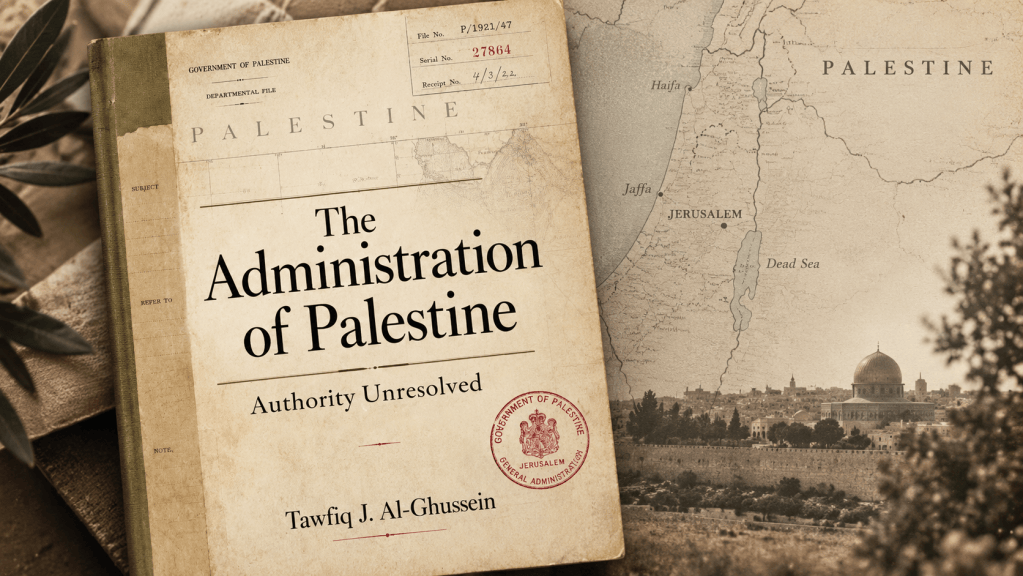
The argument I made in The Afterlife of the Mandate, and then at length in my book The Administration of Palestine: Authority Unresolved, is not that British rule and Israeli rule are the same. They are plainly not, and analogy is worthless when it flattens the differences. The continuity lies in the way Palestinian political agency has repeatedly been converted into administrative form.
Refugees: a claim that was documented but never resolved
Under the Mandate, Palestinians could petition, protest, file memoranda, establish political organisations and appeal to London and Geneva. My grandfather could sit on the Arab Higher Committee, participate in the Supreme Muslim Council, preside over a national youth congress and later join a Palestinian delegation negotiating in London.
Yet none of those roles gave Palestinians sovereign authority over the institutions deciding their country’s future. His exile to the Seychelles in 1937 made the imbalance brutally clear: the colonial administration not only determined the political framework, it possessed the power to remove Palestinian political leaders from Palestine itself.
Britain administered Palestine and, at the same time, decided which political claims would be recognised, which bodies would have legal standing and how rival claims to the land would be turned into policy.
After 1948 the same displacement took another form. The refugee question was political to its core, about dispossession, return, restitution, citizenship and national existence. But over the decades the machinery around it became humanitarian and administrative.
Food, schooling, health, registration and refugee status all had to be managed, and organisations such as the United Nations Relief and Works Agency (UNRWA) did work without which whole generations would have been abandoned. Yet none of that management could answer the political question that created the refugees in the first place. A claim could be documented forever without being resolved. The file stayed open and the right stayed unsettled.
The pattern returned after Oslo. Sovereignty became governance. Liberation became institution-building. Political representation became donor-approved reform. Occupation became, increasingly, a matter of coordination, and even resistance to it could be recast as a policing problem. The language changed each time, but the displacement of political agency endured.
Will the Palestinians ever acquire the final authority to decide their own political future?
That is the argument at the heart of the book. Palestine has never lacked administration; if anything it has had too much of it. Palestinians have been counted, registered, classified, documented, permitted, policed, represented, aided, negotiated over and reconstructed by one institution after another. The one thing left unresolved is whether Palestinians hold the final authority to decide their own political future. That is why I called the book Authority Unresolved.
There is one more shift I cannot leave out. Gaza has made it hard to keep writing in the diplomatic register that shaped so much of this discussion 20 years ago. The vocabulary of the peace process was always full of abstractions: confidence-building measures, security arrangements, final-status issues, transitional frameworks, viability, moderation, reform. Those words can name real problems. They can also launder relations of power. After the destruction of Gaza, the distance between that language and what it describes has become very hard to sit with.
Whole neighbourhoods can vanish while officials debate governance models. A population can be driven from its homes again and again while conferences discuss reconstruction. Palestinians can be killed and starved and imprisoned and dispossessed, and the international conversation still swings back, almost by reflex, to the question of who will administer them afterwards. Who will run Gaza, police it, distribute the aid, supervise the rebuilding, vet the institutions. The question that gets far less urgency is the one that ought to come first, which is what political rights the people of Gaza actually have.
I described this same movement, from political question to administrative problem, in The Afterlife of the Mandate. I no longer think it is politically neutral.
Administration can keep people alive, and it can also keep an intolerable political condition in place by making it manageable. There is a real difference between feeding a besieged population and ending the siege that makes the feeding necessary. Humanitarian relief is indispensable. It is not the same thing as liberation, and calling it liberation is how domination is made to last.
The particular menace of the E1 settlement—the fragmenting of Palestine
People sometimes read all this as a straightforward journey from two states to some other formula. I do not think that is what happened. My concern moved from the number of states to the kind of sovereignty a state would actually contain.
In 2002 a two-state deal on the 1967 lines looked, at least in principle, like it could deliver Palestinian self-determination. After decades of settlement growth, fragmentation and creeping annexation that has to face a much harder test. A Palestinian state that does not control its borders, its resources, its movement, its security or its own political direction is a state in name, and the name settles very little. And if Israel has made a real partition impossible, the answer cannot be that Palestinians are subordinated permanently instead.
The physical geography has changed as well. The argument about two states cannot be conducted as though the land for the second state had stayed frozen since the 1990s. The advance of the E1 settlement plan east of Jerusalem, pushed through in 2025 after being held off for three decades, is only one example.
Its significance lies less in the number of housing units than in what the corridor does politically, welding Ma’ale Adumim to Jerusalem, sealing East Jerusalem off from Ramallah and Bethlehem, and cutting the territorial continuity any viable Palestinian state would need. Territory can be altered long before annexation is ever declared. It can be administered out from under you.
So the principle has to come before the constitutional shape. Either Palestinians exercise genuine sovereignty in a viable state of their own, or the order between the river and the sea rests on full political and constitutional equality. The one thing that cannot stand as a permanent settlement is a system where one people holds sovereignty and the other is handed administration.
A political system cannot mature if elections are predestined to achieve an approved outcome
One more warning from that 2002 article I recall with less satisfaction. I wrote that Hamas was moving into the social vacuum a failing Authority had left behind, running schools and clinics and paying out to the poor where the government would not. Four years later Hamas won the 2006 legislative elections. What followed taught me something else about the order we had been encouraged to build. Palestinians were told that elections and democratic legitimacy were essential, and then, when an election produced a result the powerful found unacceptable, the democratic choice itself was treated as conditional. Whatever one thinks of Hamas, a political system cannot mature if elections are welcome only when they produce an approved outcome.
That is the argument I made in A People Cannot Be Put on Probation. Palestinian political rights cannot be made to wait on Palestinians first proving their moderation, or building perfect institutions, or passing some vague test of readiness for freedom.
No other people is asked to sit that exam before holding basic rights. Twenty-four years ago I put much more weight on showing that Palestinians could build the right kind of state. I am now far more suspicious of what that demand smuggles in. Palestinians should build democratic institutions because democracy is worth having.
They should refuse corruption because corruption is ruinous. They should hold elections because legitimacy rests on consent. They should protect civil liberties because they deserve freedom from their own governments as much as from a foreign one. None of that is an entrance exam for national freedom. A people does not earn self-determination by behaving well enough to satisfy its occupier.
For years Palestinians were handed a sequence of conditions. Build the institutions, reform the security services, hold the elections, satisfy the donors, show moderation, return to the table, and statehood would follow. Sometimes those tests were met badly and sometimes well, but sovereignty did not follow either way.
The conditions simply multiplied, until a transitional examination had quietly become permanent, and the strange assumption took hold that Palestinians had to behave like the citizens of a sovereign state before they could be permitted to have one.
It would be tempting to tell this as a conversion story. It would also be inaccurate. The evolution has been substantial, but so has the continuity.
Jewish Israelis will remain part of the reality of the land
In 2002 I believed Palestinians held political rights that did not begin with Oslo, and I still do. I believed the leadership owed accountability to Palestinians and had no right to treat the national movement as private property.
I believed Palestinians were entitled to real control over their land, borders, resources and future. I believed Jewish Israelis would remain part of the reality of the land, and that Palestinian liberation could not mean simply reversing domination and imposing it on someone else. And I believed peace would require political courage on both sides. Those convictions have not weakened. If anything, the years since have made clearer to me what would be required to make them meaningful.
Those convictions are also bound up with inheritance. I cannot look at the political history of Palestine without thinking of the generations of my own family who lived through successive systems of rule and responded to them in very different ways. My great-grandfather served an empire with distinction. My grandfather challenged a Mandate, built political institutions and was exiled for doing so. My father helped sustain a national movement, gave generously to Palestinian education and public life, and later paid dearly for demanding accountability from its leadership. None of them lived to see Palestinian sovereignty.
I carry their achievements, but also the disappointments they endured and the responsibilities they left behind. I am the beneficiary of their generosity, their courage, their imperfections and their accomplishments. Their example has never made me feel entitled to a place in that history. It has made me conscious of the standard against which public commitment ought to be measured, and hopeful that my own work may contribute, however modestly, to the questions they spent their lives confronting.
The symbols of power and power itself—the fundamental question for Palestinian rights
What changed in my own politics is my understanding of what has prevented the principles they believed in, and that I still believe in, from becoming real. I once placed most of my faith in reform and negotiation. I now place much greater emphasis on structures of power. Leadership still matters enormously, but the record has shown me how little even principled and competent leadership can achieve when the decisive powers remain embedded in a system somebody else controls.
Looking back, the question that runs through everything I have written was there earlier than I realised. In 2002 I was already worrying at the difference between the symbols of power and power itself. I thought I was writing about Arafat. Twenty-four years on it has become the organising question of nearly everything I write about Palestine.
What is an authority that cannot make the final decision? What is a border another state controls, or a citizenship that depends on another state’s population registry, or self-government where another army holds ultimate force? What is recognition without power behind it?
These are not word games. They describe the ordinary Palestinian experience of the last century. The British called their rule a Mandate. After 1948 much of the Palestinian question was folded into refugee administration and relief. Oslo spoke of interim self-government. The Authority took on the vocabulary and the furniture of a state. The diplomacy of the moment talks endlessly about reconstruction, governance and reform. The terminology keeps changing and the same question survives underneath it: who decides?
Perhaps that is the real distance between what I wrote in 2002 and what I write now. I was already troubled by the substitution of the appearance of power for power itself, but I still thought principally in terms of Palestinian leadership and Palestinian institutions. The years that followed, the entrenchment of Oslo’s supposedly temporary arrangements, the expansion of settlements, the deterioration of the Authority and, finally, the devastation of Gaza, did not erase that earlier argument. They forced me to widen it.
For more than a century Palestinians have repeatedly been governed through institutions whose authority stops precisely where sovereign power begins. That is why I no longer think the central task is simply to improve the institutions through which Palestinian dependency is administered. Those institutions should be democratic, accountable and competent, but they cannot be allowed to become substitutes for the political freedom they were supposedly created to achieve.
In 2002 I thought the urgent question was how Palestinians should govern themselves better. I still believe that matters, and I remain convinced that Palestinians deserve institutions that are democratic, accountable and worthy of their political aspirations. I have simply come to believe that another question must be answered alongside it: whether Palestinians will finally be able to exercise the sovereign power to govern themselves at all.
Tawfiq al-Ghussein is a writer and researcher on settler colonialism, religion and political violence. His book The Administration of Palestine, published by the Britain Palestine Project, is reviewed on our website by BPP Trustee Mike Scott-Baumann.