

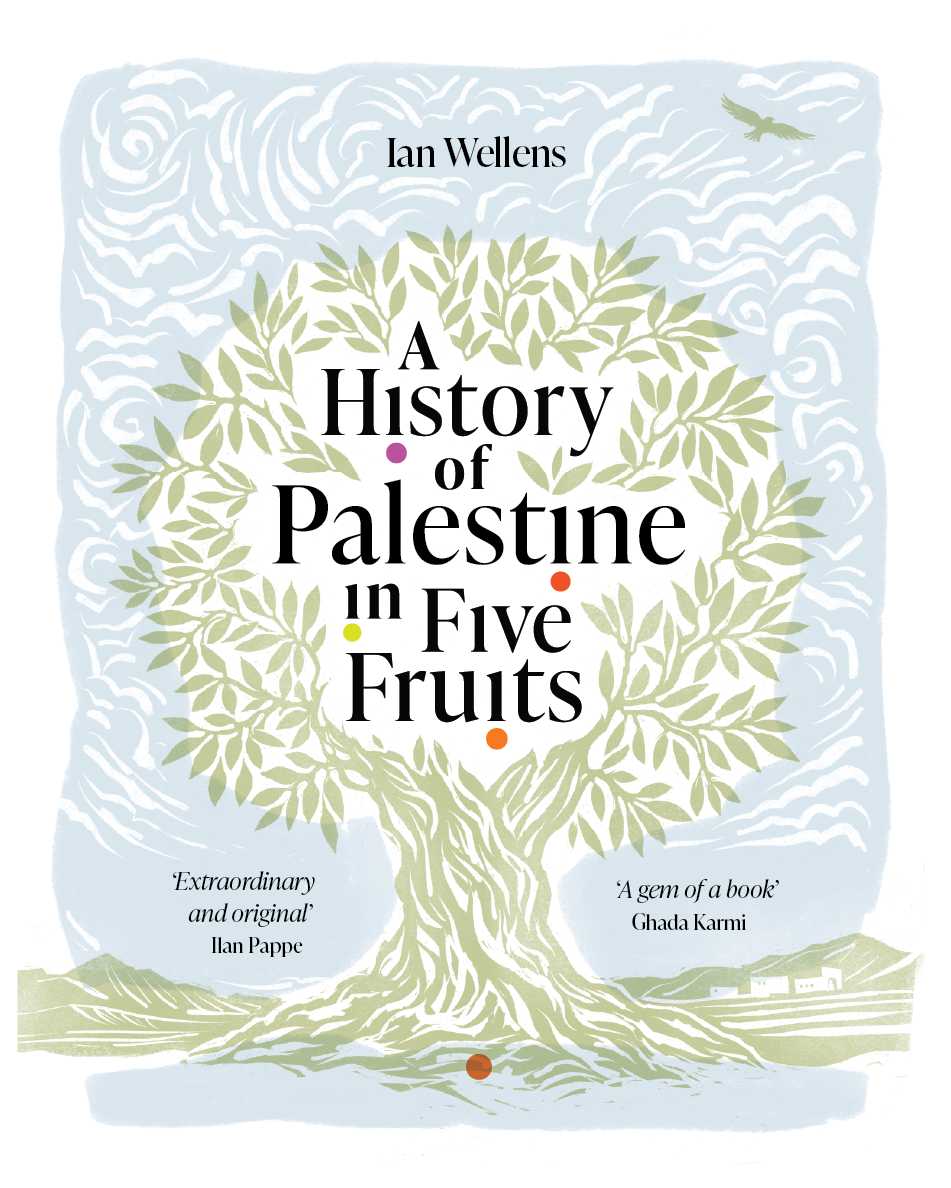
By Ian Wellens
Annea Press
Reviewed by SM
In Ian Wellens’s recently published A History of Palestine in Five Fruits, the land speaks for itself. Wellens presents five fruits as sources of Palestinian history, deriving from them a narrative which is rooted in place, grounded in historical fact and both succinctly and stylishly told. During a summer when Israeli settlers’ violent attempts to seize more of the West Bank have grown ever more brazen – and have prompted increased, albeit insufficient, international scrutiny – his unique approach feels particularly apt. Taking nature as his witness, he refocuses attention on the land and the enduring struggle of the Palestinian people to remain on, grow from and sustain it.
The locus of Wellens’s story is the Tree of Life mosaic found in Khirbat al Mafjar (Hisham’s Palace), an archaeological site in Jericho. This ancient art work, miraculously preserved and beautifully restored, depicts a fruit tree, a rich representation of rootedness and rejuvenation. Although the fruits this tree bears are not clearly identifiable, Wellens takes it as inspiration, and selects five fruits with “special symbolic importance” for Palestine: olives, dates, oranges, aubergines and the watermelon. Considering each in turn, he crosses a breadth of historical, political and cultural issues; ranging from the well-known importance of the olive harvest for Palestinian communities, to the reason to boycott Israeli-grown dates, to the poignant story of Yaffa’s (or Jaffa) oranges. What emerges is an account both poetic and substantial, and, taking testament from the seemingly ‘neutral’ natural world, irrefutable.
In the opening section of the book, Wellens, who is from and lives in Devon, in the West of England, explains that the book originated from a conversation with his 13-year-old grandson in the summer of 2024 about the ongoing genocide in Gaza, in which he sought to explain how the world got to that point. Taking that initial discussion as a basis, the book is very accessible and stunningly forthright. Reading it, you almost feel you are having a winding conversation on a long walk with a trusted – and very knowledgeable – friend, as each section opens with verse about the fruits before deftly entering into prose discussion of the political history.
It was a pleasant surprise that the fruit motif was not a way to make the account more abstract or palatable, or turn it into a metaphor, but instead made it all the more tangible and intimate. Indeed, there is a bit of glee in imagining someone picking up this book expecting it to be a gentle, pastoral read and finding Wellens’s incisive account. He says the book “tries to clarify a situation endlessly represented as complicated but which… [he] believe[s] to be quite simple”, and in this he certainly succeeds. Rarely have I read an account of Palestinian history written with so much clarity and so few caveats.
Through his focus on nature, Wellens cleaves quickly to the crux of the settler colonial practice which underpins the existence of Israel, and is refreshingly clear-cut in his discussion of the issue in these terms. As he writes, early “Zionists apparently wanted the land, but without the people”.
It is this framework that informed the violent creation of Israel and ongoing violence inherent in the maintenance and expansion of its state. In all of this, the land and people are targeted as one. The fruits are not just witnesses to this process, but are often weaponised as part of it. This is rarely more apparent than with the olive trees, which come under passive attack through the blockage of access or restriction of water to Palestinian farms, and direct attack as they are burned and hacked by settlers (often overseen and protected by the Israeli military.)
Olive trees not only have deep importance for Palestinian communities, their oil drizzled into ancestral recipes and their harvest season woven into the calendar, they are also a testament to the long memory of the land, some flourishing for millenia before colonial state borders were first drawn. As Wellens evocatively describes it, for Zionism to work, “[the olive trees] would have to go because they sustained the people… they would have to go because they were loved… but above all, they would have to go just because they were there first.”
The olives are an emblematic, but not singular, case of the land and what grows from it being targeted and harnessed by Israel against Palestinian inhabitants. As Wellens recounts, during the Nakba in 1948, Palestinian land was depopulated – its people forcibly displaced – on a massive scale. To literally cover this up, more than 500 villages were demolished and planted over with Northern European pines, a fast growing species which, being non-indigenous, did huge ecological damage. Swathes of other land were turned into nature reserves, giving a haunting undertone to the Israeli claim of ‘making the desert bloom’. Across the Jordan Valley, a dry area stretching the eastern side of Palestine, settlers took over Palestinian farms and used them for industrial date planting: “the dates replaced the people”. The scale and intensiveness of these farms, which did not employ the regenerative processes Palestinian fellahin farmers had used for centuries, are leading to the exhaustion and desertification of the earth. This is foundational to the international call to boycott Israeli dates and other produce grown on stolen (occupied) Palestinian land, as well as banning all trade with illegal Israeli settlements.
Yet, at the same time, the land is the root and site of Palestinians’ steadfastness, and its fruits totems of their struggle. As Wellens highlights, “what happened to Palestine was not some sort of natural disaster”, and the Palestinian people have resisted. They continue to tend to the land and grow from it, even when farmland is threatened by instrumentalised drought and armed settlement. Their cuisine draws on nature’s ingredients, from aubergines to pomegranates to figs, and connects them to the land and the diaspora to their home. These actions are, of course, aspects of everyday life continuing, but as Wellens reminds us, they are not merely quotidian. They actively maintain the oneness of the people and their land which Zionism seeks to prize apart.
Wellens elegantly and assertively contextualises this in his alternative history, borne witness to by the fruits which illustrate it; fruits rooted in the land for thousands of years and which will grow for years to come.