

By Tawfiq Al-Ghussein and Rania Hammad
Originally published in Arabic by Hayat, Washington
26 Aug 2026
A Letter on genocide
By Tawfiq Al-Ghussein and Rania Hammad
Originally published in Arabic by Hayat, Washington
26 Aug 2026
We Palestinians did not need belated reports to know where this road would lead. We have long known that when a people is stripped of its land, besieged, displaced and reduced to the cold language of security, their killing can eventually become justifiable in the eyes of those accustomed to seeing them as a problem rather than a people.
What is happening in Gaza today is not an isolated eruption detached from its history, but an intensified moment in a process that began decades ago, a process visible to anyone who wished to see it and audible to anyone willing to listen.
We knew. We knew it during the Nakba, when villages became names erased from maps, and refugees were required to prove their right to homes whose keys they still held in their hands. We knew it under occupation, at checkpoints, in prisons, in the confiscation of land, and in settlements expanding year after year while the world continued to repeat the vocabulary of the “peace process”. We knew it when rights became matters for negotiation, freedom became an item indefinitely postponed and sovereignty became a promise without a date.
The tragedy is not that the world did not know. The information was there, the facts were documented, and the testimonies were innumerable. The tragedy is that knowledge never became political will. Reports were issued, statements of concern followed one another, emergency sessions were convened and the language of international law was repeatedly invoked. Yet, the reality on the ground continued to move in one direction. Palestinians would hear an acknowledgement that their rights were being violated, only to see that same violation become still more deeply entrenched the following day.
Here lies the cruel paradox. When the instruments of documentation are stripped of any will to enforce their findings, they become an increasingly precise record of the world’s incapacity. A report followed by no accountability, a condemnation carrying no cost, and a resolution ignored without consequence may offer the victim verbal recognition, but they offer no protection. Delay itself becomes part of the crime, because every passing month allows another reality to be imposed, one that becomes progressively harder to reverse.
What should have remained unthinkable becomes open to discussion, justification
We knew that dehumanisation always precedes the stripping away of rights. When Palestinians are repeatedly presented as a demographic or security threat, their killing begins to carry less weight in the public imagination. When the lives of an entire people are compressed into a vocabulary of “deterrence”, “targets” and “collateral damage”, language ceases to describe the crime and begins instead to soften its impact. What should have remained unthinkable becomes, through repetition, open to discussion, and eventually open to justification.
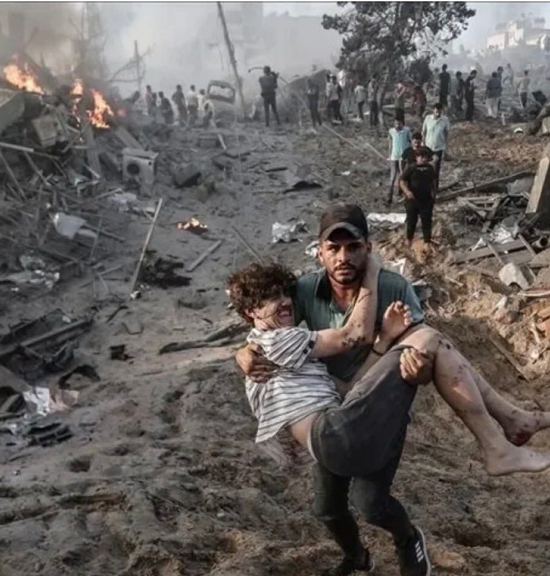
What has happened since October 2023 has exposed the limits of this system in a way that can no longer be concealed. Entire neighbourhoods have been destroyed. Hospitals, schools, universities and places of worship have been bombed. Journalists, doctors and humanitarian workers have been killed.
The population has been driven into hunger and repeated displacement. At every stage, the world was told to await more evidence, further investigation, or ever more precise legal formulations. But those dying under bombardment do not have the luxury of waiting for the language of institutions to reach completion. Even the announcement of a ceasefire in October 2025 did not bring this process to an end. Killing, bombing and displacement continued, as though the ceasefire itself had become yet another temporary arrangement for managing violence rather than ending it.
We also knew that belated recognition can become a form of belated absolution. When an international institution finally adopts a description that Palestinians and their human rights organisations have been using for years, it can appear as though the truth itself came into existence on the day that institution acknowledged it. But truth does not begin at the moment it is recognised in a Western capital. A victim did not become a victim when a report discovered them. They were a victim before the report, and the delay in believing them may itself have helped prolong what was being done to them.
Moral rhetoric: a curtain behind which the same reality continues
That is why this is not fundamentally a dispute over terminology. The question is not when the world chooses to use the word “apartheid”, nor when it concludes that a crime amounts to genocide, nor when the language of governments moves from “concern” to “grave concern”. The real question is what happens after the words. Do the weapons stop? Are sanctions imposed? Are civilians protected? Is a state that behaves as though impunity were an acquired right ever held accountable? If none of this happens, moral rhetoric becomes a curtain behind which the same reality continues.
International law has been tested repeatedly in Palestine, and it is no exaggeration to say that Palestine has become one of the clearest tests of the credibility of an order that claims to be rules based.
If rules are applied to the weak but suspended when they confront the powerful and their allies, then the problem is no longer the violation of one particular rule. It is the meaning of the entire system. When millions watch a crime being documented moment by moment, while institutions remain incapable of stopping it, the loss is not borne by Palestinians alone. The very idea of law is diminished.
Yet none of this is an argument for despair. Quite the opposite. The expansion of popular solidarity across the world, the protests, the positions taken by students, trade unions, writers and artists and the mounting pressure on governments all demonstrate that the old monopoly over the narrative is no longer possible. A widening gulf has emerged between what people can see and what their governments are willing to do. If that gulf is converted into sustained and organised political pressure it can become an instrument for breaking the cycle of impunity.
Silence serves the party that changes reality through force
Solidarity, however, is not enough if it remains symbolic. The scale of what has happened demands a transition from the language of sympathy to the language of measures. What is required is not another statement couched in stronger terms, but policies capable of stopping the crime and preventing its repetition: an end to military support that enables the killing to continue, the activation of sanctions and mechanisms of accountability, the protection of civilians and the enforcement of international law rather than its treatment as a diplomatic option that may be discarded when its political cost becomes inconvenient.
We knew that silence is not neutrality. When the balance of power is this unequal, silence serves the party capable of changing reality through force.
Perhaps the most dangerous development of the past decades has been the world’s willingness to allow the temporary to become permanent: temporary occupation, temporary negotiations, temporary security arrangements, temporary restrictions. Over time, the temporary became the very structure of life, while Palestinians continued to be required to prove that they were worthy of their natural right to freedom.
Gaza today is not merely a Palestinian question. It is a question about the limits of what human beings can witness before continuing with their lives as though nothing has happened. It is a question about the value of treaties when they cannot protect those being killed, about the value of courts when their rulings can be ignored and about the value of journalism when the wording of a headline itself becomes part of the struggle to obscure responsibility. Above all, it is a question about what it means to know.
Palestinians have known for a long time. They said that dispossession does not end at the moment of expulsion, that occupation does not impose limits upon itself and that impunity invites more impunity. They said that settlement was not a property venture but a project of sovereignty, and that blockade was not a security measure but a means of reshaping the life of an entire society. They were told they were exaggerating, that their warnings were too strident, and that a solution would come “later”. Then “later” arrived in the form of catastrophe.
Today, no one can plausibly claim that they did not know. The images exist. The testimonies exist. The hunger is visible. The destruction is visible. Language inciting erasure has been spoken openly. The problem is no longer a lack of information, but the moral and political decision about what is to be done with what we know.
And so the heaviest words remain: we knew. But they are no longer addressed to Palestinians alone. You know now, too. And the question that will remain after every report, every photograph, every funeral, and every city reduced to rubble will not be what the world knew, but what it did once it knew.
Tawfiq al-Ghussein is a London-based writer and researcher on international law, geopolitical strategy, settler colonialism and Middle East politics. Rania Hammad is vice-president of the National Association Italia-Palestine and spokesperson of the Palestinian community of Rome and Lazio.