By Brian Brivati, Executive Director
7 July 2026
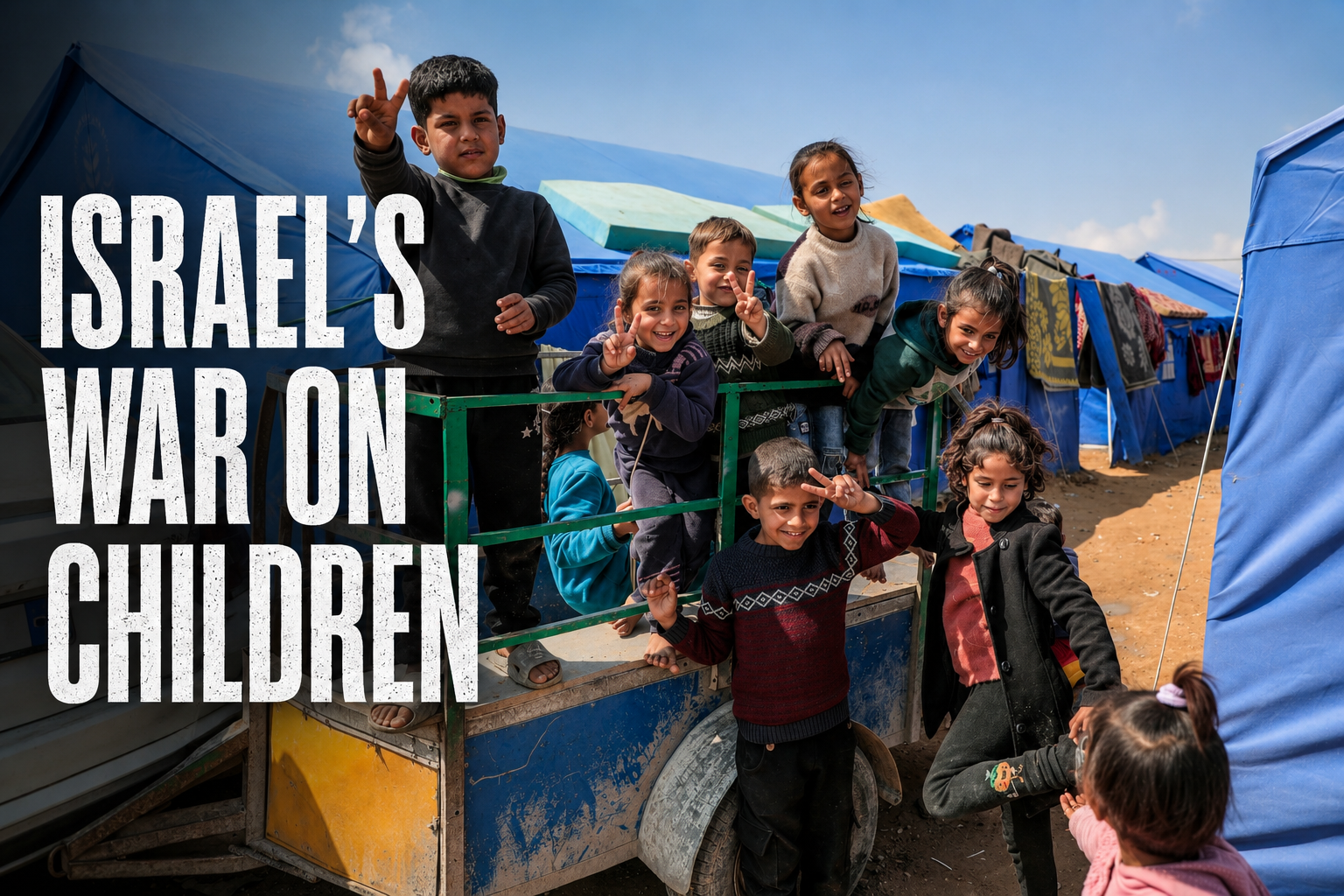
This United Nations Commission of Inquiry examines Israel’s use of torture, inhumane and degrading treatment, including sexual and gender-based violence, against Palestinian children, particularly during mass arrests and in detention.
It analyses pattern of Israel’s targeting of critical infrastructure essential to children, such as healthcare facilities and its short- to long-term consequences, as well as the impact of reproductive violence on newborns, resulting in poor neonatal health and birthing outcomes; attacks on orphanages and schools, impacting the loss of care for orphans and unaccompanied children, and inducing academic harm and learning disruptions for children, respectively.
The commission examines the impact of the conditions of life imposed by Israel in Gaza resulting in preventable mortality of children, exacerbating morbidity and serious mental trauma from the relentless and widespread attacks by Israel over two years – collectively revealing severe, multi-layered harm to Palestinian children’s survival, health and development.
Further, the Commission examines how Israeli soldiers mock and weaponise symbols of childhood in Gaza, raising ethical, disciplinary and legal questions about the conduct of the Israeli security forces during the ground invasion of Gaza.
The UN Commission of Inquiry report on the intentional targeting of Palestinian children in Israel Defence Force {IDF} military operations in the State of Palestine presents extensive evidence based on well established evidential methodology used in comparable UN reports.
The report concludes that this targeting resulted in genocide, crimes against humanity and war crimes in Gaza, as well as war crimes in the occupied West Bank of Palestine. The c
ommission examined violations against Palestinian children from 7 Oct 2023 onward, and found that at least 20,179 Palestinian children were killed and 44,143 injured, between 7 Oct 2023 and 7 Oct 2025 around 30 per cent of the overall official death toll.
A sustained violation of the Rights of the Child, which Israel signed
There was a campaign of intentional destruction of the infrastructure that creates life – maternity and neonatal clinics for example – and sustains childhood – paediatric healthcare facilities, nurseries, schools, playgrounds. The report not only links this policy to the charge of genocide in Gaza but also to the sustained violation of the Convention on the Rights of the Child to which Israel is a signatory, and war crimes, in the West Bank.
The IDF has accepted the Palestinian Authorities casualty figures, which the Lancet and other sources say understate the level of killings. Having accepted these casualty figures, the IDF is also accepting the proportion of those killed who were children.
The question is therefore one of intent.
The report lays out compelling evidence that the targeting of children is part of the Israel security strategy and an extension of the Israeli Government’s policy of preventing a viable Palestinian state becoming a reality. It also demonstrates a policy of destroying education infrastructure with the clear intention of forcing parents to leave Gaza so that their children can have an education and a childhood.
It is a policy of deliberately inflicting conditions of life calculated to bring about the group’s physical destruction and imposing measures intended to prevent births, two clauses of the definition of genocide that are cited less often than the killing of members of group but which constitute elements of the crime.
The commission found Israeli forces continued to use high-payload munitions and wide-area-effect weapons in densely populated residential areas despite mounting child casualties. This indicated that attacks killing children in such high numbers were intentional. The commission focused on children killed by quadcopter drones and sniper fire, often by single gunshots. Doctors interviewed by the commission said autopsies suggested a high degree of precision, pointing to carefully aimed shots rather than accidental or indiscriminate fire. It criticised Israeli forces for describing some children killed near military-control lines as “suspects”, arguing that this language shifted responsibility onto the children themselves.
Israel’s response is that the UN report is a libelous sham
Israel’s response was not simply to reject the findings. Its mission in Geneva called the report a “defamatory advocacy report” and dismissed it as a “libelous sham.” Israel said it does not deliberately target children, that it strives to minimise civilian harm, and that the report ignored Hamas’s tactics of using civilians as human shields and embedding military facilities in civilian infrastructure.
Israel’s supporters took up the libel claim and linked the report to medieval antisemitic tropes of the blood libel. Antisemitism is real. It is rising in many places. It has a long and lethal history. It includes genocide, pogroms, conspiracy theories, collective blame, Holocaust denial, threats against Jews and old myths about Jewish cruelty and child murder. Key texts of the Holocaust like Mein Kampf and of European antisemitism like the Protocols of the Wise Men of Zion, can be easily purchased across Arab world. The “blood libel” – the medieval accusation that Jews murdered Christian children for ritual purposes – is one of the most poisonous antisemitic lies in history. Which is why alleging its use should be done with precision.
The widely discredited International Holocaust Remembrance Alliance’s definition of antisemitism gives examples of antisemitic speech, including the use of classic antisemitic symbols and images, such as blood libel, to characterise Israel or Israelis.
But the same IHRA text also states that criticism of Israel similar to that levelled against any other country cannot be regarded as antisemitic. If someone claims Jews as Jews murder children, that is antisemitic. If someone holds Jews collectively responsible for the actions of the Israeli state, that is antisemitic. If someone uses Gaza to launder ancient fantasies of Jewish blood-guilt, that must be confronted directly as antisemitism.
But a UN-mandated inquiry alleging that a state military targeted children with drones, sniper fire, heavy munitions, military detention and abuse is not the same thing as a medieval blood myth. It is an evidence based claim about a government and its armed forces. It cannot be dismissed as antisemitism merely because the state accused is Israel. This is where Israeli propaganda does real damage to the fight against antisemitism itself.
Antisemitism risks becoming criticism Israel does not want to answer
When every grave allegation against Israel is folded into the language of the hatred of Jewish people, the term antisemitism is weakened. It becomes less a warning against a real danger and more a failing government strategic communications device.
The public begins to hear “antisemitism” and suspect that what is really meant is “criticism we do not want to answer.” That, as many Israeli critics of the current Government, like Peter Beinart, and experts on antisemitism, like Deborah Lipstadt, have argued, is a disaster for the Jewish community globally.
It makes it easier for cynics to dismiss the very real fight that is needed against genuine antisemitism. It turns a word that should protect Jewish people into a shield for state power. And it asks Jewish history to perform a grotesque function: not remembrance, not warning, but the basis for immunity.
In addition to the slurs against the report, Israel also attacked the methodology. We are told the evidence is unreliable, the investigators are biased, the witnesses are suspect, the process is political, the standard of proof is too low, and the conclusions are predetermined.
Some methodological criticism can be legitimate. UN commissions are not courts. They do not prove guilt beyond reasonable doubt. They often work under severe access constraints, security restrictions, witness-protection concerns and state non-cooperation. But that is true across conflicts. It is not unique to Israel and Palestine.
The Report uses the same methodology and standard of proof as previous UN Commissions of Inquiry, “reasonable grounds”, combining thousands of verified open-source records with remote and in-person interviews, documentary evidence, medical records, forensic analysis, satellite and digital verification and testimony from victims, witnesses, healthcare workers, journalists and other experts.
The methodology the commission used was the same as for a UN Ukraine inquiry
The commission placed children’s rights and welfare at the centre of its investigation, interviewing children wherever possible while following strict ethical safeguards, including informed consent, the principle of “do no harm,” and measures to minimise re-traumatisation. Where direct interviews would have risked further harm, investigators relied on independently verified evidence and forensic analysis.
The UN Commission of Inquiry on Ukraine used the same “reasonable grounds” standard. It relied primarily on first-hand interviews with victims and witnesses, sought corroboration from primary and secondary sources, consulted documents, inspected graves, detention sites, torture sites and weapon remnants and selected incidents for investigation based on gravity, patterns, access and available documentation.
The UN fact-finding mission in Myanmar used the “reasonable grounds” standard too. It conducted 875 interviews with victims and eyewitnesses, used satellite imagery, authenticated documents, photographs and videos, checked information against secondary sources, consulted experts, reviewed open-source material and relied only on information it considered verified and corroborated. Myanmar, like Israel, did not cooperate.
The UN Commission of Inquiry on North Korea had no access to the country. It therefore used public hearings, confidential interviews, written submissions, expert evidence and the “reasonable grounds” standard. It explicitly recognised the need to protect witnesses from reprisals and stored information in a confidential database.
Israel’s strongest contextual argument is Hamas. The war began with the Hamas-led attack of 7 Oct 2023, in which around 1,200 people were killed and 251 people were taken hostage. Hamas has committed war crimes. It embeds itself in civilian areas. It has shown contempt for Israeli and Palestinian life alike.
None of this should be minimised but the use of human shields, a policy established by the British in Palestine in 1930s, substantiates the claim of intentionally targeting children: if Hamas was using them as human shields then Israel was intentionally killing those human shields. The move from “Hamas uses civilian areas” to “therefore Israeli conduct cannot be scrutinised” is one of the central evasions of the war.
International humanitarian law exists precisely because armed groups and states fight in conditions of fear, rage, concealment and asymmetry. The harder the battlefield, the more necessary the law becomes, not the less. The purpose of this rhetorical strategy is not simply to persuade people that Israel is innocent. It is to try to make the asking of questions illegitimate.
A serious Israeli response would not begin with “sham”. It would begin with disclosure. It would allow independent investigators access to sites, witnesses, detention facilities and operational records.
No fight against antisemitism requires silence about dead children
It would publish the rules of engagement governing fire near so-called control lines. It would explain how children came to be shot by drones or snipers. It would release evidence for claims that those killed were combatants or immediate threats.
It would investigate commanders as well as individual soldiers. It would cooperate with international mechanisms rather than denounce them from a distance. Most importantly, it would stop treating the publication of evidence of children’s deaths as an attack on the Jewish people. There is no fight against antisemitism worthy of the name that requires silence about dead children.
There is no defence of Jewish safety that depends on denying Palestinian reality. And there is no credible rebuttal to a UN report alleging the deliberate targeting of children that consists mainly of calling the report a blood libel.
The UN report concludes with these demands of member states of the UN – including the UN Security Council Member the UK and its soon to be new PM:
B. To all the Member States and those involved in ceasefire negotiations:
(a) Arrest any Israeli officials against whom arrest warrants have been issued by the International Criminal Court and extradite them into the custody of the ICC;
(b) Employ all means reasonably available to them to prevent the commission of genocide, war crimes and crimes against humanity and to ensure full compliance with the Geneva Conventions in the Occupied Palestinian Territory;
(c) Cease the transfer of arms and other equipment or items, including jet fuel, to the State of Israel or third States where there is reason to suspect their use in military trade or operations that have involved or could involve the commission of genocide, war crimes or crimes against humanity or other violations of the Geneva Conventions in the Occupied Palestinian Territory;
(d) Conduct investigations under domestic or universal jurisdiction of Israeli individuals or organisations suspected of having participated in unlawful acts of violence against Palestinian children, including Israeli suspects holding dual or multiple nationalities;
(e) Impose targeted sanctions, including prohibiting financial dealings and revoking or denying visas of individual Israeli ministers and officials and Israeli military personnel who may be responsible for inciting or committing violence relating to the abuse, killing or maiming of children;
(f) Impose targeted sanctions on extremist settlers, including a ban on financial transactions and travel, as well as on private entities, including charities, that support the settlement enterprise;
(g) Exhort Israel to end the siege of Gaza immediately, completely and permanently and allow unhindered humanitarian access to deliver aid and other support tailored to children’s needs in Gaza;
(h) Support political solutions and processes aimed at achieving lasting peace in Palestine, based on the right of Palestinians to self-determination and rooted in the principle of inclusivity and ownership, engaging and listening to Palestinians, including children;
(i) Support and facilitate access to justice for victims of crimes against children as a key component of any political solutions and process.