

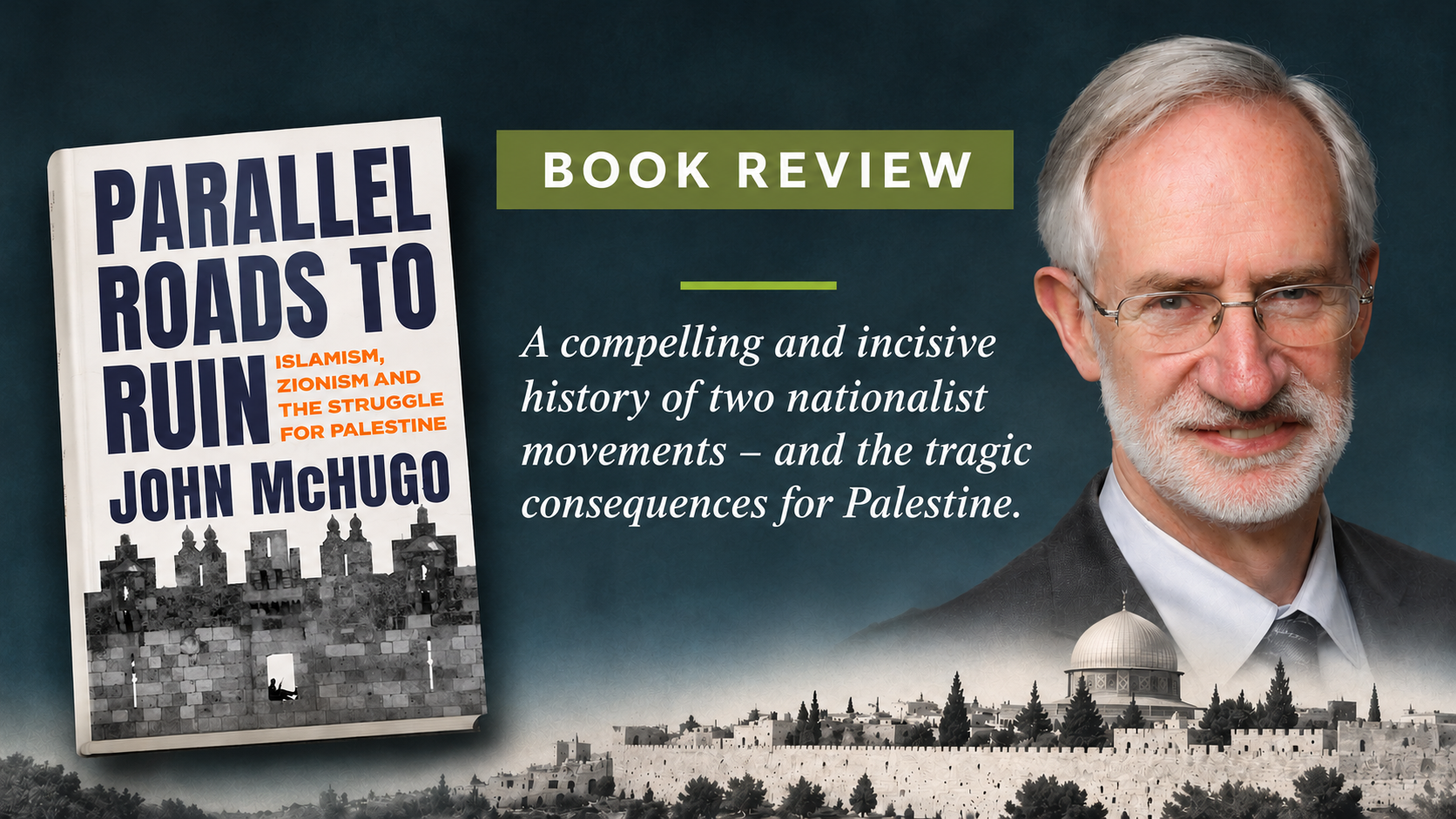
By John McHugo
C Hurst & Co Publishers
ISBN:9781805266679
£25.00
Review by The Rt Revd Michael Doe
Watch webinar with the author
The hallmark of the Balfour Project, and now the Britain Palestine Project, is that it is not an academic history society, nor a partisan campaigning body, but rather a charity strongly committed to advocacy based on historical facts and current realities. It has wanted to show how the history and especially the role of Britain have shaped events, and thereby created responsibilities in what is now Palestine and Israel.
Amongst its trustees engaged in this task have been Michael Scott-Bauman (Palestinians and Israelis – a short history of conflict, History Press 2021}; and Peter Shambrook (Policy of Deceit: Britain and Palestine, 1914-1939), One World Books 2024). And now another one hits the bookshops.
John McHugo has a remarkable gift of writing history as a developing story, helped by the way he introduces the people behind the events. Many of us will know the names on the Jewish side: Theodore Herzl and Chaim Weizmann, who pioneered the reinvention of Zionism; Ben Gurion, who defended the new Jewish state, come what may; Ariel Sharon and now Benjamin Netanyahu.
We may be less familiar with the other side: Al-Afghani, the “founding father of Islamism”; his followers, Muhammad Abduh and Rashid Rida; Hassan-al-Banna, founder of the Muslim Brotherhood; Sayyid Qutb and his journey to a more radical Islamism; and Shaykh Ahmad Yassin, who wrote the Hamas charter. And not forgetting Osama bin Laden.
Nationalist identity enmeshed with issues of faith
McHugo shows how such leaders and thinkers took some of the Jewish and Muslim fundamentals they inherited and developed them in the political context and challenges they faced. At a time when much of “The West” was being secularised, separating religion and politics, Zionism and Islamism saw an increasing religious radicalism as ethnic and nationalistic identity became enmeshed with issues of faith.
This was reinforced by the belief that the other side, often propelled by its supporters elsewhere, were the cause of their oppression. To quote what may be the best summary in the book: “If Zionism came into being in reaction to the oppression of Jews and hatred for them in the age of European nationalism, Islamism was a reaction to the imperialism that flowed from that nationalism [and] a reaction to the conscious and unconscious racism that underlay it”.
McHugo begins with the history of Jews and Muslims in Europe, and their position as the Ottoman Empire collapsed. Although he does not spend much time on the well-known British duplicity of McMahon-Hussein, Sykes-Picot and the Balfour Declaration itself, he does record how both sides regarded the British presence.
As the Mandate came to an end the Zionists impatiently carved out their new State, having angrily rejected the 1939 White Paper limiting Jewish immigration. From the Arab side it was seen as British imperialism protecting its own interests, such as ownership of the Suez Canal, just as later Western influence was regarded as bringing moral decadence.
Could Zionism ever accommodate Palestinians as a parallel entity?
McHugo does his best to disentangle the religious from the political, especially the way that religion, on both sides, may not have been the most determining cause of the conflict. A return to Jerusalem had not been a major feature of Jewish belief. Islamism arose as much from nationalism as the Quran. But in both cases religion exacerbated it, including the issue of violence. Did the Quran permit or even demand it? For all its talk of self-defence and the need for security, did the Jewish belief in Greater Israel mean that Zionism would always be offensive?
More widely, as he charts the various attempts to find a compromise, especially by the assassinated Yitzhak Rabin, McHugo asks whether Zionism, as seen in Israel, could ever accommodate Palestinians as a parallel entity. On the other side, while the Palestinians did give way on the existence of the Israeli State, events were soon overtaken by the militant Islamism of Al-Qaeda and Daesh.
Reading this book as a Christian, I am intrigued by Arthur Balfour and his support for Zionism: how far did it arise from his own Calvinist beliefs? And McHugo is right to draw attention to the Jewish theologian Martin Buber, who came to denounce the immorality of both allying Israel with Western imperialism and trying to bring about an ethnically Jewish state by force of arms. For Buber, the messianic hope was not just for Jews but to bring justice and peace for all humanity.
This is a scholarly but eminently accessible book. An Index would have helped navigate its complex issues.
In his concluding chapter McHugo – himself a lawyer – rightly asserts the overriding importance of international law. He acknowledges the high ideals which can be found in Zionism and Islamism, and how many of their followers today do work for reconciliation.
But these two religions bear at least some of the blame for the causes of the conflict and the failure to find any resolution. That is true, but as this book shows, it is only by understanding the changing role they have played in the past, and the way they are embedded in the identity and culture of people today, that some way forward may be found.
The Rt Revd Michael Doe was a Trustee of the Balfour Project 2022-2025